


Theory, analysis, and interpretation of single-molecule force spectroscopy experiments
- PMID: 18852468
- PMCID: PMC2572921
- DOI: 10.1073/pnas.0806085105
Theory, analysis, and interpretation of single-molecule force spectroscopy experiments
Abstract
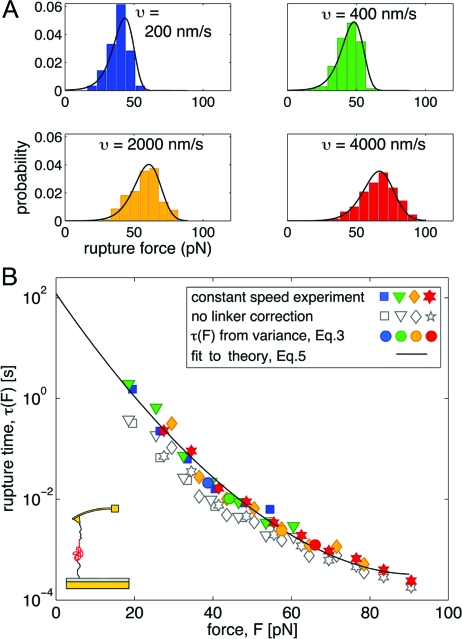
Dynamic force spectroscopy probes the kinetic and thermodynamic properties of single molecules and molecular assemblies. Here, we propose a simple procedure to extract kinetic information from such experiments. The cornerstone of our method is a transformation of the rupture-force histograms obtained at different force-loading rates into the force-dependent lifetimes measurable in constant-force experiments. To interpret the force-dependent lifetimes, we derive a generalization of Bell's formula that is formally exact within the framework of Kramers theory. This result complements the analytical expression for the lifetime that we derived previously for a class of model potentials. We illustrate our procedure by analyzing the nanopore unzipping of DNA hairpins and the unfolding of a protein attached by flexible linkers to an atomic force microscope. Our procedure to transform rupture-force histograms into the force-dependent lifetimes remains valid even when the molecular extension is a poor reaction coordinate and higher-dimensional free-energy surfaces must be considered. In this case the microscopic interpretation of the lifetimes becomes more challenging because the lifetimes can reveal richer, and even nonmonotonic, dependence on the force.
Conflict of interest statement
The authors declare no conflict of interest.
Figures

References
-
- Bustamante C, Chemla YR, Forde NR, Izhaky D. Mechanical processes in biochemistry. Annu Rev Biochem. 2004;73:705–748. - PubMed
-
- Florin EL, Moy VT, Gaub HE. Adhesion forces between individual ligand-receptor pairs. Science. 1994;264:415–417. - PubMed
-
- Merkel R, Nassoy P, Leung A, Ritchie K, Evans E. Energy landscapes of receptor-ligand bonds explored with dynamic force spectroscopy. Nature. 1999;397:50–53. - PubMed
-
- Kellermayer MSZ, Smith SB, Granzier HL, Bustamante C. Folding-unfolding transitions in single titin molecules characterized with laser tweezers. Science. 1997;276:1112–1116. - PubMed
Publication types
MeSH terms
Substances
Grants and funding
LinkOut - more resources
Full Text Sources
Other Literature Sources
