. 2008;3(10):e3391.
doi: 10.1371/journal.pone.0003391. Epub 2008 Oct 13.

Impaired autophagy of an intracellular pathogen induced by a Crohn's disease associated ATG16L1 variant

Affiliations

Impaired autophagy of an intracellular pathogen induced by a Crohn's disease associated ATG16L1 variant

Petric Kuballa et al. PLoS One. 2008.

Abstract

The genetic risk factors predisposing individuals to the development of inflammatory bowel disease are beginning to be deciphered by genome-wide association studies. Surprisingly, these new data point towards a critical role of autophagy in the pathogenesis of Crohn's disease. A single common coding variant in the autophagy protein ATG16L1 predisposes individuals to the development of Crohn's disease: while ATG16L1 encoding threonine at amino acid position 300 (ATG16L1*300T) confers protection, ATG16L1 encoding for alanine instead of threonine (ATG16L1*300A, also known as T300A) mediates risk towards the development of Crohn's disease. Here we report that, in human epithelial cells, the Crohn's disease-associated ATG16L1 coding variant shows impairment in the capture of internalized Salmonella within autophagosomes. Thus, we propose that the association of ATG16L1*300A with increased risk of Crohn's disease is due to impaired bacterial handling and lowered rates of bacterial capture by autophagy.


Conflict of interest statement

Competing Interests: The authors have declared that no competing interests exist.

Figures

Figure 1
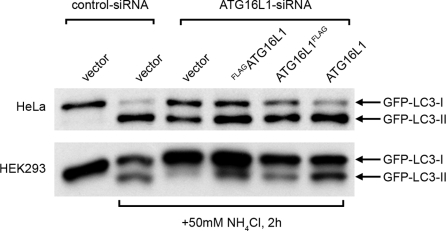
Figure 1. Differentially tagged ATG16L1*300T constructs show differential abilities to mediate basal autophagy.
In a 12-well format, HeLa and HEK293 cells, stably transduced to express GFP-LC3, were co-transfected with control siRNA and empty FLAG-vector or ATG16L1 siRNA and empty FLAG-vector or expression constructs encoding ATG16L1 carrying no tag (‘ATG16L1’) a 3-fold FLAG-tag at its N-terminus (‘FLAGATG16L1’) or C-terminus (‘ATG16L1FLAG’), as indicated. 48 h. post-transfection, 50 mM ammonium chloride (NH4Cl) was added for 2 h., where indicated, to block lysosomal turnover of GFP-LC3. Protein levels of GFP-LC3-I (cytosolic) and GFP-LC3-II (membrane-bound) were determined by Western blot analysis using anti-GFP-antibody.
Figure 2
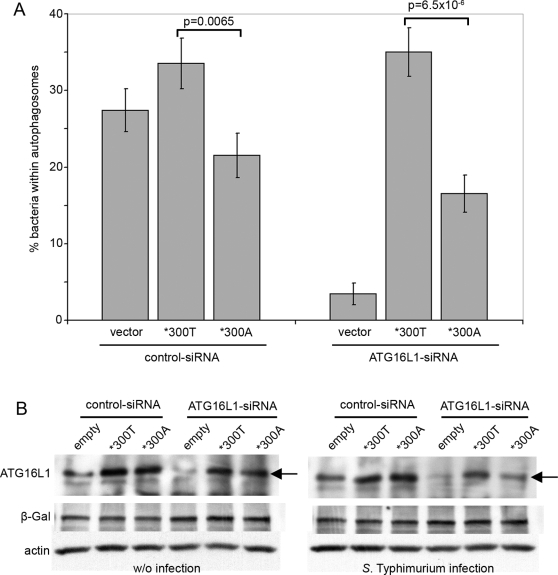
Figure 2. ATG16L1*300T is defective in mediating anti-Salmonella autophagy in HeLa cells.
(A) HeLa cells stably expressing GFP-LC3 were co-transfected with control or ATG16L1-targeting siRNA and empty vector, ATG16L1*300T or ATG16L1*300A expression constructs, as indicated. 48 h. following transfection, cells were infected with S. Typhimurium (SL1344) for 1 h. and fixed. The percentage of internalized bacteria captured within GFP-LC3-positive autophagosomes was calculated and is shown as means with error bars representing standard errors. P values were calculated as described in Material and Methods. (B) HeLa cells were co-transfected as described in Fig. 2A with the additional co-transfection of a beta-galactosidase expression plasmid in each sample. 48 h. following transfection, one set of cells was left untreated (w/o infection) while the other set was infected with S. Typhimurium (SL1344) for 1 h. 5% of each lysate were used for straight Western blotting and detection of beta-galactosidase (β-Gal) (indicator of transfection efficiency) and actin (loading control). ATG16L1 expression levels were detected in the remaining 95% of each lysate by immunoprecipitation with anti-ATG16L1-02 antibody and Western blot analysis using anti-ATG16L1-01 antibody. Note the loss of ATG16L1*300A protein (compared to *300T and without infection) during S. Typhimurium infection – arrowed. w/o, without.
Figure 3
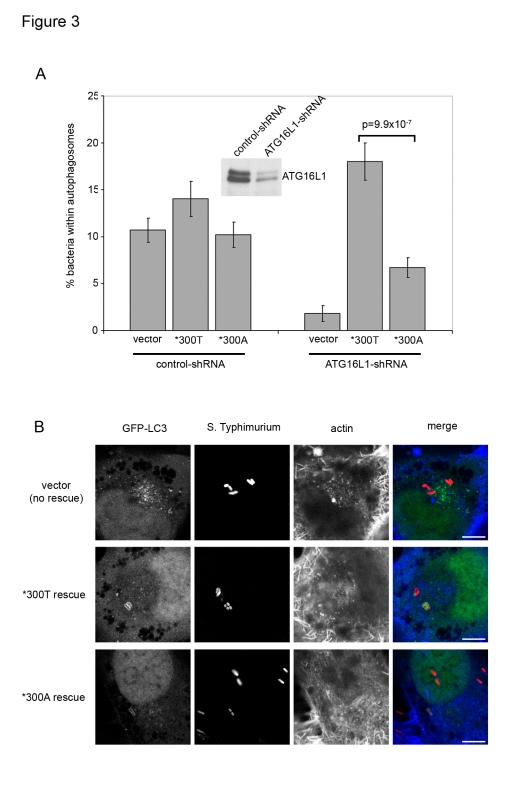
Figure 3. In the human gut epithelial cell line Caco2, ATG16L1*300A is impaired in its ability to mediate anti-Salmonella autophagy.
(A) Caco2 cells were transduced with lentiviruses expressing non-targeting shRNA (control-shRNA) or ATG16L1-targeting shRNA (ATG16L1-shRNA). Protein levels of endogenous ATG16L1 were detected in stably transduced cells by immunoprecipitation with anti-ATG16L1-02 antibody and Western blot analysis using anti-ATG16L1-01 antibody (inset). The generated CaCo2 cell lines were nucleofected with both GFP-LC3 and either control (vector), ATG16L1*300T or *300A expression constructs, as indicated. 48 h. after nucleofection cells were infected with S. Typhimurium for one hour and fixed. The percentage of GFP-LC3-positive bacteria and P values were determined as described in Fig. 2A. (B) Representative confocal optical sections of infected ATG16L1-deficient and ATG16L1 allele-specific resconstituted Caco2 cells. GFP-LC3 (green in merge), SL1344 (red in merge) and actin (blue in merge) are shown, scale bars represent 10 µm. Note the lack of GFP-LC3-marked membranes around internalized bacteria in knock-down cells (top row), recovery of autophagy in ATG16L1*300T-reconstituted cells (middle row) and partial recovery in *300A-reconstituted cells (bottom row).
Figure 4
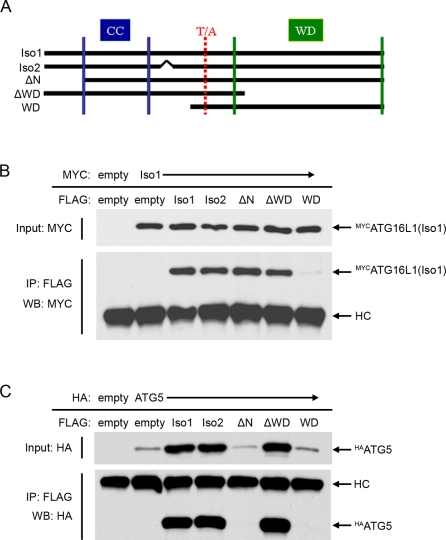
Figure 4. Human ATG16L1 forms homodimers depending on a region containing the coiled coil domain and heterodimers with human ATG5 via its very N-terminus.
(A) Schematic view of ATG16L1 expression constructs used in this manuscript. Amongst a number of predicted isoforms, isoform 1 (Iso1) and isoform 2 (Iso2) of human ATG16L1 reflect homologues of mouse Apg16L isoforms β and α, respectively, and are the most prominently known isoforms in humans. ATG16L1 Iso1 represents the longest human isoform and encodes for 607 amino acids with a predicted coiled coil domain (amino acids 78–230, CC) and seven WD domains (amino acids 320–359, 364–403, 406–445, 447–484, 486–525, 532–573, 575–607, respectively, WD). Amino acid position 300 can be encoded by threonine or alanine (T/A), and individuals carrying alleles coding for alanine (ATG16L1*300A) show a significantly increased risk for the development of CD. Iso2 lacks a stretch of 19 amino acids (amino acids 266–284 of Iso1) resulting in a shorter 588 amino acid protein. For mutational studies, three truncated expression constructs of Iso1 have been generated encoding amino acids 85–607 (ΔN), amino acids 1–341 (ΔWD) and amino acids 286–607 (WD), respectively. (B and C) HEK293T cells were co-transfected with FLAG-tagged expression constructs of ATG16L1 (as shown in Fig. 4A) and MYC-tagged ATG16L1 Isoform 1 (B) or HA-tagged ATG5 (C), respectively. 40 h. post-transfection cells were harvested and lysed. While 10% of each lysate served as input-control, the remaining lysate was incubated with goat anti-mouse beads and anti-FLAG-antibody overnight at 4°C to immunoprecipitate (IP) FLAG-ATG16L1 constructs. Over-expressed (input) and co-precipitated MYC-tagged ATG16L1 Isoform 1 were determined by Western blotting using an anti-MYC antibody (Fig. 4B); ATG5 was detected using anti-HA-antibody (Fig. 4C). Please note that under the conditions used only the monomeric (not conjugated to ATG12) form of ATG5 was expressed in significant amounts, in addition ATG5 protein levels appear elevated/stabilized upon binding to ATG16L1. HC: heavy chain. Empty: vector encoding the corresponding tag only.
Figure 5
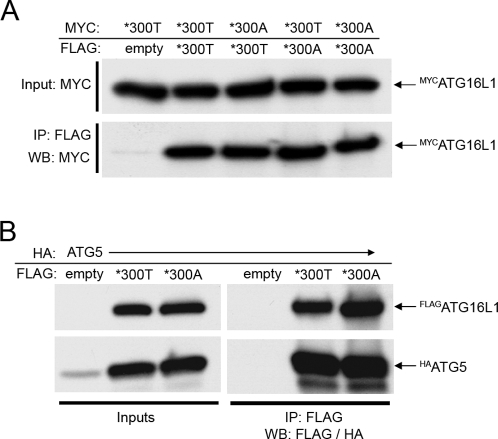
Figure 5. The formation of ATG16L1-homodimers and ATG16L1-ATG5-heterodimers is not affected by the *300A/T polymorphism.
(A) HEK293T cells were co-transfected with FLAG and MYC-tagged ATG16L1*300A or *300T, as indicated. FLAG-tagged proteins were immunoprecipitated using anti-FLAG antibody. Both the inputs of MYC-ATG16L1 and co-precipitated MYC-ATG16L1 are shown. (B) HEK293T cells were co-transfected with FLAG-tagged ATG16L1*300A or *300T and HA-tagged ATG5, respectively, as indicated. Shown are inputs, as well as immunoprecipitated FLAG-ATG16L1 and co-precipitated monomeric HA-ATG5. Under the conditions used, only the monomeric (not conjugated to ATG12) form of ATG5 was expressed in significant amounts.
Figure 6
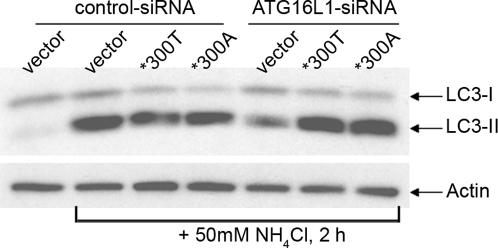
Figure 6. Overall levels of basal autophagy are not affected by the ATG16L1*300A polymorphism.
HeLa cells were transfected as described in Fig. 2A. 48 h. post-transfection 50 mM ammonium chloride (NH4Cl) was added for 2 h. where indicated. Protein levels of LC3 and actin were detected by Western blotting using anti-LC3B and anti-actin antibodies, respectively.

References

    1. Barrett JC, Hansoul S, Nicolae DL, Cho JH, Duerr RH, et al. Genome-wide association defines more than 30 distinct susceptibility loci for Crohn's disease. Nat Genet. 2008;40:955–962. - PMC - PubMed
    1. McCarroll SA, Huett A, Kuballa P, Chilewski SD, Landry A, et al. Deletion polymorphism upstream of IRGM associated with altered IRGM expression and Crohn's disease. Nat Genet. 2008;40:1107–1112. - PMC - PubMed
    1. Sartor RB. Microbial influences in inflammatory bowel diseases. Gastroenterology. 2008;134:577–594. - PubMed
    1. Xavier RJ, Podolsky DK. Unravelling the pathogenesis of inflammatory bowel disease. Nature. 2007;448:427–434. - PubMed
    1. Mizushima N, Levine B, Cuervo AM, Klionsky DJ. Autophagy fights disease through cellular self-digestion. Nature. 2008;451:1069–1075. - PMC - PubMed

Publication types