Randomized Controlled Trial
. 2009 Jan;467(1):101-11.
doi: 10.1007/s11999-008-0540-9. Epub 2008 Oct 15.

2008 John Charnley award: metal ion levels after metal-on-metal total hip arthroplasty: a randomized trial

Affiliations
Randomized Controlled Trial

2008 John Charnley award: metal ion levels after metal-on-metal total hip arthroplasty: a randomized trial

C Anderson Engh Jr et al. Clin Orthop Relat Res. 2009 Jan.

Abstract

Metal-on-metal bearing total hip arthroplasty is performed more commonly than in the past. There may be manufacturing differences such as clearance, roughness, metallurgy, and head size that affect performance. In a prospective, randomized trial, we compared 2-year postoperative ion levels for a 28-mm metal-on-polyethylene bearing with 28-mm and 36-mm metal-on-metal bearings. We measured serum, erythrocyte, and urine ion levels. We observed no difference in the ion levels for the 28-mm and 36-mm metal-on-metal bearings. The ion levels in these patients were lower than reported for most other metal-on-metal bearings. Although both erythrocyte and serum cobalt increased, erythrocyte chromium and erythrocyte titanium did not increase despite a four- to sixfold serum chromium and a three- to fourfold serum titanium increase. This may represent a threshold level for serum chromium and serum titanium below which erythrocytes are not affected.

Level of evidence: Level I, therapeutic study. See the Guidelines for Authors for a complete description of levels of evidence.


Figures
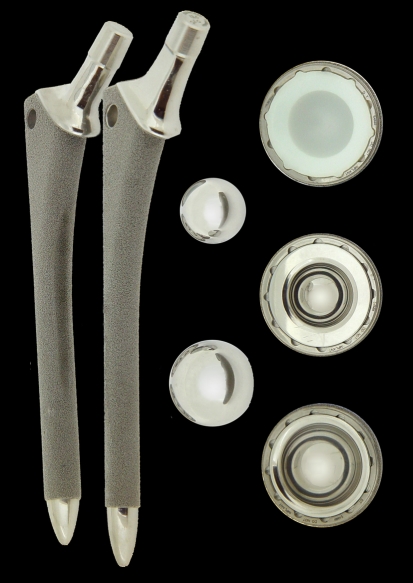
Fig. 1
Fig. 1
This figure shows extensively porous-coated femoral stems, 28-mm and 36-mm femoral heads, and the Pinnacle shell with the three different bearing surfaces.
Fig. 2A–C
Fig. 2A–C
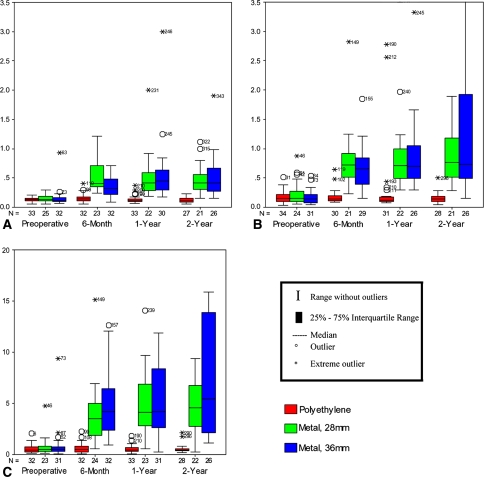
Cobalt ion levels in (A) erythrocytes, (B) serum, and (C) urine among the three treatment groups at the preoperative, 6-month, 1-year, and 2-year intervals. All metal ion level units are in micrograms/liter. The number of cases in each group is denoted by the N. The upper limits of normal for cobalt in erythrocytes, serum, and urine are 0.23 μg/L, 0.40 μg/L, and 1.25 μg/L, respectively. At 2 years, cobalt serum, erythrocyte, and urine ion levels in the two metal-on-metal groups were higher compared with the metal-on-polyethylene group (all p < 0.001). There was no difference at 2 years in these same ion levels comparing the 28-mm and 36-mm metal-on-metal groups (p = 0.915, 0.831, 0.612).
Fig. 3A–C
Fig. 3A–C
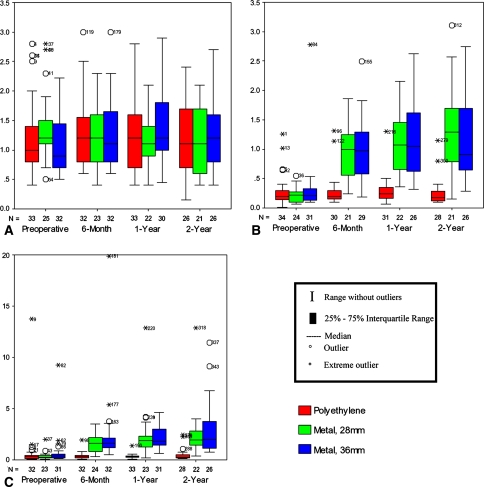
Chromium ion levels in (A) erythrocytes, (B) serum, and (C) urine among the three treatment groups at the preoperative, 6-month, 1-year, and 2-year intervals. All metal ion level units are in micrograms/liter. The number of cases in each group is denoted by the N. The upper limits of normal for chromium in erythrocytes, serum, and urine are 3.0 μg/L, 0.3 μg/L, and 0.8 μg/L, respectively. Although serum chromium ion levels increased at 2 years for the 28-mm and 36-mm metal-on-metal groups (all p ≤ 0.001), there was no corresponding elevation either within groups (p = 0.198 and 0.525) or between groups for erythrocyte chromium (p = 0.864 and 0.527). There was no difference comparing the two metal-on-metal groups (p = 0.427, 0.600, 0.788).
Fig. 4A–C
Fig. 4A–C
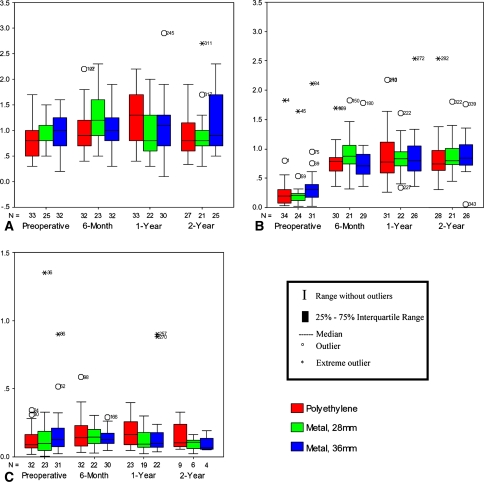
Titanium ion levels in (A) erythrocytes, (B) serum, and (C) urine among the three treatment groups at the preoperative, 6-month, 1-year, and 2-year intervals. All metal ion level units are in micrograms/liter. The number of cases in each group is denoted by the N. The upper limits of normal for titanium in erythrocytes, serum, and urine are 1.96 μg/L, 0.28 μg/L, and 0.4 μg/L, respectively. At 2 years, although serum titanium levels increased in all three treatment groups (all p < 0.001), no differences were found for erythrocyte titanium either within groups (p = 0.391, 0.647, 0.388) or between the metal-on-polyethylene and metal-on-metal groups (p = 0.668 and 0.204). There was no difference comparing the two metal-on-metal groups (p = 0.549, 0.974, 0.669).

References

    1. Brodner W, Bitzan P, Meisinger V, Kaider A, Gottsauner-Wolf F, Kotz R. Serum cobalt levels after metal-on-metal total hip arthroplasty. J Bone Joint Surg Am. 2003;85:2168–2173. - PubMed
    1. Brodner W, Grubl A, Jankovsky R, Mesinger V, Lehr S, Gottsauner-Wolf F. Cup inclination and serum concentration of cobalt and chromium after metal-on-metal total hip arthroplasty. J Arthroplasty. 2004;19:66–70. - DOI - PubMed
    1. Brown SR, Davies WA, DeHeer DH, Swanson AB. Long-term survival of McKee-Farrar total hip prostheses. Clin Orthop Relat Res. 2002;402:157–163. - DOI - PubMed
    1. Clarke MT, Lee PTH, Arora A, Villar RN. Levels of metal ions after small and large diameter metal-on-metal hip arthroplasty. J Bone Joint Surg Br. 2003;85:913–917. - PubMed
    1. Davies AP, Willert HG, Campbell PA, Learmonth ID, Case CP. An unusual lymphocytic perivascular infiltration in tissues around contemporary metal-on-metal joint replacements. J Bone Joint Surg Am. 2005;87:18–27. - DOI - PubMed

Publication types

MeSH terms