Comparative Study
. 2009 Feb;26(2):273-83.
doi: 10.1093/molbev/msn231. Epub 2008 Oct 14.

An investigation of the statistical power of neutrality tests based on comparative and population genetic data

Affiliations
Comparative Study

An investigation of the statistical power of neutrality tests based on comparative and population genetic data

Weiwei Zhai et al. Mol Biol Evol. 2009 Feb.

Abstract

In this report, we investigate the statistical power of several tests of selective neutrality based on patterns of genetic diversity within and between species. The goal is to compare tests based solely on population genetic data with tests using comparative data or a combination of comparative and population genetic data. We show that in the presence of repeated selective sweeps on relatively neutral background, tests based on the d(N)/d(S) ratios in comparative data almost always have more power to detect selection than tests based on population genetic data, even if the overall level of divergence is low. Tests based solely on the distribution of allele frequencies or the site frequency spectrum, such as the Ewens-Watterson test or Tajima's D, have less power in detecting both positive and negative selection because of the transient nature of positive selection and the weak signal left by negative selection. The Hudson-Kreitman-Aguadé test is the most powerful test for detecting positive selection among the population genetic tests investigated, whereas McDonald-Kreitman test typically has more power to detect negative selection. We discuss our findings in the light of the discordant results obtained in several recently published genomic scans.


Figures
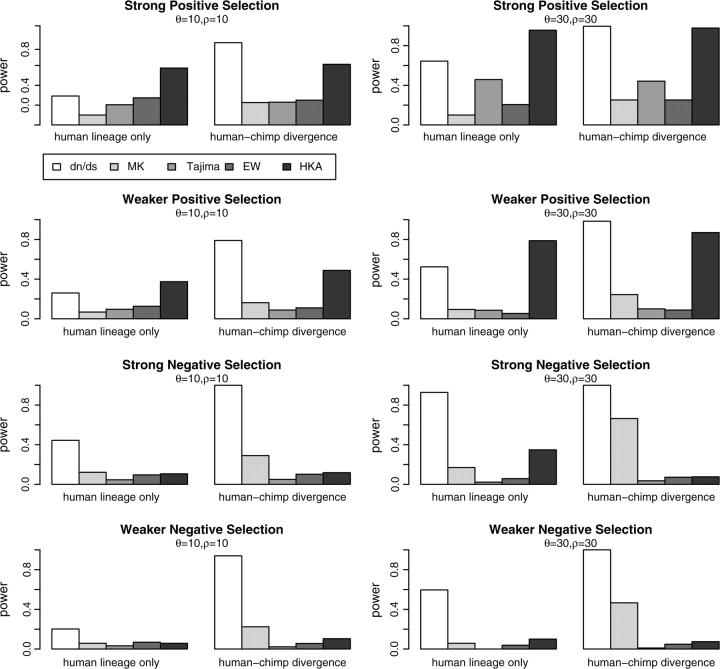
F<sc>IG</sc>. 1.—
FIG. 1.—
Statistical power of five neutrality tests assuming a random position model. Parameters are chosen as described in table 1 and discussed in the text. Two different values of θ and recombination rate (ρ = 4Nr) are simulated. “Human lineage only” corresponds to the cases where only the right lineage is under selection, whereas human–chimp divergence refers to the case where both lineages are under selection.
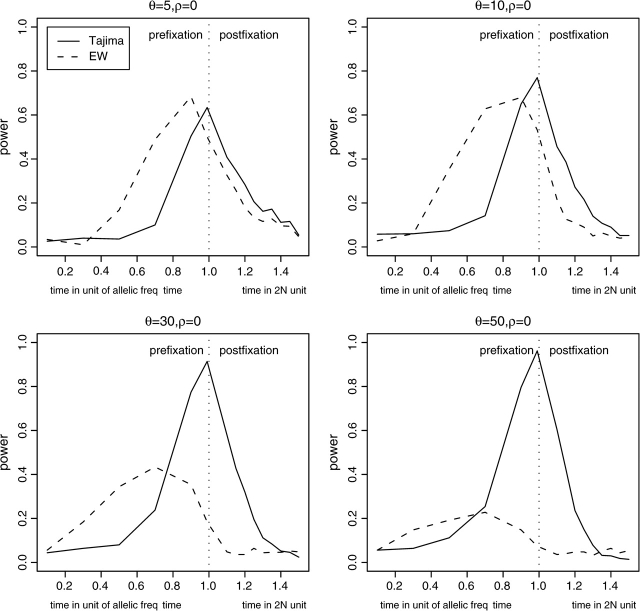
F<sc>IG</sc>. 2.—
FIG. 2.—
Statistical power of Tajima's D test and EW test on a single hitchhiking event with nonrecombining segments. The time to the left of the fixation event is measured in the frequency of the advantageous allele. The time to the right is measured in 2N generations. The selection coefficient (S = 2Ns) is set to be 100.
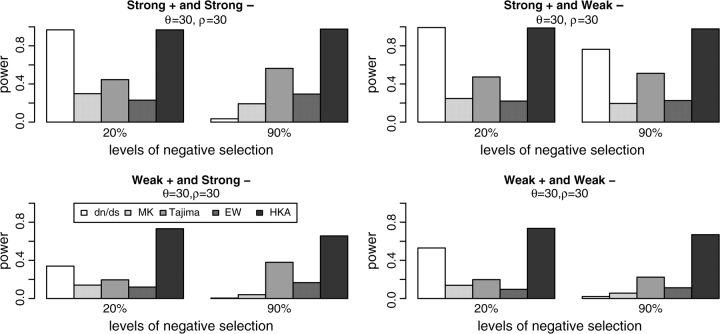
F<sc>IG</sc>. 3.—
FIG. 3.—
Statistical power of five neutrality tests under mosaic selection. Selection parameters are listed in table 1 and are also discussed in the text. Two different assumptions regarding the proportion of negatively selected mutations (20% or 90%) are used.
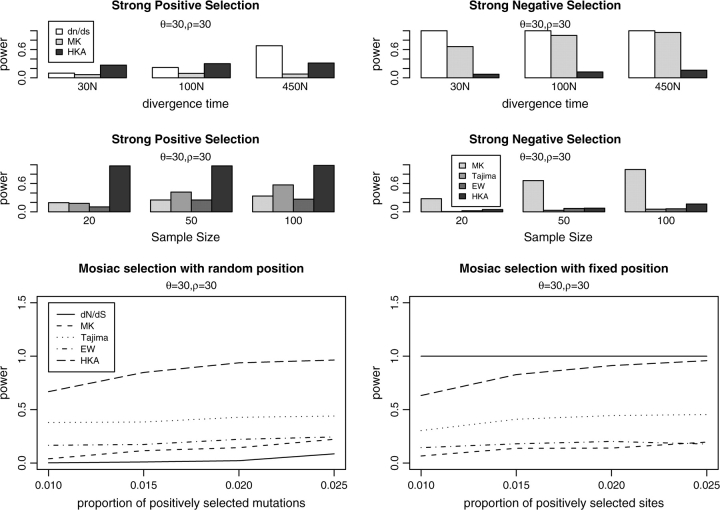
F<sc>IG</sc>. 4.—
FIG. 4.—
Factors affecting the statistical power of several neutrality tests. In the top panel, we investigate the effect of divergence time on the statistical power of the dN/dS, MK, and HKA test. In the middle panel, we look at the relationship between sample size and statistical power for MK, Tajima's D, EW, and HKA test. In the bottom panel, difference between random position and fixed position are plotted. The parameters used in the simulations are listed in table 1 and are also discussed in the text.

References

    1. Akashi H. Inferring the fitness effects of DNA mutations from polymorphism and divergence data: statistical power to detect directional selection under stationarity and free recombination. Genetics. 1999;151:221–238. - PMC - PubMed
    1. Akey JM, Zhang G, Zhang K, Jin L, Shriver MD. Interrogating a high-density SNP map for signatures of natural selection. Genome Res. 2002;12:1805–1814. - PMC - PubMed
    1. Andolfatto P. Adaptive hitchhiking effects on genome variability. Curr Opin Genet Dev. 2001;11:635–641. - PubMed
    1. Andolfatto P. Adaptive evolution of non-coding DNA in Drosophila. Nature. 2005;437:1149–1152. - PubMed
    1. Bersaglieri T, Sabeti PC, Patterson N, Vanderploeg T, Schaffner SF, Drake JA, Rhodes M, Reich DE, Hirschhorn JN. Genetic signatures of strong recent positive selection at the lactase gene. Am J Hum Genet. 2004;74:1111–1120. - PMC - PubMed

Publication types