Association of hemoglobin variability and mortality among contemporary incident hemodialysis patients
- PMID: 18922985
- PMCID: PMC2572293
- DOI: 10.2215/CJN.02390508
Association of hemoglobin variability and mortality among contemporary incident hemodialysis patients
Abstract
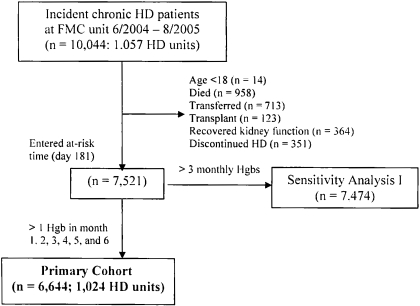
Background and objectives: Evidence exists that variability in hemoglobin may be an independent risk factor for mortality among hemodialysis patients. These observations were based on a 1996 cohort, a time when anemia management differed greatly from present. Design, settings, participants and measurements: A retrospective cohort study of patients incident to Fresenius Medical Care units between 2004 and 2005 (n = 6644). Hemoglobin variability (Hgb-Var) was defined for each subject as the residual SD of a linear regression model of time on hemoglobin.
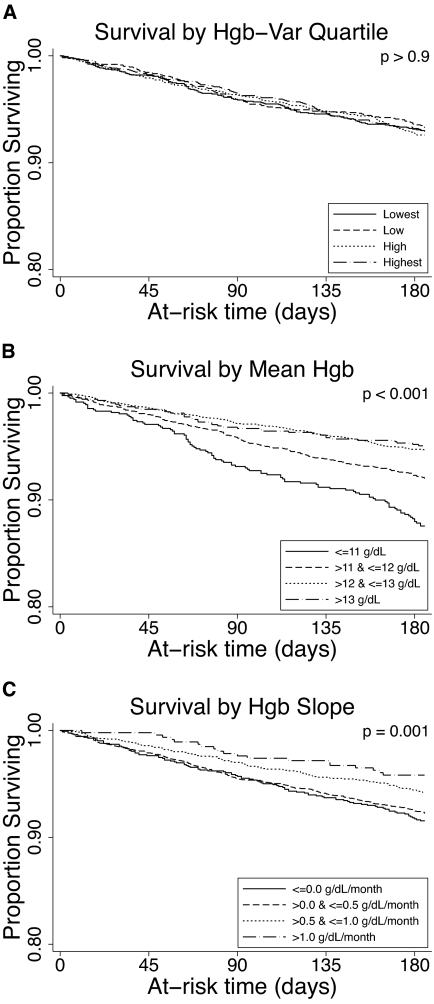
Results: The mean (SD) of Hgb-Var was 1.13 (0.55) g/dl. In the primary analysis, each g/dl increase of Hgb-Var was associated with an adjusted hazard ratio (95% confidence interval) for all-cause mortality of 1.11 (0.92 to 1.33). No significant interaction with Hgb-Var and mortality was found on the basis of age (P = 0.22), arterial disease (P = 0.45), Hgb slope (P = 0.68), or mean Hgb (P = 0.78). When Hgb-Var was defined by a regression model that included a quadratic term for time (enabling descriptions of curvilinear hemoglobin trajectories), model fit was greatly improved (P for difference <0.001). The corresponding adjusted hazard ratio (95% confidence interval) for all-cause mortality was 1.17 (0.93 to 1.49).
Conclusions: Hgb-Var was not found to be associated with all-cause mortality when examined in a contemporary incident hemodialysis population. More research is needed to determine whether differences in these findings compared with prior analyses relate to temporal trends in anemia management or from differences in the relationship between Hgb-Var and outcomes among incident versus prevalent hemodialysis patients.
Figures
References
-
- U.S. Renal Data System: USRDS 2007 Annual Data Report: Atlas of Chronic Kidney Disease and End-Stage Renal Disease in the United States, Bethesda, MD, National Institutes of Health, National Institute of Diabetes and Digestive and Kidney Diseases, 2007; http://www.usrds.org, Accessed October 25, 2007
-
- Pisoni RL, Bragg-Gresham JL, Young EW, Akizawa T, Asano Y, Locatelli F, Commer J, Cruz JM, Kerr PG, Mendelssohn DC, Held PJ, Port FK: Anemia management and outcomes from 12 countries in the dialysis outcomes and practice patterns study (DOPPS). Am J Kidney Dis 44: 94–111, 2004 - PubMed
-
- Plantinga LC, Fink NE, Jaar BG, Huang I, Wu AW, Meyer KB, Powe NR: Relation between level of changes of hemoglobin and generic and disease-specific quality of life measures in hemodialysis. Qual Life Res 16: 755–765, 2007 - PubMed
-
- Moreno F, Sanz-Guajardo D, López-Gómez JM, Jofre R, Valderrábano F: Increasing the hematocrit has a beneficial effect on quality of life and is safe in selected hemodialysis patients. J Am Soc Nephrol 11: 335–342, 2000 - PubMed
-
- McMahon LP, McKenna MJ, Sangkabutra T, Mason K, Sostaric S, Skinner SL, Burge C, Murphy B, Crankshaw D: Physical performance and associated electrolyte changes after haemoglobin normalization: a comparative study in haemodialysis patients. Nephrol Dial Transplant 14: 1182–1187, 1999 - PubMed
Publication types
MeSH terms
Substances
Grants and funding
LinkOut - more resources
Full Text Sources
Medical