Comment
doi: 10.1101/gad.1732108.
Histone H2B ubiquitination: the cancer connection
Affiliations
- PMID: 18923072
- PMCID: PMC2751279
- DOI: 10.1101/gad.1732108
Item in Clipboard
Comment
Histone H2B ubiquitination: the cancer connection
Genes Dev.
.
Abstract
Post-translational modifications of histones play a critical role in gene expression control. Ultimately, cancer is a disease of aberrant gene expression. Accordingly, several histone-modifying enzymes have been described as proto-oncogenes or tumor suppressors. Recent reports, including one from Shema and colleagues (pp. 2664- 2676) in the October 1, 2008, issue of Genes and Development, indicate that deregulation of histone H2B monoubiquitination may contribute to cancer development.
Figures
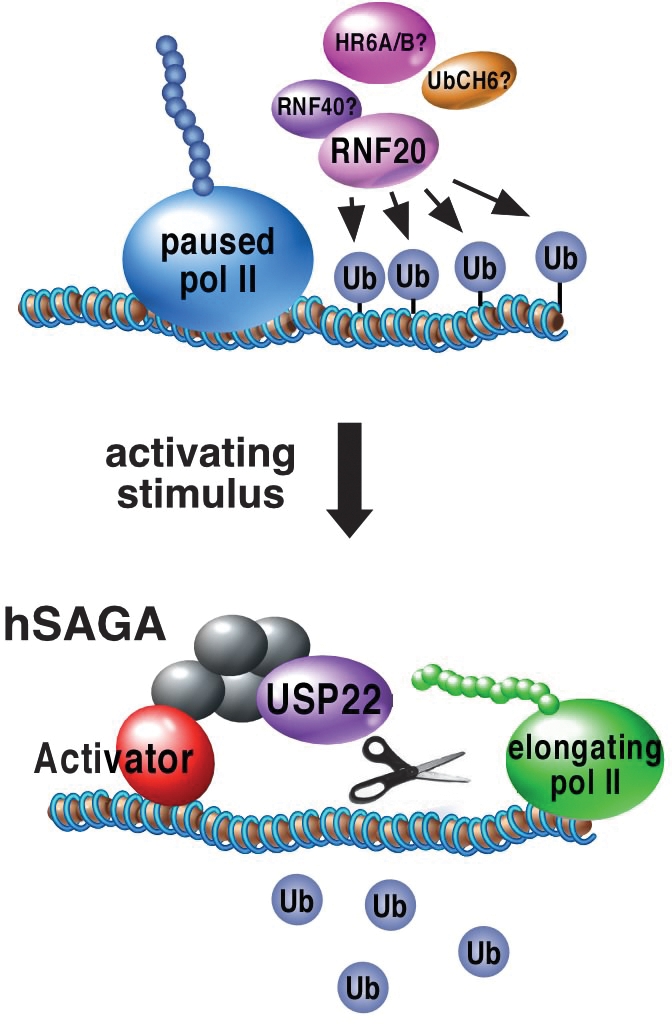
Model for the mechanism of action of RNF20, ubH2B, and USP22 in activation of inducible genes carrying poised RNAPII. RNF20-repressed genes, such as many in the serum-response transcriptional network, carry high amounts of ubH2B and display signs of poised RNAPII, including marks associated with transcription initiation such as H3K4me3. ubH2B occupancy is higher right downstream from transcription start sites, suggesting that it may block early elongation steps at these genes. Possible E2s for RNF20 include Ubch6 and the human homologs of Rad6. The deubiquitinase module of hSAGA, containing USP22, is required for full induction of several inducible genes, including some controlled by MYC, p53, and the AR. Thus, activators could recruit hSAGA to promoters repressed by ubH2B in order to promote elongation via H2B deubiquitination.
Comment on
-
The histone H2B-specific ubiquitin ligase RNF20/hBRE1 acts as a putative tumor suppressor through selective regulation of gene expression.Genes Dev. 2008 Oct 1;22(19):2664-76. doi: 10.1101/gad.1703008. Genes Dev. 2008. PMID: 18832071 Free PMC article.
References
-
- Ahn S.H., Kim M., Buratowski S. Phosphorylation of serine 2 within the RNA polymerase II C-terminal domain couples transcription and 3′ end processing. Mol. Cell. 2004;13:67–76. - PubMed
-
- Boritzki T.J., Jackson R.C., Morris H.P., Weber G. Guanosine-5′-phosphate synthetase and guanosine-5′-phosphate kinase in rat hepatomas and kidney tumors. Biochim. Biophys. Acta. 1981;658:102–110. - PubMed
-
- Bracken A.P., Kleine-Kohlbrecher D., Dietrich N., Pasini D., Gargiulo G., Beekman C., Theilgaard-Monch K., Minucci S., Porse B.T., Marine J.C., et al. The Polycomb group proteins bind throughout the INK4A–ARF locus and are disassociated in senescent cells. Genes & Dev. 2007;21:525–530. - PMC - PubMed
-
- Briggs S.D., Xiao T., Sun Z.W., Caldwell J.A., Shabanowitz J., Hunt D.F., Allis C.D., Strahl B.D. Gene silencing: Trans-histone regulatory pathway in chromatin. Nature. 2002;418:498. - PubMed
Publication types
MeSH terms
Substances
Grants and funding
LinkOut - more resources
Full Text Sources
Other Literature Sources
Miscellaneous