BLAP18/RMI2, a novel OB-fold-containing protein, is an essential component of the Bloom helicase-double Holliday junction dissolvasome
- PMID: 18923083
- PMCID: PMC2569884
- DOI: 10.1101/gad.1725108
BLAP18/RMI2, a novel OB-fold-containing protein, is an essential component of the Bloom helicase-double Holliday junction dissolvasome
Abstract
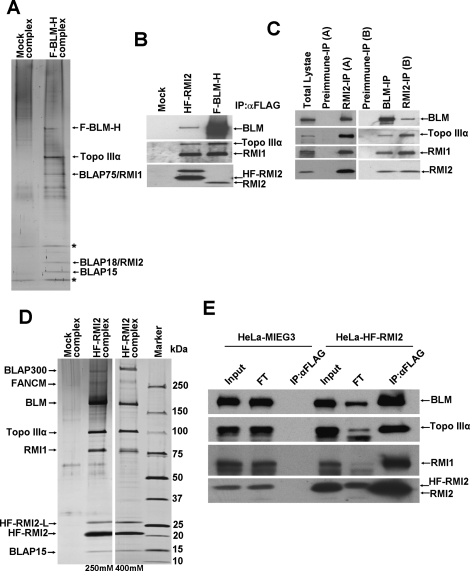
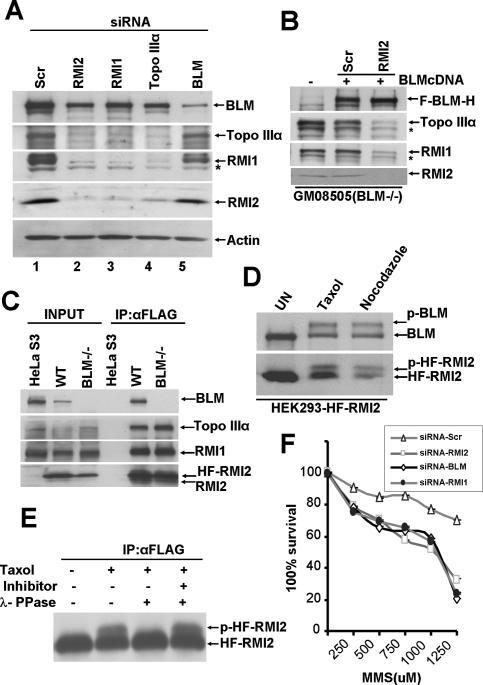
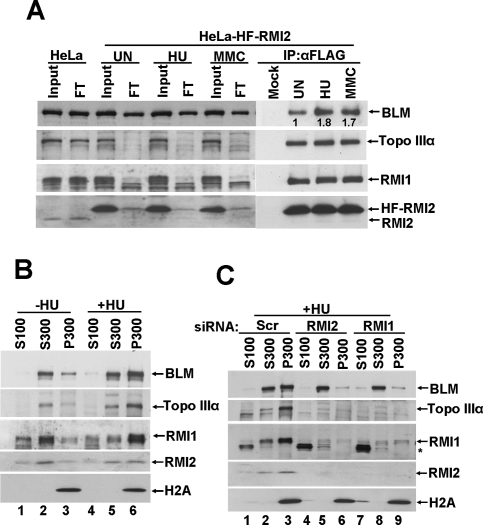
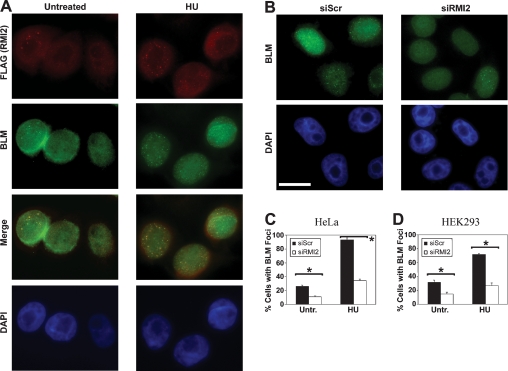
Bloom Syndrome is an autosomal recessive cancer-prone disorder caused by mutations in the BLM gene. BLM encodes a DNA helicase of the RECQ family, and associates with Topo IIIalpha and BLAP75/RMI1 (BLAP for BLM-associated polypeptide/RecQ-mediated genome instability) to form the BTB (BLM-Topo IIIalpha-BLAP75/RMI1) complex. This complex can resolve the double Holliday junction (dHJ), a DNA intermediate generated during homologous recombination, to yield noncrossover recombinants exclusively. This attribute of the BTB complex likely serves to prevent chromosomal aberrations and rearrangements. Here we report the isolation and characterization of a novel member of the BTB complex termed BLAP18/RMI2. BLAP18/RMI2 contains a putative OB-fold domain, and several lines of evidence suggest that it is essential for BTB complex function. First, the majority of BLAP18/RMI2 exists in complex with Topo IIIalpha and BLAP75/RMI1. Second, depletion of BLAP18/RMI2 results in the destabilization of the BTB complex. Third, BLAP18/RMI2-depleted cells show spontaneous chromosomal breaks and are sensitive to methyl methanesulfonate treatment. Fourth, BLAP18/RMI2 is required to target BLM to chromatin and for the assembly of BLM foci upon hydroxyurea treatment. Finally, BLAP18/RMI2 stimulates the dHJ resolution capability of the BTB complex. Together, these results establish BLAP18/RMI2 as an essential member of the BTB dHJ dissolvasome that is required for the maintenance of a stable genome.
Figures
Comment in
-
More complexity to the Bloom's syndrome complex.Genes Dev. 2008 Oct 15;22(20):2737-42. doi: 10.1101/gad.1732808. Genes Dev. 2008. PMID: 18923071 Free PMC article.
References
-
- Bischof O., Galande S., Farzaneh F., Kohwi-Shigematsu T., Campisi J. Selective cleavage of BLM, the Bloom syndrome protein, during apoptotic cell death. J. Biol. Chem. 2001;276:12068–12075. - PubMed
-
- Brosh R.M., Li J.L., Kenny M.K., Karow J.K., Cooper M.P., Kureekattil R.P., Hickson I.D., Bohr V.A. Replication protein A physically interacts with the Bloom’s syndrome protein and stimulates its helicase activity. J. Biol. Chem. 2000;275:23500–23508. - PubMed
-
- Bussen W., Raynard S., Busygina V., Singh A.K., Sung P. Holliday junction processing activity of the BLM–Topo IIIα–BLAP75 complex. J. Biol. Chem. 2007;282:31484–31492. - PubMed
-
- Chandra S., Levran O., Jurickova I., Maas C., Kapur R., Schindler D., Henry R., Milton K., Batish S.D., Cancelas J.A., et al. A rapid method for retrovirus-mediated identification of complementation groups in Fanconi anemia patients. Mol. Ther. 2005;12:976–984. - PubMed
Publication types
MeSH terms
Substances
Grants and funding
LinkOut - more resources
Full Text Sources
Other Literature Sources
Molecular Biology Databases
Miscellaneous