. 2008 Sep;31(9):786-95.
doi: 10.1177/039139880803100906.

Bioelectric effect and bacterial biofilms. A systematic review

Affiliations

Bioelectric effect and bacterial biofilms. A systematic review

J L Del Pozo et al. Int J Artif Organs. 2008 Sep.

Abstract

Bacteria growing in biofilms cause a wide range of human infections. Biofilm bacteria are resistant to antimicrobics at levels 500 to 5,000 times higher than those needed to kill non-biofilm bacteria. In vitro experiments have shown that electric current can enhance the activity of some antimicrobial agents against certain bacteria in biofilms; this has been termed the ''bioelectric effect''. Direct electrical current has already been safely used in humans for fracture healing. Application of direct electric current with antimicrobial chemotherapy in humans could theoretically abrogate the need to remove the device in device-related infections, a procedure associated with substantial morbidity and cost. In this article, we review what has been described in the literature with regards to the bioelectric effect.


Figures
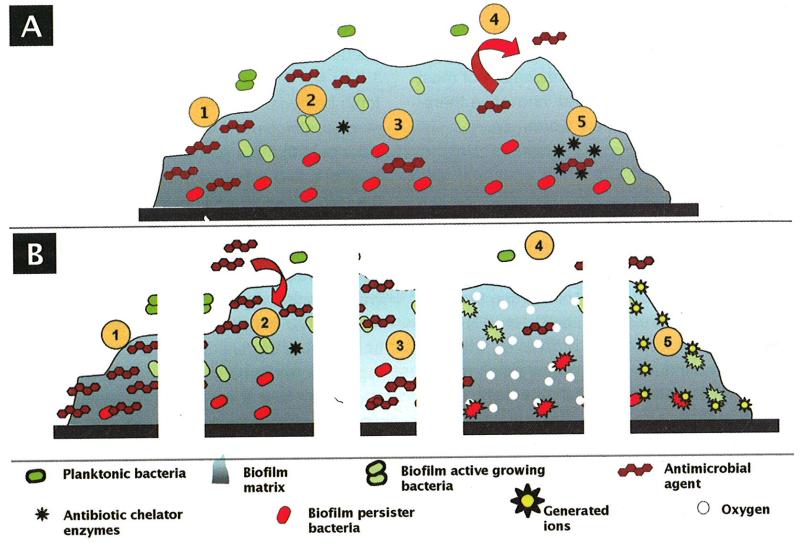
Fig. 1
Fig. 1
A) Some proposed biofilm-associated resistance mechanisms: (1) antimicrobial agents may be trapped and destroyed by enzymes in the biofilm matrix; (2) antimicrobial agents may fail to penetrate beyond the surface layers of the biofilm; (3) antimicrobial agents may not be active against non-growing microorganisms; (4) expression of biofilm specific resistance genes (e.g., efflux pumps); (5) stress response to hostile environmental conditions. B) Some proposed bioelectric effect mechanisms: (1) reduction of the biofilm capacity for binding to the antimicrobial agent; (2) electrophoretic augmentation of the antimicrobial agent transport; (3) membrane permeabilization; (4) electrolytic generation of oxygen; (5) electrochemical generation of potentiating oxidants.

References

    1. Donlan RM, Costerton JW. Biofilms: survival mechanisms of clinically relevant microorganisms. Clin Microbiol Rev. 2002;15:167–93. - PMC - PubMed
    1. del Pozo JL, Patel R. The challenge of treating biofilm-associated bacterial infections. Clin Pharmacol Ther. 2007;82:204–9. - PubMed
    1. Lewis K. Riddle of biofilm resistance. Antimicrob Agents Chemother. 2001;45:999–1007. - PMC - PubMed
    1. Anderl JN, Franklin MJ, Stewart PS. Role of antibiotic penetration limitation in Klebsiella pneumoniae biofilm resistance to ampicillin and ciprofloxacin. Antimicrob Agents Chemother. 2000;44:1818–24. - PMC - PubMed
    1. Anwar H, Oasgupta MK, Costerton Jw. Testing the susceptibility of bacteria in biofilms to antibacterial agents. Antimicrob Agents Chemother. 1990;34:2043–6. - PMC - PubMed

Publication types

Substances
