


Brazilian version of the foot health status questionnaire (FHSQ-BR): cross-cultural adaptation and evaluation of measurement properties
- PMID: 18925317
- PMCID: PMC2664715
- DOI: 10.1590/s1807-59322008000500005
Brazilian version of the foot health status questionnaire (FHSQ-BR): cross-cultural adaptation and evaluation of measurement properties
Abstract
Objective: To conduct a cross-cultural adaptation of the Foot Health Status Questionnaire into Brazilian-Portuguese and to assess its measurement properties.
Introduction: This instrument is an outcome measure with 10 domains with scores ranging from 0-100, worst to best, respectively. The translated instrument will improve the examinations and foot care of rheumatoid arthritis patients.
Methods: The questions were translated, back-translated, evaluated by a multidisciplinary committee and pre-tested (n = 40 rheumatoid arthritis subjects). The new version was submitted to a field test (n = 65) to evaluate measurement properties such as test-retest reliability, internal consistency and construct validity. The Health Assessment Questionnaire, Numeric Rating Scale for foot pain and Sharp/van der Heijde scores for foot X-rays were used to test the construct validity.
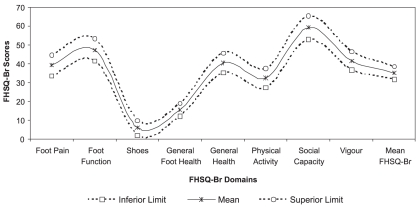
Results: The cross-cultural adaptation was completed with minor wording adaptations from the original instrument. The evaluation of measurement properties showed high reliability with low variation coefficients between interviews. The alpha-Cronbach coefficients varied from 0.468 to 0.855, while correlation to the Health Assessment Questionnaire and Numeric Rating Scale was statistically significant for five out of eight domains.
Discussion: Intra- and inter-observer correlations showed high reliability. Internal consistency coefficients were high for all domains, revealing higher values for less subjective domains. As for construct validity, each domain revealed correlations with a specific group of parameters according to what the domains intended to measure.
Conclusion: The FHSQ was cross-culturally adapted, generating a reliable, consistent, and valid instrument that is useful for evaluating foot health in patients with rheumatoid arthritis.
Figures
References
-
- Gorter K, Kuyvenhoven M, de Melker R. Health care utilization by older people with non-traumatic foot complaints. What makes the difference? Scand J Prim Health Care. 2001;19:1991–3. - PubMed
-
- Dawson J, Thorogood M, Marks SA, Juszczak E, Dodd C, Lavis G, Fitzpatrick R. The prevalence of foot problems in older women: a cause of concern. J Public Health Med. 2002;24:77–84. - PubMed
-
- Menz HB, Lord SR. Foot pain impairs balance and functional ability in community-dwelling older people. J Am Podiatr Med Assoc. 2001;91:222–9. - PubMed
-
- André M, Hagelberg S, Stenström CH. The Juvenile Arthritis Foot Disability Index: Development and evaluation of measurement properties. J Rheumatol. 2004;31:2488–93. - PubMed
-
- Smyth CJ, Janson RW. Rheumatologic view of the rheumatoid foot. Clin Orthop. 1997;1:7–17. - PubMed
Publication types
MeSH terms
LinkOut - more resources
Full Text Sources
Medical
Research Materials
