


Induction of Bim and Bid gene expression during accelerated apoptosis in severe sepsis
- PMID: 18925930
- PMCID: PMC2592767
- DOI: 10.1186/cc7088
Induction of Bim and Bid gene expression during accelerated apoptosis in severe sepsis
Abstract
Introduction: In transgenic animal models of sepsis, members of the Bcl-2 family of proteins regulate lymphocyte apoptosis and survival of sepsis. This study investigates the gene regulation of pro-apoptotic and anti-apoptotic members of the Bcl-2 family of proteins in patients with early stage severe sepsis.
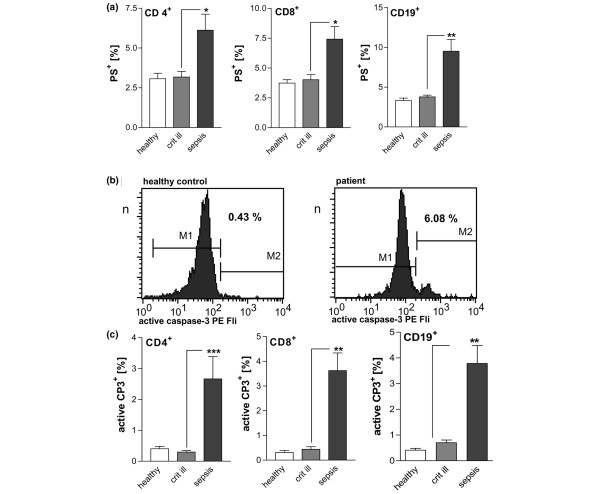
Methods: In this prospective case-control study, patients were recruited from three intensive care units (ICUs) in a university hospital. Sixteen patients were enrolled when they fulfilled the criteria of severe sepsis. Ten critically ill but non-septic patients and 11 healthy volunteers served as controls. Blood samples were immediately obtained at inclusion. To confirm the presence of accelerated apoptosis in the patient groups, caspase-3 activation and phosphatidylserine externalisation in CD4+, CD8+ and CD19+ lymphocyte subsets were assessed using flow cytometry. Specific mRNAs of Bcl-2 family members were quantified from whole blood by real-time PCR. To test for statistical significance, Kruskal-Wallis testing with Dunn's multiple comparison test for post hoc analysis was performed.
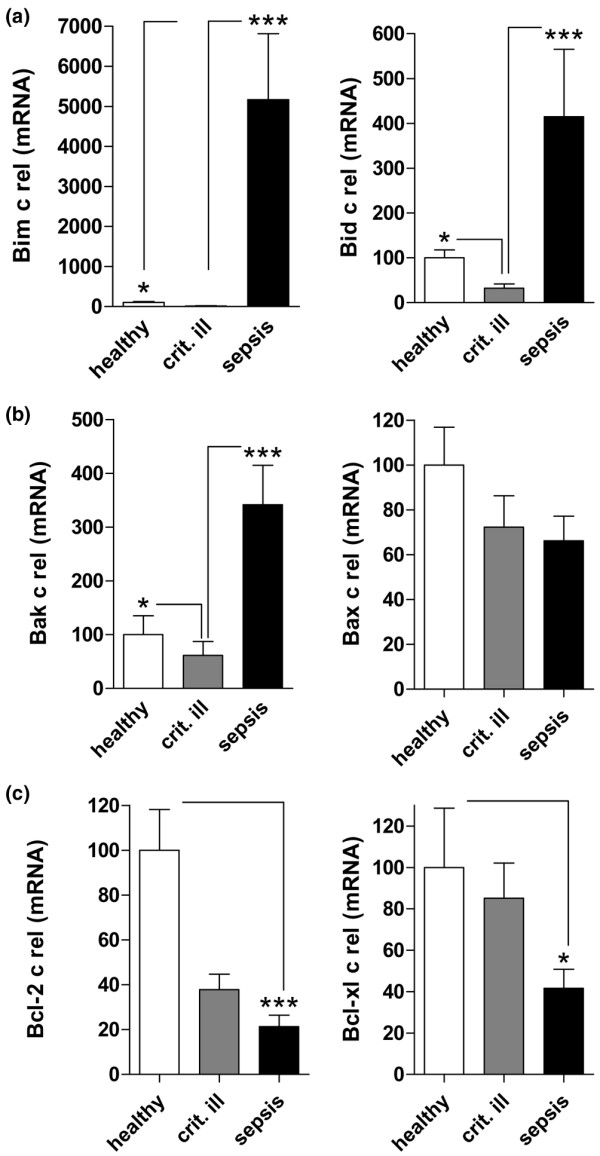
Results: In all lymphocyte populations caspase-3 (p < 0.05) was activated, which was reflected in an increased phosphatidylserine externalisation (p < 0.05). Accordingly, lymphocyte counts were decreased in early severe sepsis. In CD4+ T-cells (p < 0.05) and B-cells (p < 0.001) the Bcl-2 protein was decreased in severe sepsis. Gene expression of the BH3-only Bim was massively upregulated as compared with critically ill patients (p < 0.001) and 51.6-fold as compared with healthy controls (p < 0.05). Bid was increased 12.9-fold compared with critically ill patients (p < 0.001). In the group of mitochondrial apoptosis inducers, Bak was upregulated 5.6-fold, while the expression of Bax showed no significant variations. By contrast, the pro-survival members Bcl-2 and Bcl-xl were both downregulated in severe sepsis (p < 0.001 and p < 0.05, respectively).
Conclusions: In early severe sepsis a gene expression pattern with induction of the pro-apoptotic Bcl-2 family members Bim, Bid and Bak and a downregulation of the anti-apoptotic Bcl-2 and Bcl-xl proteins was observed in peripheral blood. This constellation may affect cellular susceptibility to apoptosis and complex immune dysfunction in sepsis.
Figures

Comment in
-
Lymphocytes, apoptosis and sepsis: making the jump from mice to humans.Crit Care. 2009;13(1):109. doi: 10.1186/cc7144. Epub 2009 Jan 12. Crit Care. 2009. PMID: 19216722 Free PMC article. Review.
References
-
- Hotchkiss RS, Osmon SB, Chang KC, Wagner TH, Coopersmith CM, Karl IE. Accelerated lymphocyte death in sepsis occurs by both the death receptor and mitochondrial pathways. J Immunol. 2005;174:5110–5118. - PubMed
-
- Adrie C, Bachelet M, Vayssier-Taussat M, Russo-Marie F, Bouchaert I, Adib-Conquy M, Cavaillon JM, Pinsky MR, Dhainaut JF, Polla BS. Mitochondrial membrane potential and apoptosis peripheral blood monocytes in severe human sepsis. Am J Respir Crit Care Med. 2001;164:389–395. - PubMed
-
- Efron PA, Martins A, Minnich D, Tinsley K, Ungaro R, Bahjat FR, Hotchkiss R, Clare-Salzler M, Moldawer LL. Characterization of the systemic loss of dendritic cells in murine lymph nodes during polymicrobial sepsis. J Immunol. 2004;173:3035–3043. - PubMed
Publication types
MeSH terms
Substances
LinkOut - more resources
Full Text Sources
Medical
Research Materials
