. 2008 Oct 16:8:299.
doi: 10.1186/1471-2407-8-299.

Genome profiling of chronic myelomonocytic leukemia: frequent alterations of RAS and RUNX1 genes

Affiliations

Genome profiling of chronic myelomonocytic leukemia: frequent alterations of RAS and RUNX1 genes

Véronique Gelsi-Boyer et al. BMC Cancer. .

Abstract

Background: Chronic myelomonocytic leukemia (CMML) is a hematological disease close to, but separate from both myeloproliferative disorders (MPD) and myelodysplastic syndromes and may show either myeloproliferative (MP-CMML) or myelodysplastic (MD-CMML) features. Not much is known about the molecular biology of this disease.

Methods: We studied a series of 30 CMML samples (13 MP- and 11 MD-CMMLs, and 6 acutely transformed cases) from 29 patients by using Agilent high density array-comparative genomic hybridization (aCGH) and sequencing of 12 candidate genes.

Results: Two-thirds of samples did not show any obvious alteration of aCGH profiles. In one-third we observed chromosome abnormalities (e.g. trisomy 8, del20q) and gain or loss of genes (e.g. NF1, RB1 and CDK6). RAS mutations were detected in 4 cases (including an uncommon codon 146 mutation in KRAS) and PTPN11 mutations in 3 cases. We detected 11 RUNX1 alterations (9 mutations and 2 rearrangements). The rearrangements were a new, cryptic inversion of chromosomal region 21q21-22 leading to break and fusion of RUNX1 to USP16. RAS and RUNX1 alterations were not mutually exclusive. RAS pathway mutations occurred in MP-CMMLs (approximately 46%) but not in MD-CMMLs. RUNX1 alterations (mutations and cryptic rearrangement) occurred in both MP and MD classes (~38%).

Conclusion: We detected RAS pathway mutations and RUNX1 alterations. The latter included a new cryptic USP16-RUNX1 fusion. In some samples, two alterations coexisted already at this early chronic stage.


Figures

Figure 1
Figure 1
Examples of aCGH profiles. A: aCGH profile of chromosome 17 in case 80. Red arrow shows deletion including NF1. B: aCGH profile of chromosome 13 in case 74 showing RB1 deletion. For a and b, a zoom of the region is shown to the right of the profiles. C: aCGH profile of chromosome 3 in case 1 showing a series of deletions at 3q. D: aCGH profiles of chromosome 20 in cases 3, 37, 74 and 96 (3 and 37 are from the same patient).
Figure 2
Figure 2
Mutation of RAS, PTPN11 and RUNX1 genes in CMML. Examples of mutations in candidate genes. From top to bottom, sequence of the mutated KRAS, PTPN11, SOS1 and RUNX1 alleles, demonstrating base change in the forward sequence at the position indicated by an arrow. The corresponding sequence is shown above. Primers and conditions used are described in additional file 2.
Figure 3
Figure 3
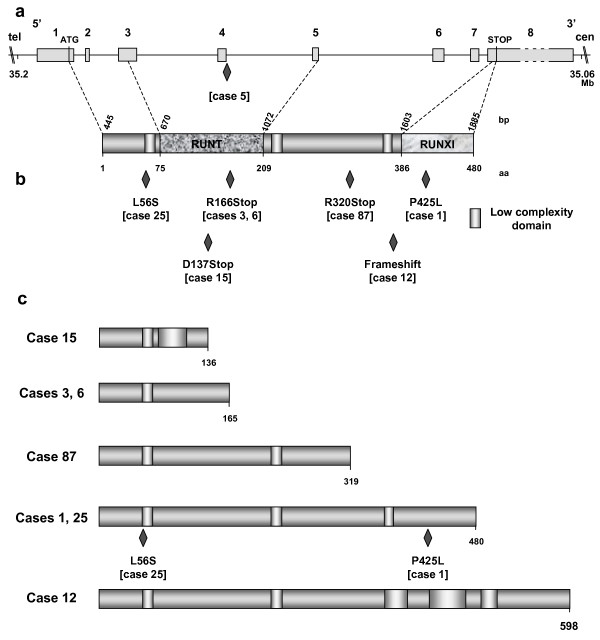
Characterization of RUNX1 mutations in CMML patients. A: Genomic organization of RUNX1 gene at 21q22.12 and RUNX1 protein. Functional (i.e. RUNT and RUNXI [for RUNX Inhibitor domain], as defined by PFAM accession numbers PF00853 and PF08504, respectively) and motifs of the RUNX1 protein were positioned according to the SMART program . Nucleotide (cDNA level) and deduced aminoacid sequences of the RUNX1 protein are positioned above and below the corresponding protein, respectively. The genomic RUNX1 sequence of CMML 5 exhibited a mutation in the consensus splicing sequence of intron 3. B: Mutations of RUNX1. All mutations but one introduced an aberrant stop codon (cases 3, 6, 12, 15 and 87). Two missense mutations (cases 1 and 25) were also observed. The mutations are located with respect to the modified aminoacid of the RUNX1 protein. C: Representation of putative mutated RUNX1 proteins. According to the SMART program, all putative modified proteins have lost their RUNT and RUNXI domains.
Figure 4
Figure 4
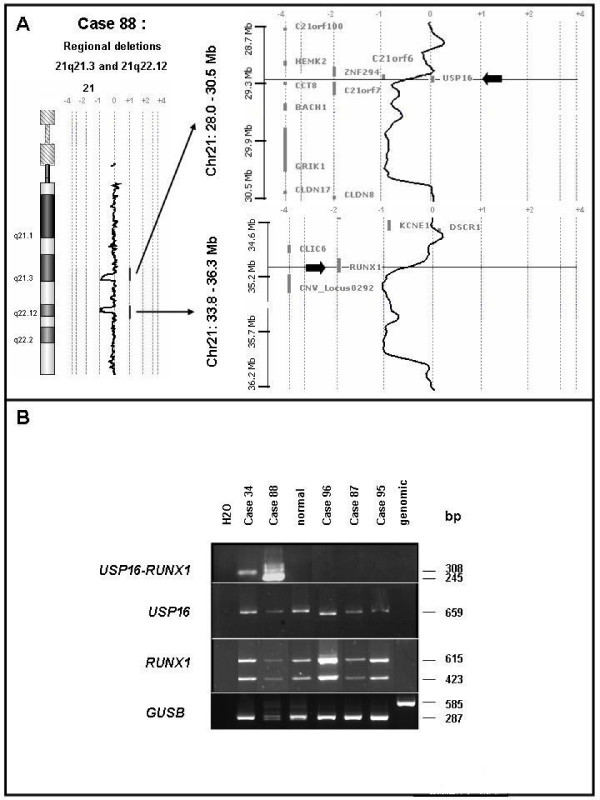
Genomic rearrangements involve USP16 and RUNX1 genes in CMML patients. A: CMML 88 aCGH profile of chromosome 21 shows regional deletions in 21q21.3 and 21q22.12. Arrows point to USP16 and RUNX1 genes targeted by transition profiles located in these respective regions. This suggests that potential gene breaks involve USP16 and RUNX1. B: PCR characterization of USP16-RUNX1 fusions in CMML. USP16, RUNX1 and USP16-RUNX1 transcripts were detected in the BM cells of the patients. The size of amplified products is shown on the right. The existence of alternatively spliced RUNX1 products could explain the various sizes observed for USP16-RUNX1 and RUNX1 transcripts. cDNA of normal lymphocytes were used as control. Primers specific for the human GUSB transcript were used for control of the RT-PCR quality control.
Figure 5
Figure 5
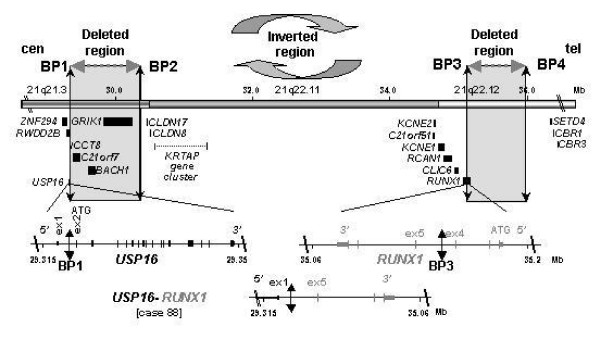
USP16-RUNX1 rearrangement in CMML 88. Organization of chromosomal region 21q21.3-q22.12 with the location of the breakpoints (BP) and deleted regions from centromere (cen) to telomere (tel). Mb scale of the corresponding 21q21.3, 21q22.11 and 21q22.12 regions corresponds to cytogenetic bands. Only genes flanking affected regions are reported on the figure. Breakpoints BP1 and BP3 targeting USP16 and RUNX1 are associated with deletions defined by intervals [BP1-BP2] and [BP3-BP4]. The USP16-RUNX1 gene fusion is explained by the inversion of the central interval [BP2-BP3]. ATG codons are in exon 2 (ex 2) and exon 1 (ex 1) of USP16 and RUNX1, respectively.

References

    1. Vardiman JW, Harris NL, Brunning RD. The world health classification (WHO) of myeloid neoplasms. Blood. 2002;100:2292–2302. doi: 10.1182/blood-2002-04-1199. - DOI - PubMed
    1. Bennett JM, Catovsky D, Daniel MT, Flandrin G, Galton DA, Gralnick H, Sultan C, Cox C. The chronic myeloid leukaemias: guidelines for distinguishing chronic granulocytic, atypical chronic myeloid, and chronic myelomonocytic leukaemia. Proposals by the French-American-British Cooperative Leukaemia Group. Br J Haematol. 1994;84:746–754. doi: 10.1111/j.1365-2141.1994.tb06734.x. - DOI - PubMed
    1. Germing U, Gattermann N, Minning H, Heyll A, Aul C. Problems in the classification of CMML–dysplastic versus proliferative type. Leuk Res. 1998;22:871–878. doi: 10.1016/S0145-2126(97)00192-6. - DOI - PubMed
    1. Nosslinger T, Reisner R, Grüner H, Tüchler H, Nowotny H, Pittermann E, Pfeilstöcker M. Dysplastic versus proliferative CMML–a retrospective analysis of 91 patients from a single institution. Leuk Res. 2001;25:741–747. doi: 10.1016/S0145-2126(01)00014-5. - DOI - PubMed
    1. Gonzalez-Medina IBJ, Torrequebrada A, Lopez A, Vallespi T, Massague I. Two groups of chronic myelomonocytic leukaemia: myelodysplastic and myeloproliferative. Prognostic implications in a series of a single center. Leuk Res. 2002;26:821–824. doi: 10.1016/S0145-2126(02)00021-8. - DOI - PubMed

Publication types

MeSH terms

Substances