. 2009 Oct;20(10):816-22.
doi: 10.1016/j.jnutbio.2008.07.011. Epub 2008 Oct 15.

Green and black tea extracts inhibit HMG-CoA reductase and activate AMP kinase to decrease cholesterol synthesis in hepatoma cells

Affiliations

Green and black tea extracts inhibit HMG-CoA reductase and activate AMP kinase to decrease cholesterol synthesis in hepatoma cells

Dev K Singh et al. J Nutr Biochem. 2009 Oct.

Abstract

Recent studies have demonstrated that green and black tea consumption can lower serum cholesterol in animals and in man, and suppression of hepatic cholesterol synthesis is suggested to contribute to this effect. To evaluate this hypothesis, we measured cholesterol synthesis in cultured rat hepatoma cells in the presence of green and black tea extracts and selected components. Green and black tea decreased cholesterol synthesis by up to 55% and 78%, respectively, as measured by a 3-h incorporation of radiolabeled acetate. Inhibition was much less evident when radiolabeled mevalonate was used, suggesting that the inhibition was mediated largely at or above the level of HMG-CoA reductase. Both extracts directly inhibited HMG-CoA reductase when added to microsomal preparations, although the extent of inhibition was considerably less than the decrease in cholesterol synthesis observed in whole cells. As HMG-CoA reductase activity also can be decreased by enzyme phosphorylation by AMP kinase, the phosphorylation state of HMG-CoA reductase and AMP kinase, which is activated by phosphorylation, was determined in lysates from cells treated with tea extracts. Both extracts increased AMP-kinase phosphorylation and HMG-CoA reductase phosphorylation by 2.5- to 4-fold, but with different time courses: maximal phosphorylation with green tea was evident within 30 min of treatment, whereas with black tea phosphorylation was slower to develop, with maximal phosphorylation occurring > or =3 hours after treatment. These results suggest that both green and black tea decrease cholesterol synthesis in whole cells by directly inhibiting HMG-CoA reductase and by promoting its inactivation by AMP kinase.


Figures
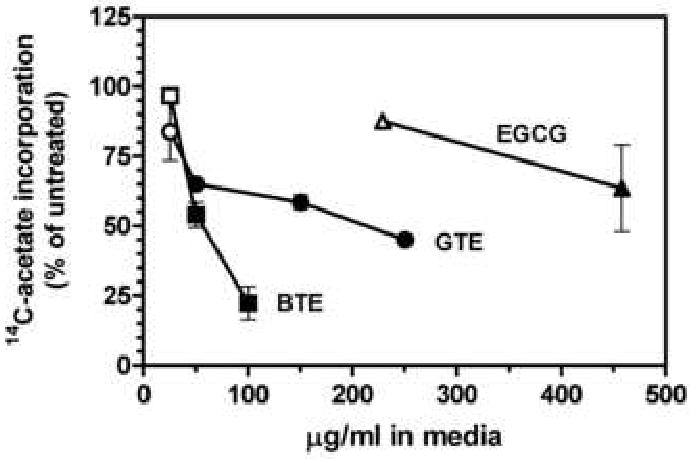
Fig. 1
Fig. 1
Inhibition of 14C-acetate incorporation into cholesterol by tea. Cholesterol synthesis from 14C-acetate was determined in 3-h assays with hepatoma cells in the presence of tea extracts or selected components. Values represent the mean and standard error of two to three experiments carried out in duplicate. Closed symbols are statistically different from untreated controls as determined by one-way analysis of variance with Dunnett's post-hoc test, p < 0.05. BTE, black tea extract; GTE, green tea extract.
Fig. 2
Fig. 2
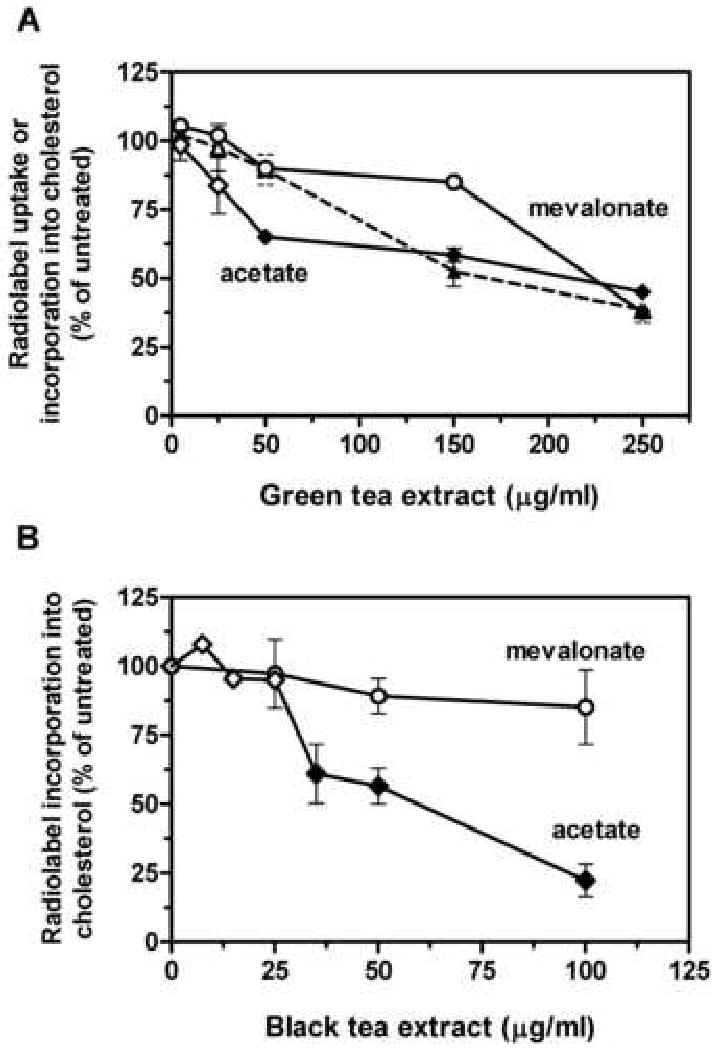
Effect of tea extract on radiolabel uptake and incorporation into cholesterol. Incorporation of 14C-acetate (acetate, diamond symbols) or 14C-mevalonate (mevalonate, circle symbols) into cholesterol was determined in 3-h assays with hepatoma cells in the presence of the indicated concentrations of green tea extract (A) or black tea extract (B). Values represent the mean and standard error of one to five experiments carried out in duplicate. The dashed line represents total 14C-acetate content in cells. Closed symbols are statistically different from untreated controls as determined by one-way analysis of variance with Dunnett's post-hoc test, p < 0.05.
Fig. 3
Fig. 3
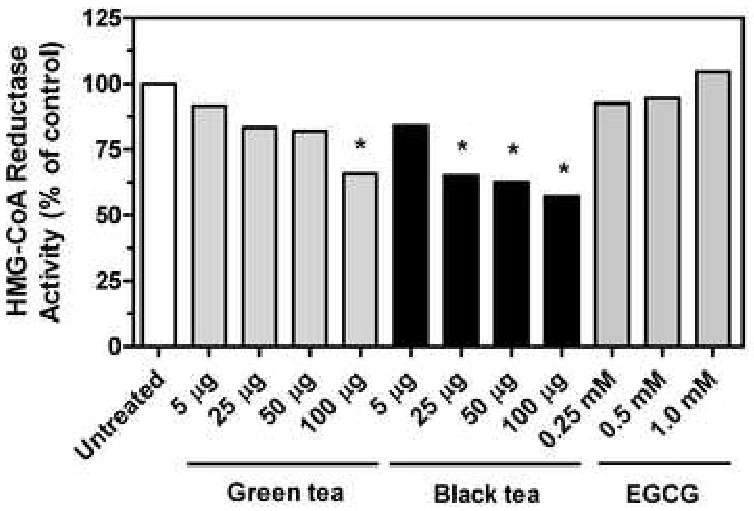
Inhibition of HMG-CoA reductase by tea extract. HMG-CoA reductase activity in rat liver microsomes was determined in the presence of the indicated tea extracts or component. Values represent the mean and standard error of two to four experiments carried out in duplicate. Asterisks indicate values statistically different from the untreated controls as determined by one-way analysis of variance with Dunnett's post-hoc test, p < 0.05.
Fig. 4
Fig. 4
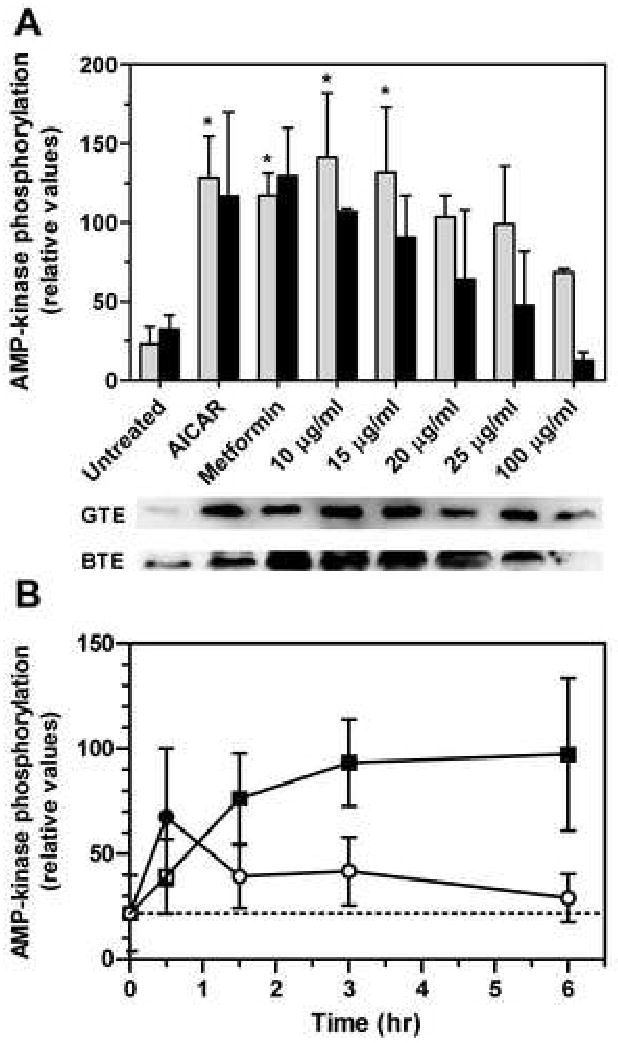
Phosphorylation of AMP-kinase by tea extract. Phosphorylated AMP-kinase was measured by immunoquantitation with an antibody specific for the phosphorylated enzyme. A, Enzyme phosphorylation in hepatoma cells after a 3-h treatment with green (grey bars) or black (black bars) tea extract; each data set included an untreated sample and samples treated with the AMP-kinase activators AICAR or metformin (1 mM each). Values represent the mean and standard deviation of 2 experiments; values that are statistically different from untreated controls are indicated with asterisks. The immunoblots below the graph illustrate the increase in AMP-kinase phosphorylation with each treatment (GTE, green tea extract; BTE, black tea extract). B, Enzyme phosphorylation in hepatoma cells at various times after treatment with 15 μg/ml of green (circles) or black (boxes) tea extract. Values represent the mean and standard deviation of 4 experiments; closed symbols are statistically different from untreated controls. Statistical significance was determined by one-way analysis of variance with Dunnett's post-hoc text, p < 0.05.
Fig. 5
Fig. 5
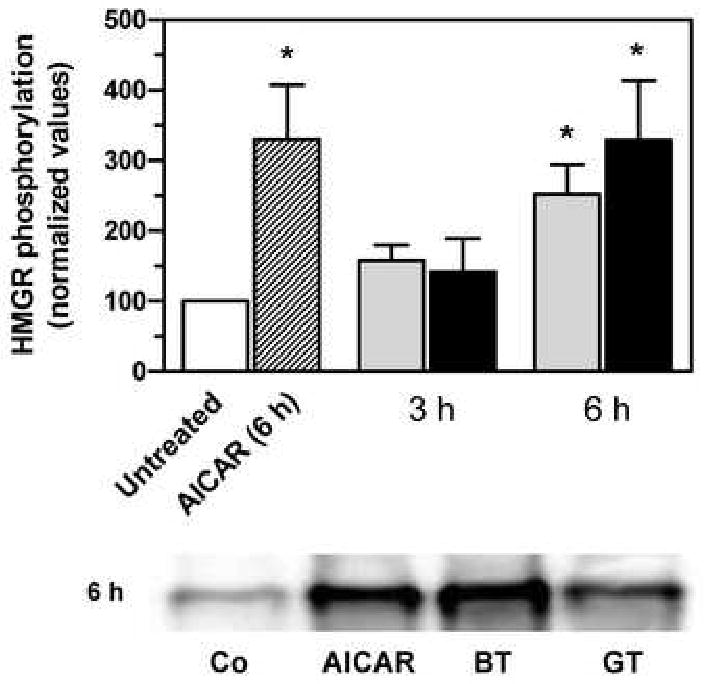
Phosphorylation of HMG-CoA reductase by tea extract. Phosphorylated HMG-CoA reductase (HMGR) was immunoprecipitated from hepatoma cell lysates with an antibody to phosphoserine/phosphothreonine/phosphotyrosine and then quantified by immunoblotting with an antibody to HMG-CoA reductase. Cells were treated with 15 μg/ml of green (grey bars) or black (black bars) tea extract or 1 mM AICAR for 3 or 6 h, as indicated. Values represent the mean and standard deviation of 3 or 4 experiments. Asterisks indicate values statistically different from the untreated cells as determined by one-way analysis of variance with Dunnett's post-hoc test, p < 0.05. The image below the graph shows a representative immunoblot of immunoprecipitated HMG-CoA reductase after 6 h of treatment; Co, untreated; BT, black tea, GT, green tea.

References

    1. Maron DJ, Lu GP, Cai NS, Wu ZG, Li YH, Chen H, Zhu JQ, Jin XJ, Wouters BC, Zhao J. Cholesterol-lowering effect of a theaflavin-enriched green tea extract: a randomized controlled trial. Arch Intern Med. 2003;163:1448–53. - PubMed
    1. Davies MJ, Judd JT, Baer DJ, Clevidence BA, Paul DR, Edwards AJ, Wiseman SA, Muesing RA, Chen SC. Black tea consumption reduces total and LDL cholesterol in mildly hypercholesterolemic adults. J Nutr. 2003;133:3298S–302S. - PubMed
    1. Koo SI, Noh SK. Green tea as inhibitor of the intestinal absorption of lipids: potential mechanism for its lipid-lowering effect. J Nutr Biochem. 2007;18:179–83. - PMC - PubMed
    1. Bursill CA, Abbey M, Roach PD. A green tea extract lowers plasma cholesterol by inhibiting cholesterol synthesis and upregulating the LDL receptor in the cholesterol-fed rabbit. Atherosclerosis. 2007;193:86–93. - PubMed
    1. Bursill CA, Roach PD. A green tea catechin extract upregulates the hepatic low-density lipoprotein receptor in rats. Lipids. 2007;42:621–7. - PubMed

Publication types

MeSH terms