


Multiple Wnt genes are required for segmentation in the short-germ embryo of Tribolium castaneum
- PMID: 18926702
- PMCID: PMC2603327
- DOI: 10.1016/j.cub.2008.09.057
Multiple Wnt genes are required for segmentation in the short-germ embryo of Tribolium castaneum
Abstract
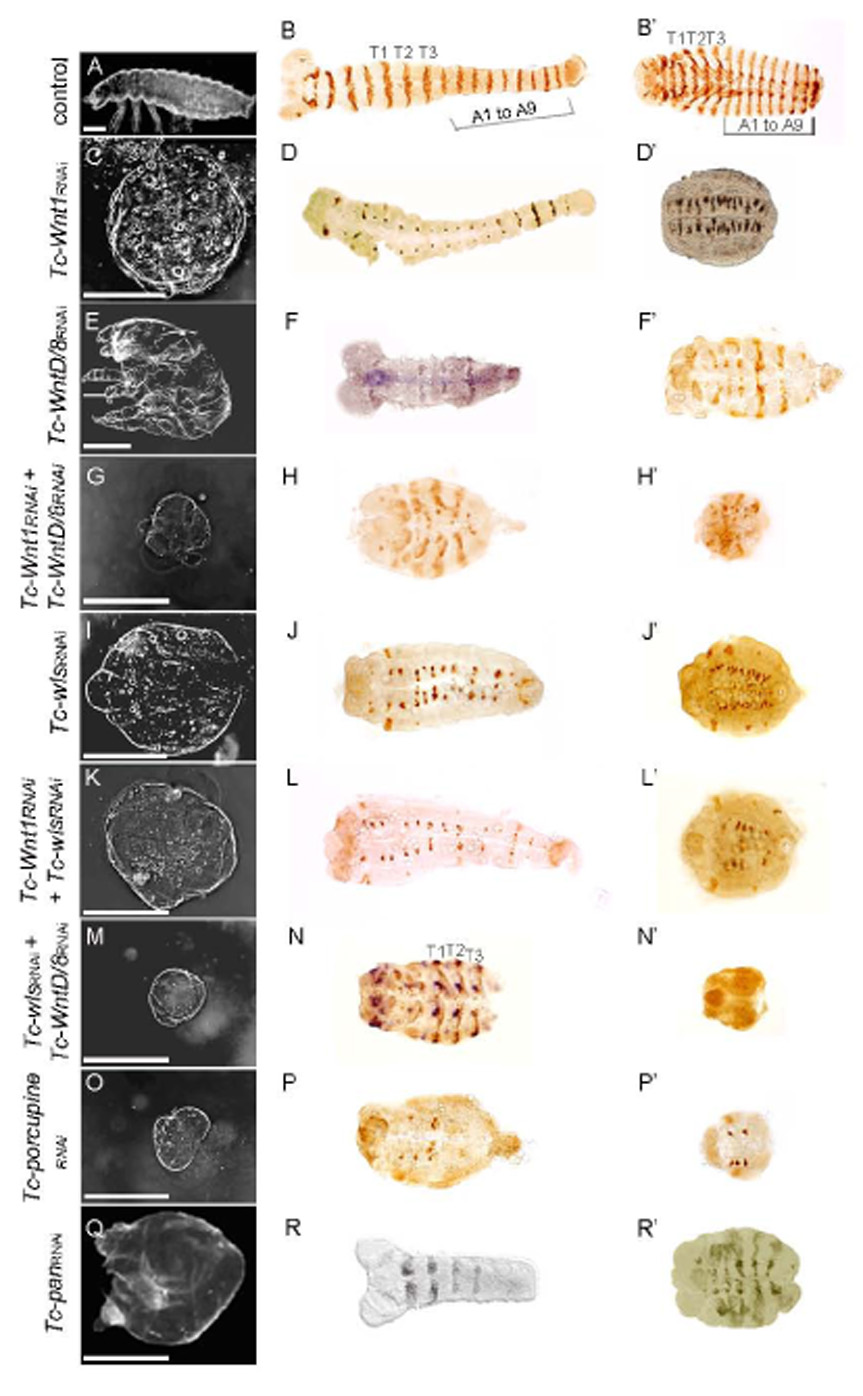
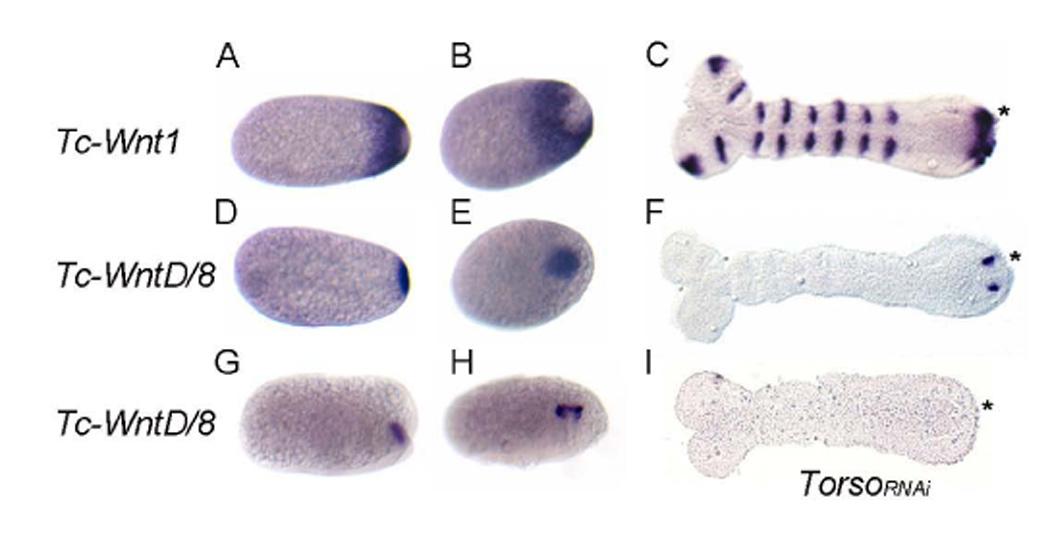
wingless (wg)/Wnt family are essential to development in virtually all metazoans. In short-germ insects, including the red flour beetle (Tribolium castaneum), the segment-polarity function of wg is conserved [1]. Wnt signaling is also implicated in posterior patterning and germband elongation [2-4], but despite its expression in the posterior growth zone, Wnt1/wg alone is not responsible for these functions [1-3]. Tribolium contains additional Wnt family genes that are also expressed in the growth zone [5]. After depleting Tc-WntD/8 we found a small percentage of embryos lacking abdominal segments. Additional removal of Tc-Wnt1 significantly enhanced the penetrance of this phenotype. Seeking alternative methods to deplete Wnt signal, we performed RNAi with other components of the Wnt pathway including wntless (wls), porcupine (porc), and pangolin (pan). Tc-wls RNAi caused segmentation defects similar to Tc-Wnt1 RNAi, but not Tc-WntD/8 RNAi, indicating that Tc-WntD/8 function is Tc-wls independent. Depletion of Tc-porc and Tc-pan produced embryos resembling double Tc-Wnt1,Tc-WntD/8 RNAi embryos, suggesting that Tc-porc is essential for the function of both ligands, which signal through the canonical pathway. This is the first evidence of functional redundancy between Wnt ligands in posterior patterning in short-germ insects. This Wnt function appears to be conserved in other arthropods [6] and vertebrates [7-9].
Figures
References
-
- Ober KA, Jockusch EL. The roles of wingless and decapentaplegic in axis and appendage development in the red flour beetle, Tribolium castaneum. Dev Biol. 2006;294(2):391–405. - PubMed
-
- Miyawaki K, Mito T, Sarashina U, Zhang H, Shinmyo Y, Ohuchi H, Noji S. Involvement of Wingless/Armadillo signaling in the posterior sequential segmentation in the cricket, Gryllus bimaculatus (Orthoptera), as revealed by RNAi analysis. Mech Dev. 2004;121:119–130. - PubMed
-
- Angelini DR, Kaufman TC. Functional analyses in the milkweed bug Oncopeltus fasciatus (Hemiptera) support a role for Wnt signaling in body segmentation but not appendage development. Dev Biol. 2005;283:409–423. - PubMed
-
- Schoppmeier M, Schroder R. Maternal Torso signaling controls body axis elongation in a shortgerm insect. Current Biology. 2005;15:2131–2136. - PubMed
-
- Bolognesi R, Beermann A, Farzana L, Wittkopp N, Lutz R, Balavoine G, Brown SJ, Schröder R. Tribolium Wnts: evidence for a larger repertoire in insects with overlapping expression patterns that suggest multiple redundant functions in embryogenesis. Development, Genes and Evolution. 2008;218:193–202. - PMC - PubMed
Publication types
MeSH terms
Substances
Grants and funding
LinkOut - more resources
Full Text Sources
