


Maternal transfer of antibodies in vertebrates: trans-generational effects on offspring immunity
- PMID: 18926976
- PMCID: PMC2666691
- DOI: 10.1098/rstb.2008.0137
Maternal transfer of antibodies in vertebrates: trans-generational effects on offspring immunity
Abstract
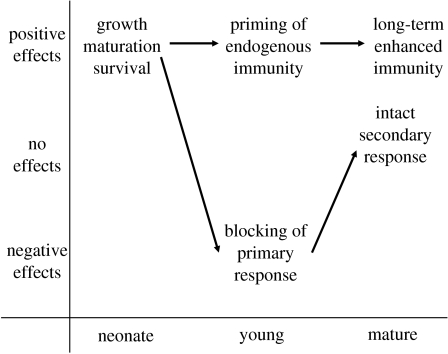
Maternal effects by which females provide their offspring with non-genetic factors such as hormones, nutrients and antibodies can have an important impact on offspring fitness. In vertebrates, maternal antibodies (matAb) are transferred from the mother, via the placenta, egg yolk or milk during lactation to offspring until they are 2 weeks (birds), 4-10 weeks (rodents) and 9 months (humans) old, respectively. matAb transfer can have direct effects on offspring growth rate in birds and rodents, probably by passively protecting the newborn from common pathogens before their endogenous immune system has matured. Indirect long-term effects of matAb transfer on the offspring's own immunity can be synergistic, if matAb act as antigen templates of the accumulated immunological experience of the mother and educate the newborn's immune system. However, it may also be suppressive if matAb reduce antigen presentation to the newborn resulting in antigen-specific blocking of offspring endogenous immunity. Our aim is to review the mechanisms and direct effects of matAb transfer in vertebrates with an emphasis on birds, outline a framework for research on the long-term effects of matAb on the endogenous immune system of the mature offspring and encourage ecological and evolutionary studies of matAb transfer in non-domesticated animals.
Figures
References
-
- Agrawal A.A., Laforsch C., Tollrian R. Transgenerational induction of defences in animals and plants. Nature. 1999;401:60–63. doi:10.1038/43425 - DOI
-
- Albrecht P., Ennis F.A., Saltzman E.J., Krugman S. Persistence of maternal antibody in infants beyond 12 months: mechanism of measles vaccine failure. J. Pediatr. 1977;91:715–718. doi:10.1016/S0022-3476(77)81021-4 - DOI - PubMed
-
- Anderson R.W. On the maternal transmission of immunity: a ‘molecular attention’ hypothesis. BioSystems. 1995;34:87–105. doi:10.1016/0303-2647(94)01444-C - DOI - PubMed
-
- Anderson R.M., May R.M. Springer; Berlin, Germany: 1982. Population biology of infectious diseases.
-
- Apanius V. Ontogeny of immune function. In: Starck J.M., Ricklefs R.E., editors. Avian growth and development: evolution within the altrcial–precocial spectrum. Oxford University Press; Oxford, UK: 1998. pp. 203–222.
Publication types
MeSH terms
LinkOut - more resources
Full Text Sources
