


Antioxidant supplementation and premature rupture of the membranes: a planned secondary analysis
- PMID: 18928997
- PMCID: PMC2723730
- DOI: 10.1016/j.ajog.2008.07.011
Antioxidant supplementation and premature rupture of the membranes: a planned secondary analysis
Abstract
Objective: The purpose of this study was to determine if antioxidant supplementation during pregnancy reduces the incidence of premature rupture of the membranes (PROM).
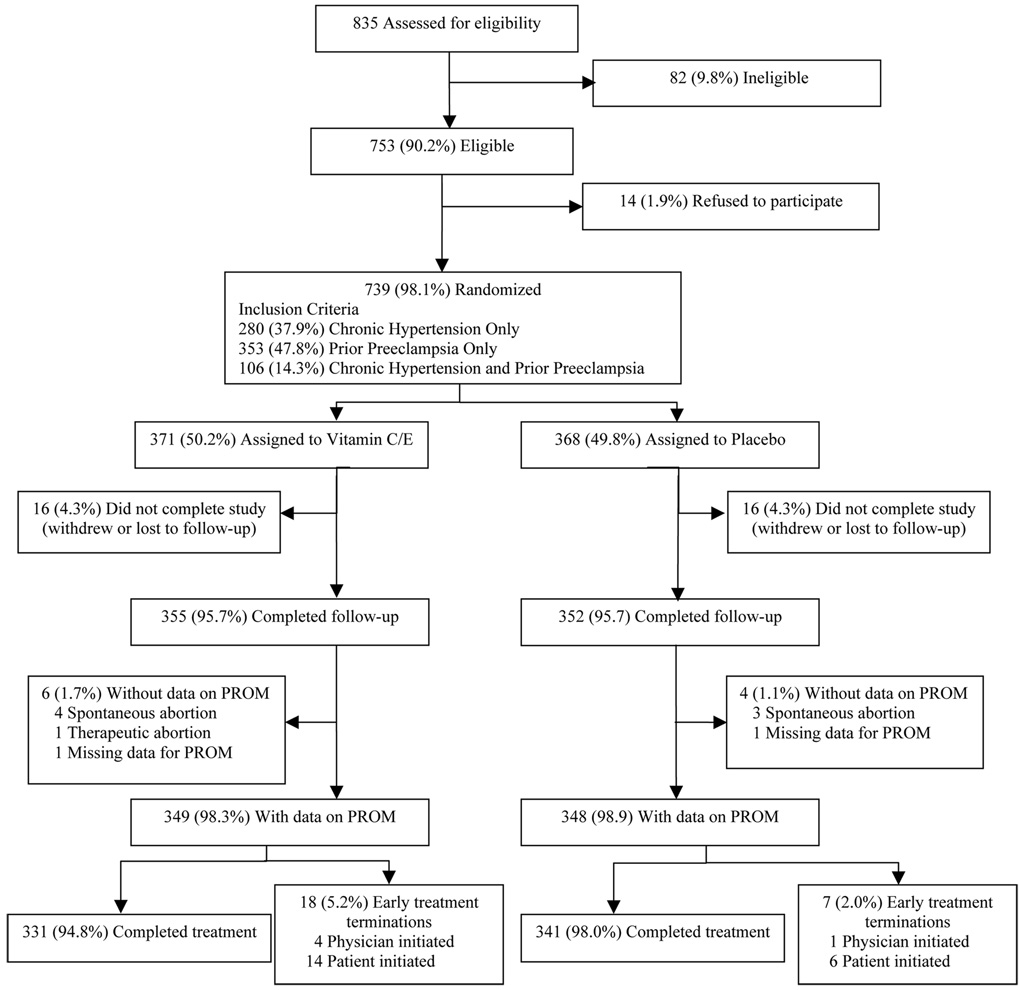
Study design: A placebo-controlled, double-blind trial was conducted. PROM and preterm PROM (PPROM) were planned secondary outcomes of the trial. Women between 12(0/7) and 19(6/7) weeks of gestation and diagnosed to have chronic hypertension or a prior history of preeclampsia were randomized to daily treatment with both vitamin C (1000 mg) and E (400 IU) or placebo.
Results: Outcome data for PROM were available for 697 of 739 patients. The rates of PROM (37/349 [10.6%] vs 19/348 [5.5%]; adjusted risk ratio [RR] 1.89 [95.42% CI, 1.11-3.23]; P = .015), and PPROM (16/349 [4.6%] vs 6/348 [1.7%]; RR 2.68 [1.07-6.71]; P = .025) were increased in the antioxidant group.
Conclusion: Contrary to expectations, vitamins C and E supplementation in this dose combination may be associated with an increased risk of PROM and PPROM.
Trial registration: ClinicalTrials.gov NCT00097110.
References
-
- Premature rupture of the membranes. ACOG Practice Bulletin. Number 80. 2007 April
-
- Woods JR, Jr, Plessinger MA, Miller RK. Vitamins C and E: missing links in preventing preterm premature rupture of membranes? Am J Obstet Gynecol. 2001 Jul;185(1):5–10. - PubMed
-
- Woods JR., Jr Reactive oxygen species and preterm premature rupture of membranes-a review. Placenta. 2001 Apr;22 Suppl A:S38–S44. - PubMed
-
- Spinnato JA, Freire S, Pinto e Silva JL, Cunha Rudge M, Martins-Costa S, et al. Antioxidant Therapy to Prevent Preeclampsia: A Randomized Controlled Trial. Obstet Gynecol. 2007 Dec;110(6):1311–1318. - PubMed
-
- Alexander GR, Himes JH, Kaufman RB, Mor J, Kogan M. A United States national reference for fetal growth. Obstet Gynecol. 1996 Feb;87(2):163–168. - PubMed
