. 2009 Jan;33(1):37-47.
doi: 10.1016/j.nbd.2008.09.014. Epub 2008 Sep 30.

Intergenerational and striatal CAG repeat instability in Huntington's disease knock-in mice involve different DNA repair genes

Affiliations

Intergenerational and striatal CAG repeat instability in Huntington's disease knock-in mice involve different DNA repair genes

Ella Dragileva et al. Neurobiol Dis. 2009 Jan.

Abstract

Modifying the length of the Huntington's disease (HD) CAG repeat, the major determinant of age of disease onset, is an attractive therapeutic approach. To explore this we are investigating mechanisms of intergenerational and somatic HD CAG repeat instability. Here, we have crossed HD CAG knock-in mice onto backgrounds deficient in mismatch repair genes, Msh3 and Msh6, to discern the effects on CAG repeat size and disease pathogenesis. We find that different mechanisms predominate in inherited and somatic instability, with Msh6 protecting against intergenerational contractions and Msh3 required both for increasing CAG length and for enhancing an early disease phenotype in striatum. Therefore, attempts to decrease inherited repeat size may entail a full understanding of Msh6 complexes, while attempts to block the age-dependent increases in CAG size in striatal neurons and to slow the disease process will require a full elucidation of Msh3 complexes and their function in CAG repeat instability.


Figures
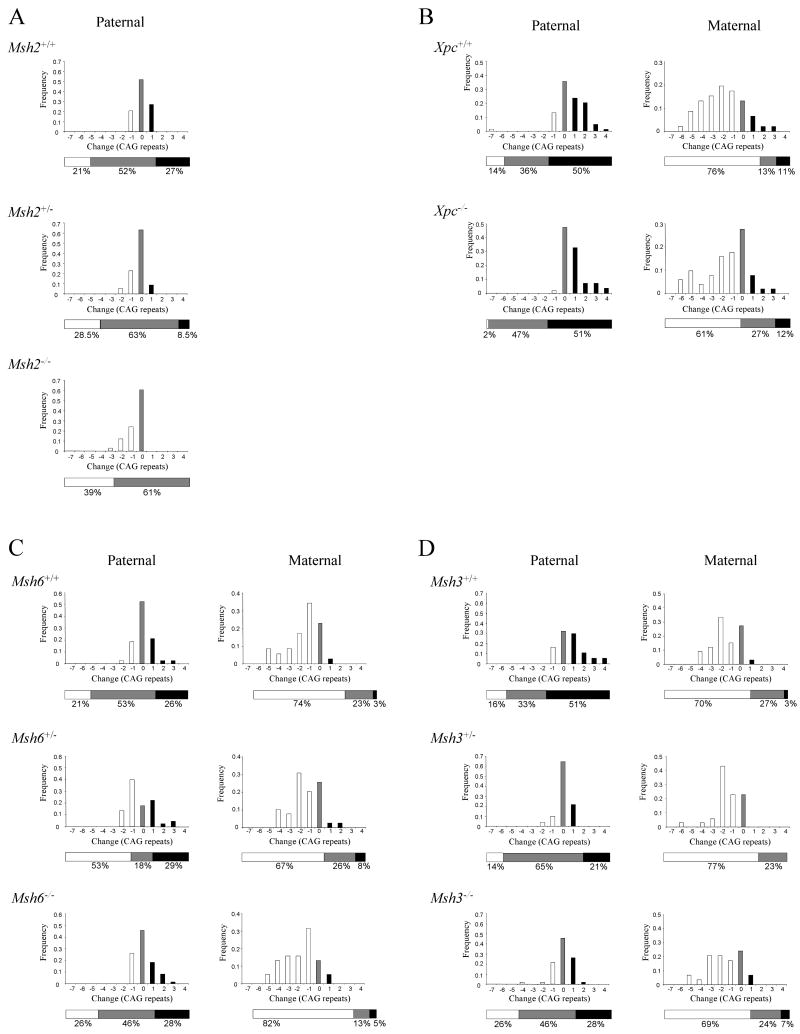
Figure 1
Figure 1
HdhQ111 CAG repeat intergenerational instability. HdhQ111 mice were crossed onto backgrounds deficient in Msh2 (A), Xpc (B), Msh6 (C) or Msh3 (D). The change in HdhQ111 CAG repeat length upon transmission from heterozygous HdhQ111/+ fathers or mothers to their progeny was determined. The total number of transmissions analyzed for each genotype, the mean age and mean CAG repeat length of the transmitting parents were as follows: (A) Paternal: Msh2+/+ n=48, 5.4 months, 88 CAGs; Msh2+/- n=35, 5.2 months, 87 CAGs; Msh2-/- n=33, 4.4 months, 86 CAGs. (B) Paternal: Xpc+/+ n= 84, 3.8 months, 103 CAGs; Xpc-/- n=55, 4.0 months, 103 CAGs. Maternal: Xpc+/+ n=55, 4.1 months, 103 CAGs, Xpc-/- n=51, 4.3 months, 102 CAGs). (C) Paternal: Msh6+/+ n=38, 5.9 months, 101 CAGs; Msh6+/- n=45, 5.6 months, 101 CAGs: Msh6-/- n=61, 5.5 months, 101 CAGs. Maternal: Msh6+/+ n=35, 5.4 months, 100 CAGs; Msh6+/- n=39, 5.7 months, 101 CAGs; Msh6-/- n=38, 5.5 months, 99 CAGs. (D) Paternal: Msh3+/+ n=37, 5.1 months, 101 CAGs; Msh3+/- n=51, 5.0 months, 101 CAGs; Msh3-/- n=46, 4.8 months, 101 CAGs. Maternal: Msh3+/+ n=33, 4.3 months, 101 CAGs; Msh3+/- n=35, 4.4 months, 101 CAGs; Msh3-/- n=29, 4.2 months, 100 CAGs. Bar graphs show frequency distributions of the inherited repeat length changes. The horizontal bars below the graphs depict the total percentage of expansions, contractions and unchanged alleles. Black: expansions; white: contractions; grey: unchanged alleles.
Figure 2
Figure 2
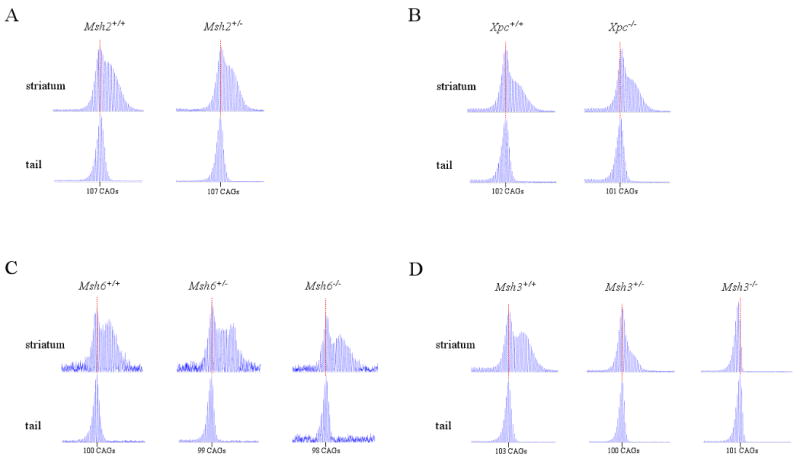
HdhQ111 CAG repeat striatal instability. HdhQ111 mice were crossed onto backgrounds deficient in Msh2 (A), Xpc (B), Msh6 (C) or Msh3 (D). ABI GeneScan traces are shown of the HdhQ111 CAG repeat PCR-amplified from genomic DNA extracted from striata or tail of heterozygous HdhQ111/Hdh+ mice at 5 months of age. The number of mice of each DNA repair genotype and the constitutive HD CAG repeat size determined from tail in each mouse is as follows: (A) Msh2+/+ n=4, CAG 106, 107, 107, 107; Msh2+/- n=4, CAG 107, 107, 108, 111. (B) Xpc+/+ n=3, CAG 100, 101, 102; Xpc-/- n=3, CAG 95, 99, 101. (C) Msh6+/+ n=3, CAG 98, 100, 100; Msh6+/- n=3, CAG 99, 99, 99; Msh6-/- n=3, CAG 98, 99, 100. (D) Msh3+/+ n=3, CAG 102, 103, 103; Msh3+/- n=4, CAG 100, 100, 101, 102; Msh3-/- n=3, CAG 94, 95, 101, 101. Mice of the same genotype had identical repeat profiles regardless of constitutive CAG repeat number. Representative GeneScan traces are shown. HD CAG repeat size in tail is indicated, the position of which is marked with a dotted red line.
Figure 3
Figure 3
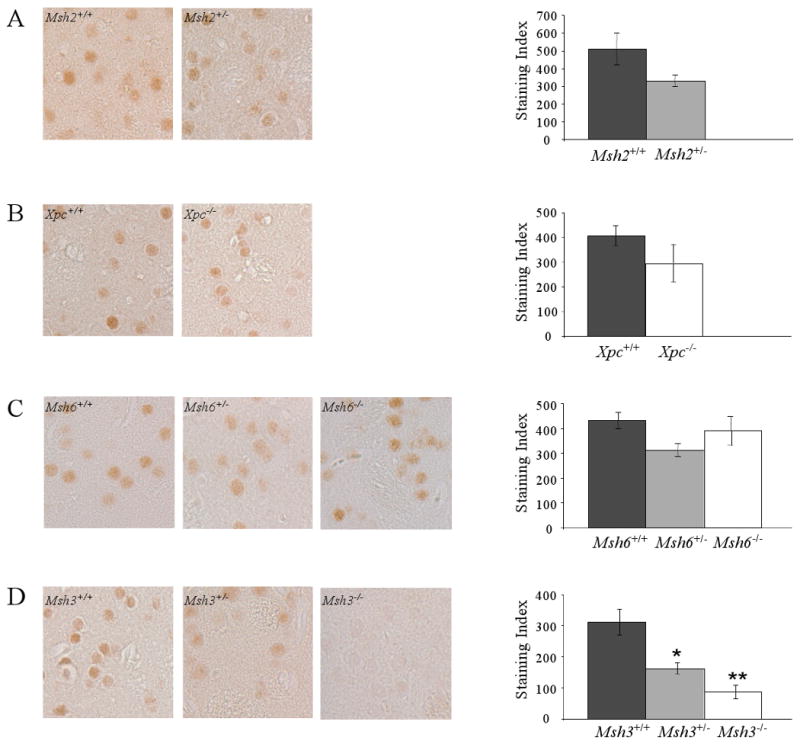
Nuclear mutant huntingtin immunostaining in striatal neurons. HdhQ111 mice were crossed onto backgrounds deficient in Msh2 (A), Xpc (B), Msh6 (C) or Msh3 (D). Striatal sections from HdhQ111/+ mice at 5 months of age were immunostained with anti-huntingtin antibody EM48 and a staining index (SI) calculated for each mouse as the product of the mean staining intensity and the number of immunostained nuclei (see Materials and Methods). Left: Representative striatal histological sections immunostained with EM48. Right: Bar graphs showing the mean SI for each genotype +/- standard error. The number of mice of each DNA repair genotype (+/+, +/-, -/-) and the constitutive HD CAG repeat size determined from tail in each mouse is as follows: (A) Msh2+/+ n=3, CAG 107, 108, 109; Msh2+/- n=4, CAG 106, 106, 107, 107. (B) Xpc+/+ n=4, CAG 99, 101, 101, 101; Xpc-/- n=3, CAG 98, 101, 102. (C) Msh6+/+ n=3, CAG 98, 99, ND#; Msh6+/- n=4, CAG 97, 98, 99, 99; Msh6-/- n=4, CAG 98, 99, 99, 99. (D) Msh3+/+ n=5, CAG 98, 100, 100, 101, 102; Msh3+/- n=5, CAG 97, 97, 100, 101, 105; Msh3-/- n=3, CAG 99, 100, 102. * p=0.02, ** p<0.001. #A repeat value could not be determined for this mouse. Loss of two Msh3 alleles had a slightly greater effect of loss of one Msh3 allele but this effect was not statistically significant (p=0.11).
Figure 4
Figure 4
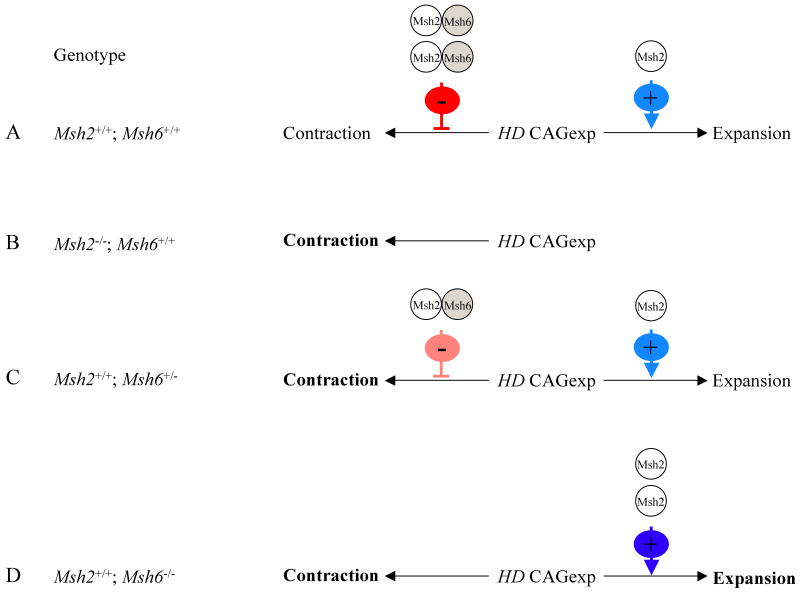
Proposed model for the roles of Msh2 and Msh6 in HdhQ111 CAG repeat intergenerational instability. The length of the expanded HD CAG repeat (HD CAGexp) inherited from fathers is determined by the combined influences of two Msh2-dependent mechanisms: Msh2 mediates expansions and Msh2-Msh6 dimers protect against contractions. A) In mice wild-type for both Msh2 and Msh6 (Msh2+/+/; Msh6+/+) expansion (light blue ‘+’ arrow) and inhibition of contraction (red ‘-’ inhibitory symbol) both occur. B) In mice lacking Msh2 (Msh2-/-; Msh6+/+) both mechanisms are abolished, the net result being an increased contraction frequency (bold type). C) In mice lacking one Msh6 allele (Msh2+/+; Msh6+/-) contraction frequency is increased (bold type) as a result of reduced Msh2-Msh6 inhibition (pink‘-’ inhibitory symbol) while expansions are unaffected. D) In mice lacking two Msh6 alleles (Msh2+/+; Msh6-/-) contraction frequency is increased (bold type) due to loss of Msh2-Msh6 inhibition. However, this is compensated by an increase in expansions (dark blue ‘+’ arrow and bold type), as in the absence of Msh6 the balance of Msh2-dependent pathways is shifted in favor of those that mediate expansions.

References

    1. Acharya S, Wilson T, Gradia S, Kane MF, Guerrette S, Marsischky GT, Kolodner R, Fishel R. hMSH2 forms specific mispair-binding complexes with hMSH3 and hMSH6. Proc Natl Acad Sci USA. 1996;93:13629–13634. - PMC - PubMed
    1. Andrew SE, Goldberg YP, Kremer B, Telenius H, Theilmann J, Adam S, Starr E, Squitieri F, Lin B, Kalchman MA, Graham RK, Hayden MR. The relationship between trinucleotide (CAG) repeat length and clinical features of Huntington's disease. Nat Genet. 1993;4:398–403. - PubMed
    1. Chang DK, Ricciardiello L, Goel A, Chang CL, Boland CR. Steady-state regulation of the human DNA mismatch repair system. J Biol Chem. 2000;275:18424–18431. - PubMed
    1. Cheo DL, Ruven HJ, Meira LB, Hammer RE, Burns DK, Tappe NJ, van Zeeland AA, Mullenders LH, Friedberg EC. Characterization of defective nucleotide excision repair in XPC mutant mice. Mut Res. 1997;374:1–9. - PubMed
    1. Duyao M, Ambrose C, Myers R, Novelletto A, Persichetti F, Frontali M, Folstein S, Ross C, Franz M, Abbott M, et al. Trinucleotide repeat length instability and age of onset in Huntington's disease. Nat Genet. 1993;4:387–392. - PubMed

Publication types

MeSH terms