


Prospective study of the association between abandoned dwellings and testosterone level on the development of behaviors leading to cannabis use disorder in boys
- PMID: 18930183
- PMCID: PMC2643094
- DOI: 10.1016/j.biopsych.2008.08.032
Prospective study of the association between abandoned dwellings and testosterone level on the development of behaviors leading to cannabis use disorder in boys
Abstract
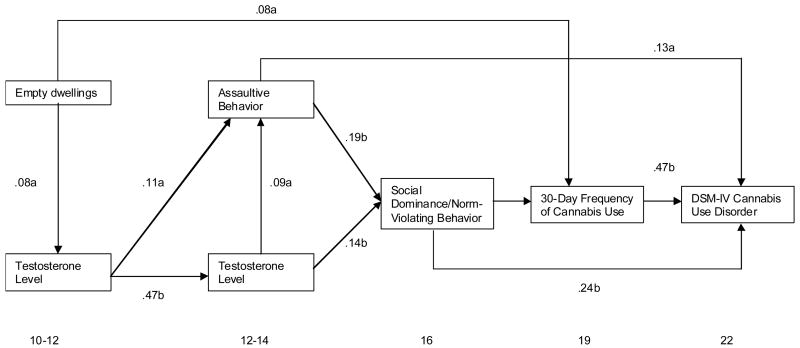
Background: The role of testosterone in the development of behaviors presaging cannabis use and subsequently cannabis use disorder was investigated in a prospective study of 208 boys. It was theorized that adverse neighborhood correlates with testosterone level that in turn potentiates behaviors predisposing to cannabis consumption and subsequently diagnosis of cannabis use disorder.
Methods: Proportion of boarded-up dwellings in the 1990 census tract and testosterone level were recorded at baseline (ages 10-12), followed by assessments of assaultiveness and testosterone level (ages 12-14), social dominance/norm-violating behavior (SDNVB) (age 16), cannabis use (age 19), and cannabis use disorder (age 22).
Results: Percent of vacant dwellings correlates with testosterone level that in turn predicts assaultive behavior sequentially leading to SDNVB, cannabis use, and cannabis use disorder. Externalizing behaviors and cannabis use disorder are not directly predicted by neighborhood quality.
Conclusions: Elevated testosterone level intermediates the association between neighborhood adversity and aggressive socially deviant behaviors presaging cannabis use and cannabis use disorder.
Figures

References
-
- Udry JR. Biosocial models of adolescent problem behaviors. Soc Biol. 1990;37:1–10. - PubMed
-
- Dabbs JM, Jr, Hopper CH, Jurkovic GJ. Testosterone and personality among college students and military veterans. Pers Ind Diff. 1990;11:1263–1269.
-
- Reynolds M, Tarter R, Kirisci L, Kirillova G, Brown S, Clark D, et al. Testosterone level and sexual maturation predict substance use disorders in adolescent boys: A prospective study. Bio Psychiatry. 2007;61:1223–1227. - PubMed
-
- Archer J. Testosterone and human aggression: an evaluation of the challenge hypothesis. Neurosci Biobehav Revws. 2006;30:319–345. - PubMed
Publication types
MeSH terms
Substances
Grants and funding
LinkOut - more resources
Full Text Sources
Medical
