Meta-Analysis
. 2008 Dec;68(3):436-61.
doi: 10.1016/j.bandc.2008.09.001. Epub 2008 Oct 18.

Eye movement dysfunction in first-degree relatives of patients with schizophrenia: a meta-analytic evaluation of candidate endophenotypes

Affiliations
Meta-Analysis

Eye movement dysfunction in first-degree relatives of patients with schizophrenia: a meta-analytic evaluation of candidate endophenotypes

Monica E Calkins et al. Brain Cogn. 2008 Dec.

Abstract

Several forms of eye movement dysfunction (EMD) are regarded as promising candidate endophenotypes of schizophrenia. Discrepancies in individual study results have led to inconsistent conclusions regarding particular aspects of EMD in relatives of schizophrenia patients. To quantitatively evaluate and compare the candidacy of smooth pursuit, saccade and fixation deficits in first-degree biological relatives, we conducted a set of meta-analytic investigations. Among 18 measures of EMD, memory-guided saccade accuracy and error rate, global smooth pursuit dysfunction, intrusive saccades during fixation, antisaccade error rate and smooth pursuit closed-loop gain emerged as best differentiating relatives from controls (standardized mean differences ranged from .46 to .66), with no significant differences among these measures. Anticipatory saccades, but no other smooth pursuit component measures were also increased in relatives. Visually-guided reflexive saccades were largely normal. Moderator analyses examining design characteristics revealed few variables affecting the magnitude of the meta-analytically observed effects. Moderate effect sizes of relatives v. controls in selective aspects of EMD supports their endophenotype potential. Future work should focus on facilitating endophenotype utility through attention to heterogeneity of EMD performance, relationships among forms of EMD, and application in molecular genetics studies.


Figures
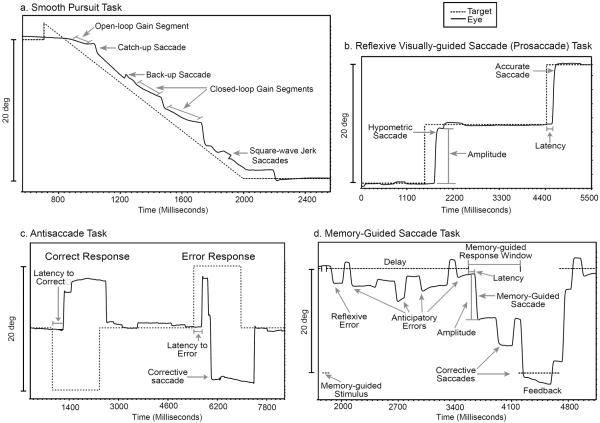
Figure 1
Figure 1
Examples of EMD paradigms. a. One trial of a smooth pursuit task, in which the target begins on the right side of the computer monitor and travels at a constant velocity (16 deg/s) to the left side of the monitor. Open-loop gain segment = initial period during which pursuit is initiated, typically scored for average acceleration during that period. Closed-loop gain segments = two of several segments during which the accuracy of pursuit maintenance is estimated by examining the ratio of eye velocity to target velocity. Catch-up saccade = corrective saccade that takes the eyes from a position behind the target to a position on or near the target. Back-up saccade = corrective saccade that takes the eyes from the target to a position behind the target. Square wave jerk saccades =intrusive saccades consisting of a pair of small amplitude saccades separated by a brief intersaccadic interval, preceded and followed by pursuit. b. Two trials of a visually-guided reflexive saccade (prosaccade) task, in which the participant is required simply to generate a saccade in the direction of target motion. In the first trial, the saccade generated is hypometric; the eye position amplitude falls short of target amplitude. In the second trial, the saccade is accurate; the eye position amplitude closely matches target amplitude. Latency reflects the reaction time between stimulus presentation and saccade initiation. c. Two trials of an antisaccade task, in which the participant is instructed to make a saccade in the direction opposite target motion. In the first trial, the participant correctly generates a saccade in the opposite direction of target motion. In the second trial, an inappropriate reflexive saccade error is made to the target, followed quickly by a corrective saccade in the appropriate direction. Both trials are scored for latency between target appearance and the initiation of the primary saccade. d. A memory-guided saccade task in which the participant is instructed to maintain fixation during the presentation of a peripheral stimulus (memory-guided stimulus), to continue fixation during a delay period, and upon offset of the fixation stimulus, to generate a saccade to the remembered location of the memory-guided stimulus. This participant generates an inappropriate reflexive error to the memory-guided stimulus and makes several saccades in anticipation of the fixation offset during the delay period. Upon the cue (fixation offset) to look to the remembered location, during the memory-guided response window, the participant generates an inaccurate memory-guided saccade, subsequently generating a corrective saccade landing closer to the appropriate location. At the end of the memory-guided response window, a feedback stimulus shows the appropriate location, to which the participant generates a final corrective saccade.
Figure 2
Figure 2
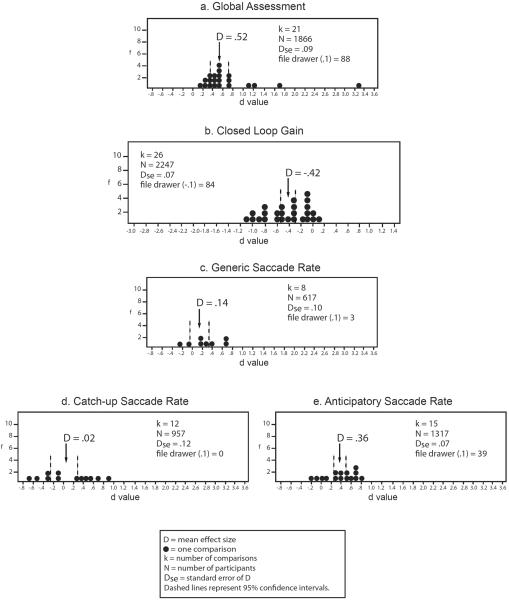
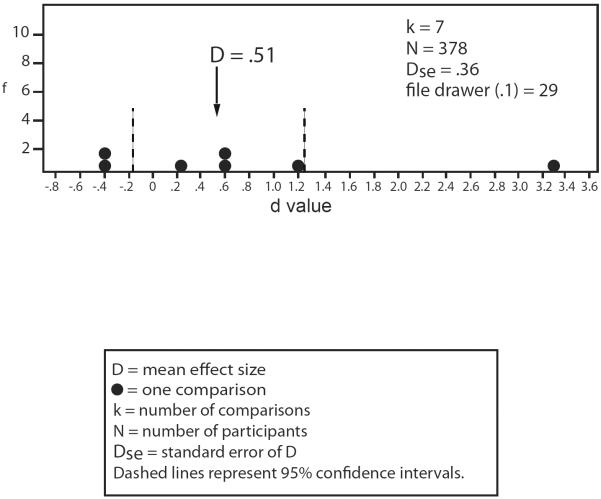
Smooth pursuit eye movement dysfunction in relatives of schizophrenia patients v. non-psychiatric controls. Frequency distributions of individual study effect sizes for group comparisons, with mean D and 95% confidence intervals. f = frequency of effect size. File drawer = number of studies required to reverse the conclusions suggested by the meta-analysis, by reducing or increasing the estimate of the population effect size to either 0.1 or −0.1, depending on the predicted relationship, specified in parentheses for each analysis. A negative effect size indicates relatives had a lower mean than controls. Effect sizes are interpreted as: .2 = small, .5 = moderate, .8 = large.
Figure 3
Figure 3
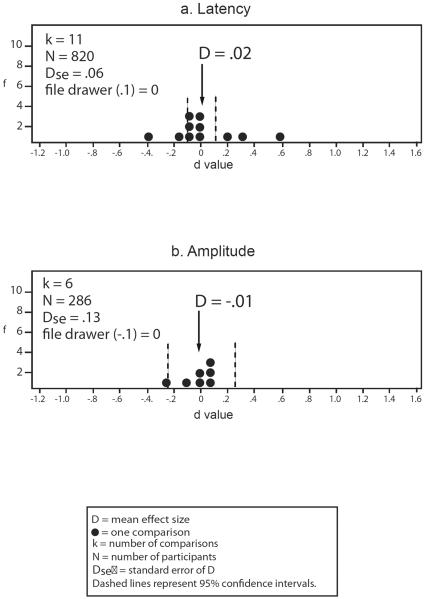
Reflexive visually guided saccades in relatives of schizophrenia patients v. non-psychiatric controls. Frequency distributions of individual study effect sizes for group comparisons, with mean D and 95% confidence intervals. f = frequency of effect size. File drawer = number of studies required to reverse the conclusions suggested by the meta-analysis, by reducing or increasing the estimate of the population effect size to either 0.1 or −0.1, depending on the predicted relationship, specified in parentheses for each analysis. A negative effect size indicates relatives had a lower mean than controls. Effect sizes are interpreted as: .2 = small, .5 = moderate, .8 = large.
Figure 4
Figure 4
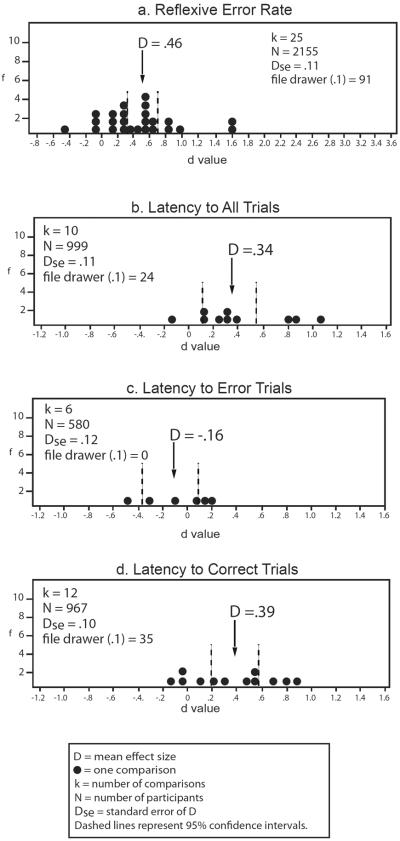
Antisaccade Performance in relatives of schizophrenia patients v non-psychiatric controls. Frequency distributions of individual study effect sizes for group comparisons, with mean D and 95% confidence intervals. f = frequency of effect size. File drawer = number of studies required to reverse the conclusions suggested by the meta-analysis, by reducing or increasing the estimate of the population effect size to either 0.1 or −0.1, depending on the predicted relationship, specified in parentheses for each analysis. A negative effect size indicates relatives had a lower mean than controls. Effect sizes are interpreted as: .2 = small, .5 = moderate, .8 = large.
Figure 5
Figure 5
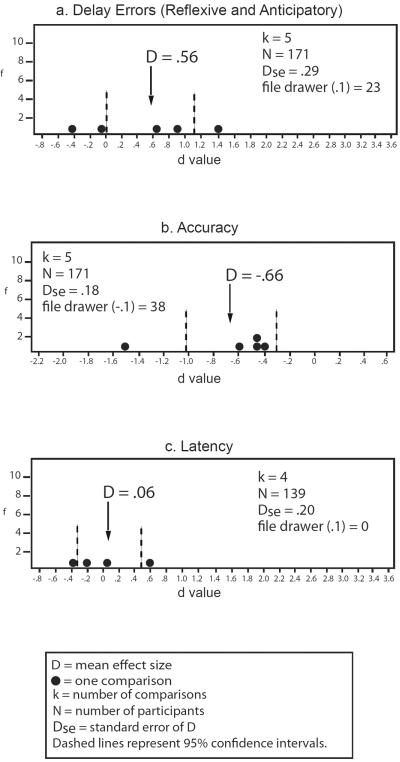
Memory-guided saccade performance in relatives of schizophrenia patients v. non-psychiatric controls. Frequency distributions of individual study effect sizes for group comparisons, with mean D and 95% confidence intervals. f = frequency of effect size. File drawer = number of studies required to reverse the conclusions suggested by the meta-analysis, by reducing or increasing the estimate of the population effect size to either 0.1 or −0.1, depending on the predicted relationship, specified in parentheses for each analysis. A negative effect size indicates relatives had a lower mean than controls. Effect sizes are interpreted as: .2 = small, .5 = moderate, .8 = large.
Figure 6
Figure 6
Fixation stability in relatives of schizophrenia patients v. non-psychiatric controls. Frequency distributions of individual study effect sizes for group comparisons, with mean D and 95% confidence intervals. f = frequency of effect size. File drawer = number of studies required to reverse the conclusions suggested by the meta-analysis, by reducing or increasing the estimate of the population effect size to either 0.1 or −0.1, depending on the predicted relationship, specified in parentheses for each analysis. A negative effect size indicates relatives had a lower mean than controls. Effect sizes are interpreted as: .2 = small, .5 = moderate, .8 = large.

References

    1. Abel LA, Friedman L, Jesberger LA, Meltzer HY. Relationships between catch-up saccades frequency and smooth pursuit gain in schizophrenics and normals. Society for Neuroscience Abstracts. 1988;14:796.
    1. Abel LA, Friedman L, Lesberger LA, Maliki A, Meltzer HY. Quantitative assessment of smooth pursuit gain and catch-up saccades in schizophrenic and affective disorders. Biological Psychiatry. 1991;29:1063–1072. - PubMed
    1. Abel LA, Ziegler A. Smooth pursuit eye movements in schizophrenics: What constitutes quantitative assessment? Biological Psychiatry. 1988;24:747–761. - PubMed
    1. Adler LE, Olincy A, Waldo M, Harris JG, Griffith J, Stevens K, et al. Schizophrenia, sensory gating, and nicotinic receptors. Schizophrenia Bulletin. 1998;24(2):189–202. - PubMed
    1. Allen JS, Matsunaga K, Nakamura T, Kitamura T, Furukawam T, Hacisalihzade SS, et al. Schizophrenia, eye movements, and biocultural heterogeneity. Human Biology. 1990;62(3):337–352. - PubMed

Publication types