. 2008 Dec;190(24):8096-105.
doi: 10.1128/JB.01180-08. Epub 2008 Oct 17.

Proteasomal components required for cell growth and stress responses in the haloarchaeon Haloferax volcanii

Affiliations

Proteasomal components required for cell growth and stress responses in the haloarchaeon Haloferax volcanii

Guangyin Zhou et al. J Bacteriol. 2008 Dec.

Abstract

Little is known regarding the biological roles of archaeal proteases. The haloarchaeon Haloferax volcanii is an ideal model for understanding these enzymes, as it is one of few archaea with an established genetic system. In this report, a series of H. volcanii mutant strains with markerless and/or conditional knockouts in each known proteasome gene was systematically generated and characterized. This included single and double knockouts of genes encoding the 20S core alpha1 (psmA), beta (psmB), and alpha2 (psmC) subunits as well as genes (panA and panB) encoding proteasome-activating nucleotidase (PAN) proteins closely related to the regulatory particle triple-A ATPases (Rpt) of eukaryotic 26S proteasomes. Our results demonstrate that 20S proteasomes are required for growth. Although synthesis of 20S proteasomes containing either alpha1 or alpha2 could be separately abolished via gene knockout with little to no impact on growth, conditional depletion of either beta alone or alpha1 and alpha2 together rendered the cells inviable. In contrast, the PAN proteins were not essential based on the robust growth of the panA panB double knockout strain. Deletion of genes encoding either alpha1 or PanA did, however, render cells more sensitive to growth on organic versus inorganic nitrogen sources and hypo-osmotic stress and limited growth in the presence of l-canavanine. Abolishment of alpha1 synthesis also had a severe impact on the ability of cells to withstand thermal stress. This contrasted with what was seen for panA knockouts, which displayed enhanced thermotolerance. Together, these results provide new and important insight into the biological role of proteasomes in archaea.


Figures
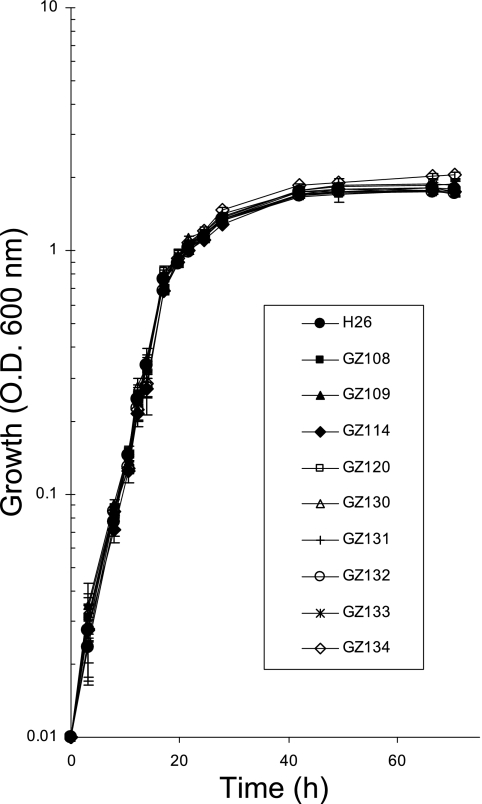
FIG. 1.
FIG. 1.
H. volcanii proteasomal mutant strains display growth rates and cell yields similar to that of parent strain H26 on complex YPC medium. Growth at 42°C (200 rpm) was monitored by an increase in OD600, where 1 unit was approximately 1 × 10⁹ CFU per ml for all strains.
FIG. 2.
FIG. 2.
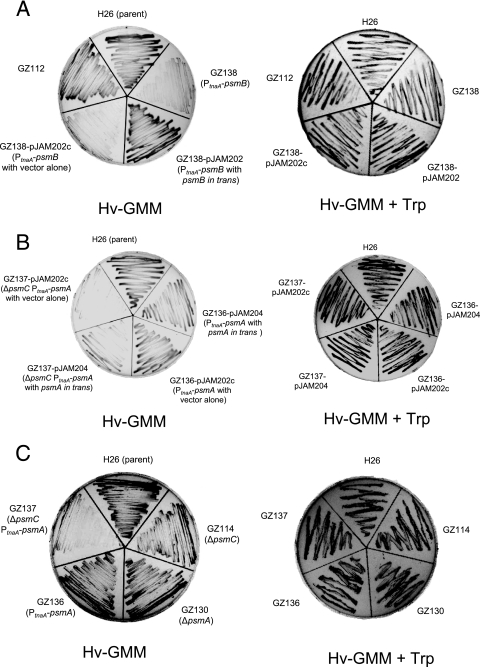
20S proteasomes are required for growth of H. volcanii. H. volcanii strains were grown on solid GMM supplemented with 2.5 mM tryptophan. Cells were transferred by loop to solid GMM with or without 2.5 mM tryptophan (Hv-GMM + Trp or Hv-GMM, respectively) and grown at 42°C as indicated. See Table 1 for strain genotype details.
FIG. 3.
FIG. 3.
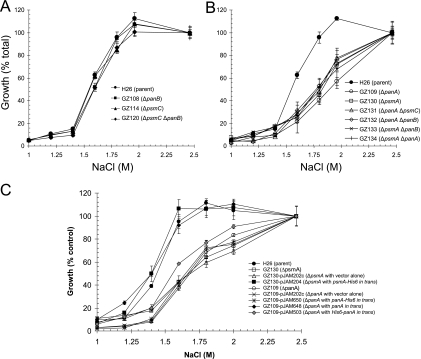
Strains deficient in 20S proteasomal α1 or PanA are sensitive to hypo-osmotic stress. Growth of H. volcanii parent (H26) and proteasomal mutant strains in GMM-Ala with NaCl concentrations as indicated and described in Materials and Methods was determined. Growth is represented as a percentage relative to growth for that strain at 2.46 M NaCl (100% growth was 0.92 to 1.36 × 10⁹ CFU·ml−1). Experiments and plating were performed in triplicate and the mean ± standard deviation (SD) was calculated.
FIG. 4.
FIG. 4.
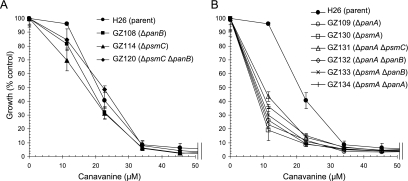
Strains deficient in 20S proteasomal α1 or PanA are sensitive to the amino acid analogue l-canavanine. Growth of H. volcanii parent (H26) and proteasomal mutant strains in GMM-Ala supplemented with l-canavanine as indicated and described in Materials and Methods was determined. Growth is represented as a percentage relative to growth at 0 μM canavanine (100% growth similar to that for Fig. 3). Experiments were performed in triplicate and the mean ± SD was calculated.
FIG. 5.
FIG. 5.
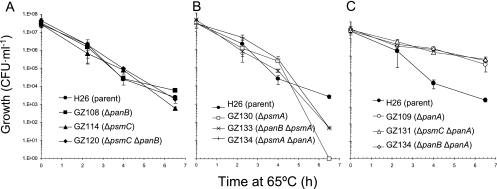
Strains deficient in 20S proteasomal α1 are sensitive to heat stress, whereas strains deficient in PanA are “superthermotolerant.” Parent (H26) and proteasomal mutant strains were grown to log phase at 42°C in GMM-Ala. Cells were diluted to an OD600 of 0.04 units and the effects of heat on cell viability were measured by a shift to 65°C (see Materials and Methods for details). Aliquots of cells were removed at 0-, 2-, 4-, 6-, and 8-h intervals. Cells were diluted, plated on GMM-Ala, and incubated at 42°C for 5 days. Experiments were performed in triplicate and the mean ± SD was calculated.

References

    1. Allers, T., and M. Mevarech. 2005. Archaeal genetics—the third way. Nat. Rev. Genet. 658-73. - PubMed
    1. Allers, T., H. P. Ngo, M. Mevarech, and R. G. Lloyd. 2004. Development of additional selectable markers for the halophilic archaeon Haloferax volcanii based on the leuB and trpA genes. Appl. Environ. Microbiol. 70943-953. - PMC - PubMed
    1. Baumeister, W., J. Walz, F. Zühl, and E. Seemüller. 1998. The proteasome: paradigm of a self-compartmentalizing protease. Cell 92367-380. - PubMed
    1. Bolhuis, H. H., P. P. Palm, A. A. Wende, M. M. Falb, M. M. Rampp, F. F. Rodriguez-Valera, F. F. Pfeiffer, and D. D. Oesterhelt. 2006. The genome of the square archaeon Haloquadratum walsbyi: life at the limits of water activity. BMC Genomics 7169. - PMC - PubMed
    1. Dyall-Smith, M. 2008. The Halohandbook: protocols for halobacterial genetics, p. 67. http://www.haloarchaea.com/resources/halohandbook/Halohandbook_2008_v7.pdf.

Publication types

MeSH terms

LinkOut - more resources