. 2008 Oct 28;105(43):16761-6.
doi: 10.1073/pnas.0808608105. Epub 2008 Oct 17.

The potential of desferrioxamine-gallium as an anti-Pseudomonas therapeutic agent

Affiliations

The potential of desferrioxamine-gallium as an anti-Pseudomonas therapeutic agent

Ehud Banin et al. Proc Natl Acad Sci U S A. .

Abstract

The opportunistic pathogen Pseudomonas aeruginosa causes infections that are difficult to treat by antibiotic therapy. This bacterium can cause biofilm infections where it shows tolerance to antibiotics. Here we report the novel use of a metallo-complex, desferrioxamine-gallium (DFO-Ga) that targets P. aeruginosa iron metabolism. This complex kills free-living bacteria and blocks biofilm formation. A combination of DFO-Ga and the anti-Pseudomonas antibiotic gentamicin caused massive killing of P. aeruginosa cells in mature biofilms. In a P. aeruginosa rabbit corneal infection, topical administration of DFO-Ga together with gentamicin decreased both infiltrate and final scar size by about 50% compared to topical application of gentamicin alone. The use of DFO-Ga as a Trojan horse delivery system that interferes with iron metabolism shows promise as a treatment for P. aeruginosa infections.


Conflict of interest statement

The authors declare no conflict of interest.

Figures
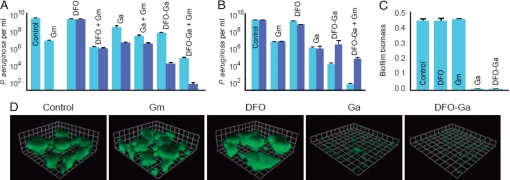
Fig. 1.
Fig. 1.
DFO-Ga is effective against P. aeruginosa stationary phase cells and blocks biofilm formation. (A) Survival of P. aeruginosa stationary phase cells treated for 24 h with desferrioxamine (DFO), gentamicin (Gm), gallium (Ga), desferrioxamine-gallium complex (DFO-Ga), or combinations of these agents as indicated. The concentrations used for each compound were 0.1 mM (light blue) or 1 mM (dark blue) for DFO, Ga, or DFO-Ga, and 10 μg per ml for Gm. (B) Survival of a P. aeruginosa mutant with defects in the two putative metallo-DFO receptor systems (see Materials and Methods). These experiments were performed as described for A, at the 1 mM concentration. The wild-type parent is light blue and the double mutant, dark blue. (C) Biofilm growth (18 h) in polyvinylchloride microtiter dish wells with the indicated compounds (concentrations were 0.001 mM for DFO, Ga, and DFO-Ga, and 0.1 μg/ml for Gm). Attached biofilm biomass was determined by measuring crystal violet binding. (D) Biofilm formation in flow cells with subinhibitory concentrations of DFO (0.001 mM), Ga (0.001 mM), DFO-Ga (0.001 mM), or Gm (0.1 μg/ml). Shown are 3D-reconstructed confocal microscope images of six-day biofilms grown in the presence of the indicated agent (a side of each square on the grids is 23 μm). P. aeruginosa cells are expressing GFP.
Fig. 2.
Fig. 2.
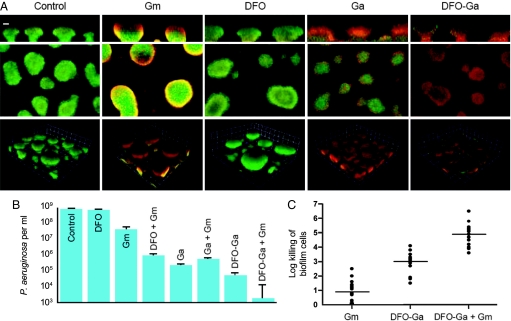
DFO-Ga kills cells in established biofilms of P. aeruginosa PAO1 and other clinical isolates of P. aeruginosa. (A) Survival of P. aeruginosa in mature biofilms treated with Gm (50 μg/ml), DFO (1 mM), Ga (1 mM), or DFO-Ga (1 mM). Six-day-old biofilms were treated for 24 h and stained with propidum iodide. Live cells are shown in green, and dead cells are red. The top images are saggital reconstructions, the middle images horizontal sections, and the bottom images 3D reconstructions. The marker bar on the top left image is 25 μm. The images on the top and middle panels are at the same magnification. For the bottom images, the squares are 23 μm on each side. (B) Spinning disk reactor biofilms were treated for 24 h with either DFO, Ga, DFO-Ga (each at 1 mM), or 50 μg/ml Gm. (C) P. aeruginosa clinical isolates from eyes, wounds and sputum from CF patients with chronic P. aeruginosa infections were grown as biofilms and treated for 24 h with Gm (50 μg/ml), DFO-Ga (1 mM) or combination of both. The horizontal lines represent means, all experiments were carried out in duplicates.
Fig. 3.
Fig. 3.
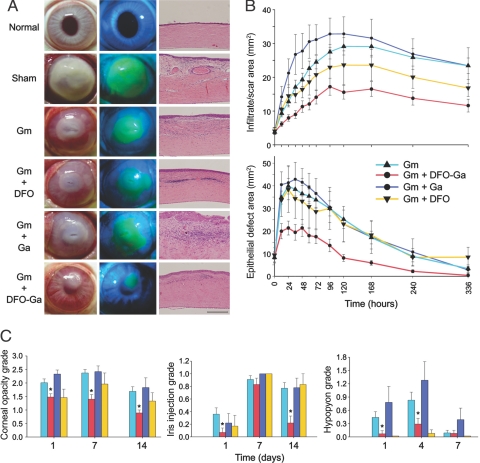
DFO-Ga reduces severity of keratitis in a rabbit infection model. (A) Representative images of P. aeruginosa infected corneas following different treatment regimens. (Left column) Photographs showing the extent of infection and infiltrate 96 h after treatment initiation. (Middle column) Fluorescein-staining of the same eyes showing the extent of epithelial injury. (Right column) Histopathology of corneas from the different experimental groups (bar is 250 μm). (B) Combined treatment of Gm plus DFO-Ga markedly reduces keratitis progression. (Top) Extent and evolution of corneal infiltrate and (bottom) epithelial defect over time in the different treatment groups (sham group progression depicted in supporting information Fig. S3). Eyes treated with Gm plus DFO-Ga fared better than eyes treated with Gm alone at all time points. The other treatment groups did not significantly differ from Gm alone. Each point represents mean area ± SEM. The method of quantification and number of eyes at each point are detailed in Table S1 and Fig. S1. (C) Disease severity parameters are reduced in Gm plus DFO-Ga treated eyes. (Left) Corneal opacity, (Middle) Iris injection and (Right) Hypopyon level. Numbers of eyes graded at each time point are detailed in Table S1. Asterisks denote a statistically significant difference between Gm+DFO-Ga and Gm alone. Bars represent means ± SEM.

References

    1. Costerton JW, Stewart PS, Greenberg EP. Bacterial biofilms: A common cause of persistent infections. Science. 1999;284:1318–1322. - PubMed
    1. O'Toole G, Kaplan HB, Kolter R. Biofilm formation as microbial development. Annu Rev Microbiol. 2000;54:49–79. - PubMed
    1. Davies D. Understanding biofilm resistance to antibacterial agents. Nat Rev Drug Discov. 2003;2:114–122. - PubMed
    1. Kaneko Y, Thoendel M, Olakanmi O, Britigan BE, Singh PK. The transition metal gallium disrupts Pseudomonas aeruginosa iron metabolism and has antimicrobial and antibiofilm activity. J Clin Invest. 2007;117:877–888. - PMC - PubMed
    1. Rasmussen TB, Givskov M. Quorum-sensing inhibitors as anti-pathogenic drugs. Int J Med Microbiol. 2006;296:149–161. - PubMed

Publication types