


Review
doi: 10.1038/onc.2008.301.
JNK signaling in apoptosis
Affiliations
- PMID: 18931691
- PMCID: PMC3063296
- DOI: 10.1038/onc.2008.301
Item in Clipboard
Review
JNK signaling in apoptosis
Oncogene.
.
Abstract
Jun N-terminal kinases or JNKs play a critical role in death receptor-initiated extrinsic as well as mitochondrial intrinsic apoptotic pathways. JNKs activate apoptotic signaling by the upregulation of pro-apoptotic genes through the transactivation of specific transcription factors or by directly modulating the activities of mitochondrial pro- and antiapoptotic proteins through distinct phosphorylation events. This review analyses our present understanding of the role of JNK in apoptotic signaling and the various mechanisms by which JNK promotes apoptosis.
Figures
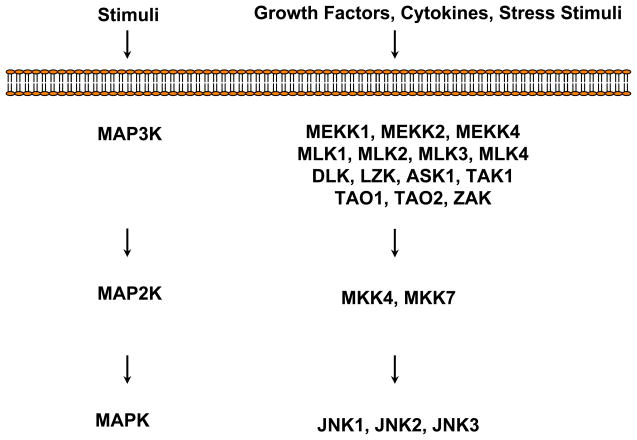
At least fourteen MAP3Ks have been shown to activate the MAP2Ks MKK4 and/or MKK7. MKK4 can activate JNKs as well as p38MAPKs (not shown), whereas MKK7 specifically activates JNKs. MKK4 and MKK7 can activate all of the three isoforms of JNKs by phosphorylating the Thr- and Tyr-residues of the TXY motif.
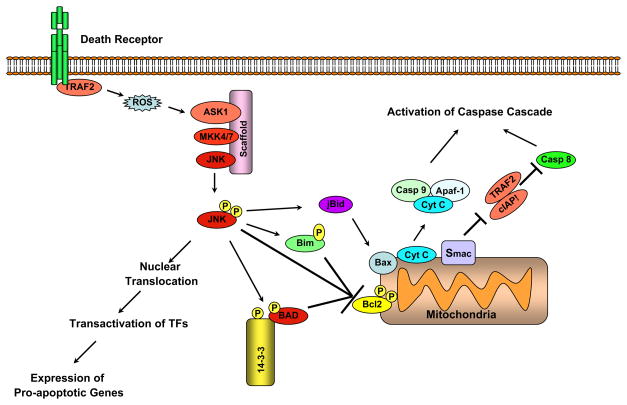
JNK can promote apoptosis by two distinct mechanisms. In the first mechanism targeted at the nuclear events, activated JNK translocated to nucleus and transactivates c-Jun and pother target transcription factors (TF). JNK can promote apoptosis by increasing the expression of pro-apoptotic genes via the transactivation of c-Jun/AP1 dependent or p53/73-protein dependent mechanisms (see text for details). In pathways directed at mitochondrial apoptotic proteins, activated JNK translocates to mitochondria. There, JNK can phosphorylate BH3-only family of Bcl2 proteins to antagonize the anti-apoptotic activity of Bcl2 or Bcl Xl. In addition JNK can stimulate the release cytochrome C (Cyt C) from mitochondrial inner membrane via Bid-Bax dependent mechanism, promoting the formation of apaptosomes consisting of cytochrome C, caspase-9 (Casp 9), and Apaf-1. This complex initiates the activation of caspase-9 dependent caspase cascade. In another mechanism JNK can promote the release of Smac/Diablo (Smac) that can inhibit the TRAF2/IAP1 inhibitory complex, thereby relieving the inhibition on caspase-8 to initiate caspase activation. In addition by phosphorylating BAD and it sequestering partner 14-3-3, JNK can promote BAD-mediated neutralization of Bcl2 family of anti-apoptotic proteins. Finally, JNK can phosphorylate Bcl2 to suppress its anti-apoptotic activity (see text for details). These nuclear and mitochondrial events regulated by JNK need not be mutually exclusive.
References
-
- Aoki H, Kang PM, Hampe J, Yoshimura K, Noma T, Matsuzaki M, Izumo S. Direct activation of mitochondrial apoptosis machinery by c-Jun N-terminal kinase in adult cardiac myocytes. J Biol Chem. 2002;277:10244–10250. - PubMed
-
- Behrens A, Sibilia M, Wagner EF. Amino-terminal phosphorylation of c-Jun regulates stress-induced apoptosis and cellular proliferation. Nat Genet. 1999;21:326–329. - PubMed
-
- Björkblom B, Vainio JC, Hongisto V, Herdegen T, Courtney MJ, Coffey ET. All JNKs Can Kill, but Nuclear Localization Is Critical for Neuronal Death. J Biol Chem. 2008;283:19704–19713. - PubMed
-
- Bossy-Wetzel E, Green DR. Caspases induce cytochrome c release from mitochondria by activating cytosolic factors. J Biol Chem. 1999;274:17484–17490. - PubMed
Publication types
MeSH terms
Substances
Grants and funding
LinkOut - more resources
Full Text Sources
Other Literature Sources
Research Materials
Miscellaneous
