. 2009 Jan;29(1):129-39.
doi: 10.1128/MCB.00963-08. Epub 2008 Oct 20.

Novel proteolytic processing of the ectodomain of the zinc transporter ZIP4 (SLC39A4) during zinc deficiency is inhibited by acrodermatitis enteropathica mutations

Affiliations

Novel proteolytic processing of the ectodomain of the zinc transporter ZIP4 (SLC39A4) during zinc deficiency is inhibited by acrodermatitis enteropathica mutations

Taiho Kambe et al. Mol Cell Biol. 2009 Jan.

Abstract

The zinc transporter ZIP4 (SLC39A4) is mutated in humans with the rare, autosomal recessive genetic disease acrodermatitis enteropathica. In mice, this gene is essential during early embryonic development. ZIP4 is dynamically regulated by multiple posttranscriptional mechanisms, and studies of mouse ZIP4 reported herein reveal that the ectodomain, the extracellular amino-terminal half of the protein, is proteolytically removed during prolonged zinc deficiency while the remaining eight-transmembrane carboxyl-terminal half of the protein is accumulated on the plasma membrane as an abundant form of ZIP4. This novel ZIP4 processing occurs in vivo in the intestine and visceral endoderm, in mouse Hepa cells that express the endogenous Slc39a4 gene and in transfected MDCK and CaCo2 cells, but not HEK293 cells. In transfected MDCK and CaCo2 cells, the ectodomain accumulated and remained associated with membranes when zinc was deficient. ZIP4 cleavage was attenuated by inhibitors of endocytosis, which suggests that the processed protein is recycled back to the plasma membrane and that the ectodomain may be internalized. Ectodomain cleavage is inhibited by acrodermatitis enteropathica mutations near a predicted metalloproteinase cleavage site which is also essential for proper ectodomain cleavage, and overexpression of processed ZIP4 or ZIP4 with ectodomain truncations rendered the mouse Mt1 gene hypersensitive to zinc. These finding suggest that the processing of ZIP4 may represent a significant regulatory mechanism controlling its function.


Figures
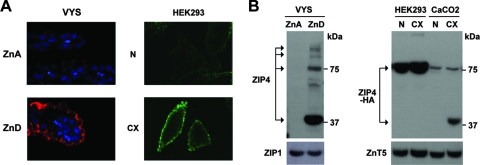
FIG. 1.
FIG. 1.
ZIP4 is processed in the VYS and in transfected CaCo2 cells but not in transfected HEK293 cells during zinc deficiency. (A) Immunofluorescence localization of endogenous ZIP4 in the embryonic mouse VYS and in transfected HEK293 cells. Pregnant mice were fed a zinc-adequate diet (ZnA) or a zinc-deficient diet (ZnD) beginning on day 8 of pregnancy, and the VYS was recovered on day 14 and processed for detection of ZIP4 using an anti-peptide antibody directed against the large intracellular loop of ZIP4 (Fig. 5A). The methods employed and these results have been described in detail previously (2, 33). Red fluorescence indicates the localization of ZIP4, whereas nuclei are stained with DAPI (4′,6′-diamidino-2-phenylindole; blue). HEK293 cells were transfected with a mouse ZIP4-HA expression vector and cultured in medium containing either 10% normal FBS (N) or 10% Chelex-treated FBS (CX) for 48 h. Cells were processed for detection of ZIP4-HA without permeabilization using an anti-HA antibody. Green fluorescence indicates the localization of ZIP4-HA. (B) Western blot detection of ZIP4 in the ZnA and ZnD VYS and in transfected HEK293 and CaCo2 cells incubated in medium containing normal 10% FBS or Chelex-treated FBS. Membrane proteins were isolated and analyzed by Western blotting using an anti-peptide antibody against ZIP4 (VYS) or an anti-HA antibody (HEK293 and CaCo2). ZIP1 and ZnT5 are shown as loading controls.
FIG. 2.
FIG. 2.
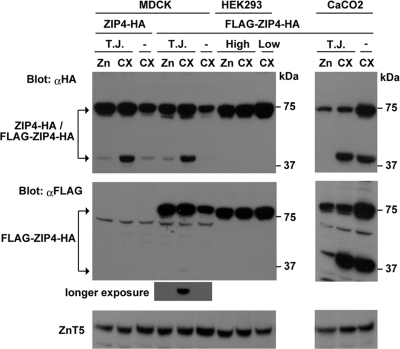
ZIP4 processing in transfected MDCK and CaCo2 cells is enhanced during zinc deficiency, and the ectodomain is specifically cleaved and internalized. Pools of stably transformed MDCK cells expressing ZIP4 with a carboxyl-terminal HA tag (ZIP4-HA) or MDCK, CaCo2, and HEK293 cells expressing ZIP4 with an amino-terminal FLAG tag and a carboxyl-terminal HA tag (FLAG-ZIP4-HA) were examined (Fig. 5A). Transfected cells were cultured in medium containing 10% Chelex-treated FBS (CX) or 10% Chelex-treated FBS to which 4 μM ZnSO4 was added prior to culture (Zn). Cells were examined when subconfluent (−) for 24 h in CX medium or after they formed tight junctions (TJ) when confluent for 4 days. HEK293 cells were cultured under high- or low-confluence conditions. ZIP4 was detected by Western blot analysis of total cellular proteins using an anti-HA (αHA) antibody and an anti-FLAG (αFLAG) antibody. Total cellular lysate was analyzed for CaCo2 cells (middle panel at right) using an anti-FLAG antibody which revealed a major ∼35-kDa band from the amino-terminal ectodomain. A band of the same size was detected in MDCK cells after a longer exposure of the membrane. ZnT5 is shown as a loading control (lower panels).
FIG. 3.
FIG. 3.
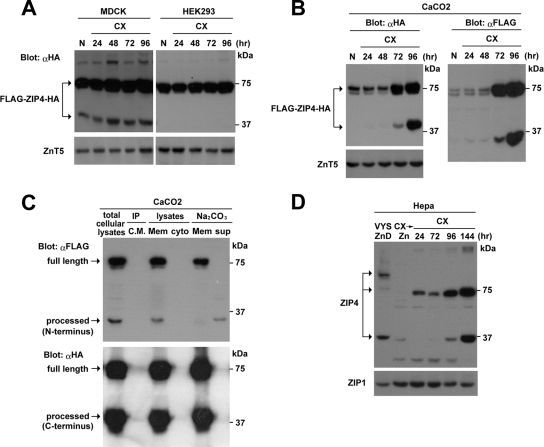
ZIP4 processing is induced in zinc-deficient medium in transfected cells and in mouse Hepa cells which express the endogenous Slc39a4 gene, and the ectodomain is loosely associated with cellular membranes. (A) Pools of stably transformed MDCK and HEK293 cells expressing FLAG-ZIP4-HA were cultured in medium containing either 10% normal FBS (N) for 24 h or 10% Chelex-treated FBS (CX) for the indicated times (24 to 96 h). MDCK cells were examined after forming tight junctions. Western blot analysis was performed using 20 μg of total cellular protein and an anti-HA antibody (αHA). ZnT5 is shown as a control. (B) Pools of stably transformed CaCo2 cells expressing FLAG-ZIP4-HA were cultured in medium containing either 10% normal FBS (N) for 24 h or 10% Chelex-treated FBS (CX) for the indicated times (24 to 96 h). Cells were examined after forming tight junctions. Western blot analysis was performed using total cellular protein (20 μg) and either an anti-HA antibody (αHA) or an anti-FLAG antibody (αFLAG). ZnT5 is shown as a control. (C) CaCo2 cells expressing FLAG-ZIP4-HA were cultured for 48 h in medium containing 10% Chelex-treated FBS, and ZIP4 was detected by Western blotting using anti-FLAG antibody (αFLAG) and anti-HA antibody (αHA). The culture medium (CM) was collected and immunoprecipitated (IP) using the anti-FLAG antibody. Membrane (Mem) and cytosolic (Cyto) fractions from these cells were prepared and subjected to Western blotting; the membrane fraction was extracted in Na2CO3, and the pellet and extract were also analyzed. (D) Mouse Hepa cells were cultured in medium containing 10% Chelex-treated FBS (CX) for the indicated times (24 to 144 h) or cultured for 28 h in 10% Chelex-treated FBS to which 4 μM zinc was added for the last 4 h (CX→Zn). In addition, lane 1 contains a sample of VYS membrane proteins from zinc-deficient (ZnD) pregnant mice as described in the legend of Fig. 1. Western blots were performed using membrane protein (20 μg) and an anti-peptide ZIP4 antibody directed against the intracellular loop between transmembrane domains III and IV of ZIP4 to detect endogenous ZIP4 peptides (Fig. 5). ZIP1 is shown as a control.
FIG. 4.
FIG. 4.
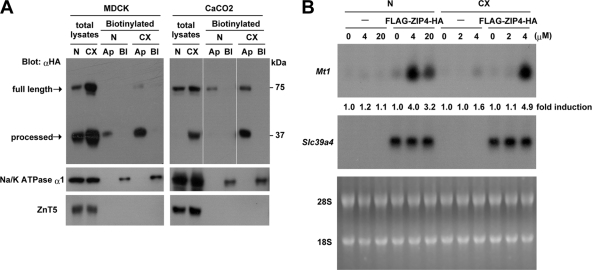
The processed ZIP4 carboxyl-terminal domain preferentially accumulates in the apical membrane in MDCK and CaCo2 cells, and these cells show a dramatically decreased dose response for zinc induction of Mt1 expression. (A) Pools of stably transfected MDCK and CaCo2 cells expressing FLAG-ZIP4-HA were grown in transwell plates until polarized and then cultured in medium containing either 10% normal FBS (N) or 10% Chelex-treated FBS (CX) for 48 h before cell surface biotinylation assays were performed. The biotinylation reagent (sulfo-NHS-SS-biotin) was added to either the apical (Ap) or basolateral (Bl) compartment of the transwell plate, as described in Materials and Methods. Solubilized proteins were captured using streptavidin beads and analyzed by Western blotting using an anti-HA antibody (αHA). Total lysates refers to aliquots of the input biotinylated proteins from the apical surface before avidin capture. The processed carboxyl-terminal peptide of ZIP4 was preferentially biotinylated in the apical membrane. ZnT5 and NaK-ATPase α1 antisera were used as controls for input and for efficiency of basolateral membrane biotinylation, respectively. (B) Nontransfected control MDCK cells (−) and pools of MDCK cells stably transfected with the FLAG-ZIP4-HA expression vector were cultured for 48 h in medium containing either 10% normal FBS (N) or 10% Chelex-treated FBS (CX). Cells were then treated from the apical chamber with the indicated concentrations of ZnSO4 (0 to 20 μM) for 6 h. Total RNA (20 μg) was isolated and fractionated by formaldehyde-agarose gel electrophoresis, transferred to nylon membranes, and hybridized with mouse Mt1 and Slc39a4 cRNA probes. Hybrids were detected by autoradiography. Gels were stained with acridine orange as a control for RNA integrity and loading (bottom panel). The relative abundance of Mt1 mRNA without zinc was defined as 1.0-fold induction, and the change in induction relative to that sample is shown below each lane (top panel).
FIG. 5.
FIG. 5.
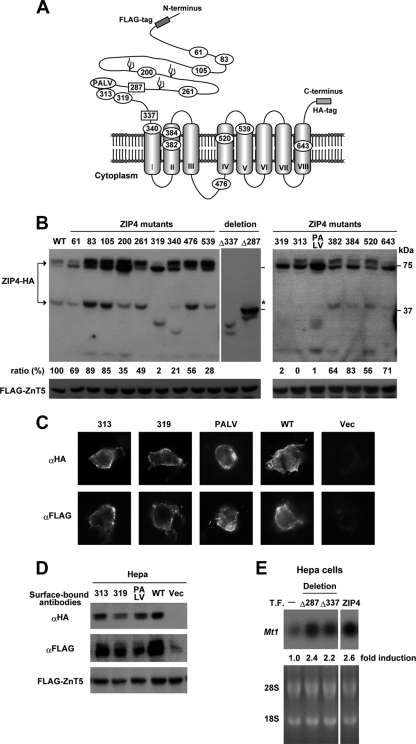
During zinc deficiency, the ectodomain of ZIP4 is cleaved just before the first transmembrane domain, and cleavage is inhibited by AE mutations near a predicted metalloproteinase cleavage site motif. (A) A cartoon of the predicted membrane topology of ZIP4 is shown with eight transmembrane domains, the large extracellular ectodomain, and the large intracellular loop between transmembrane domains III and IV. The locations of FLAG and HA tags are shown, and the anti-peptide antibody against ZIP4 was raised against a peptide from the large intracellular loop. The FLAG tag was inserted just upstream of N26 in ZIP4-HA. The positions of AE mutations (10, 12, 17, 20, 32) studied in this work are indicated, as is the PALV sequence which may represent a metalloproteinase cleavage site. The extracellular localization of the ectodomain was confirmed herein as shown below in panels C and D. (B) Hepa cells were transfected with expression vectors for wild-type ZIP4-HA or the indicated ZIP4-HA mutants. The expression vector for FLAG-ZnT5 was cotransfected as a transfection control. After transfection, Hepa cells were cultured in medium containing 10% normal FBS for 24 h. The overexpression of ZIP4 in these transfection assays led to increased accumulation of processed wild-type ZIP4 in cells cultured in medium containing normal levels of zinc. Western blotting was performed using total cellular protein (20 μg) and an anti-HA antibody for ZIP4-HA. Most of the ZIP4 mutants used here correspond to those found in human AE patients. The numbers shown indicate the residue mutated in mouse ZIP4-HA. Mutations introduced in mouse ZIP4 were as follows (corresponding residues in the human sequence are indicated in parentheses): C61R (C62R), P83L (P84L), N105K (N106K), P200L (P200L), Q261W (R251W), C319Y (C309Y), G340D (G330D), K476A (K463A), G539R (G526R), Q313H (Q303H), L382P (L372P), G384R (G374R), H520A (H507A), and G643R (G630R). The K476 residue is a putative ubiquitination site which was mutated to alanine in the large intracellular loop. The PALV oval indicates mutation of the 308PALV311 sequence to 308ESLY311. Amino-terminal deletion mutants (Δ337 and Δ287) are indicated by the terminal amino acid remaining after the deleted portion of ZIP4. The Δ287 mutant has a deletion of residues 1 to 286, and residue 287 is methionine. The Δ337 mutant has a deletion of residues 1 to 336 just before the first transmembrane domain, and methionine was added by fusing the MEVLLGVKIGC leader peptide to the N terminus. The predicted mobility of the Δ287 mutant of ZIP4 is indicated by an asterisk. It should be noted that the 319, 313, and PALV mutants showed almost no properly processed ZIP4 peptide although smaller ZIP4 peptides were detected. An estimation of the relative efficiency of processing in each sample is shown below the top panel. FLAG-ZnT5 is shown as a control for transfection efficiency. (C) The 313, 319, and PALV mutants of ZIP4 were expressed in Hepa cells, and their localization on the cell surface was examined by immunofluorescence microscopy of fixed, nonpermeabilized cells using anti-HA (αHA) and anti-FLAG (αFLAG) antibodies. (D) The extracellular localization of the amino and carboxyl termini of the 313, 319, and PALV mutants of ZIP4 expressed in Hepa cells was examined by Western blot detection of surface-bound antibodies using a horseradish peroxidase-conjugated anti-immunoglobulin G antibody. Transfected Hepa cells were fixed and then incubated with anti-HA or anti-FLAG antibodies. After removal of unbound antibodies, the bound antibodies were solubilized and then detected by Western blotting. Vec, cells transfected with the empty vector. WT, wild type. FLAG-ZnT5 is shown as a control for transfection efficiency. (E) Hepa cells were not transfected (T.F.−) or transfected with the ZIP4-HA expression vector (ZIP4) or vectors expressing amino-terminal deletion mutants of ZIP4-HA (Δ287 and Δ337). Cells were cultured in medium containing 10% normal FBS for 24 h and then treated with ZnSO4 (4 μM) for 6 h before Northern blot analysis and quantification of relative levels of Mt1 mRNA.
FIG. 6.
FIG. 6.
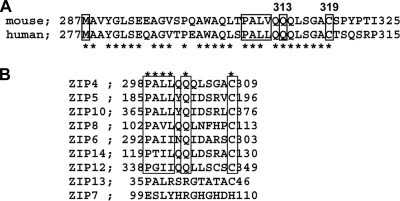
Conservation of amino acids encompassing the PALV motif in human and mouse ZIP4 and conservation of this potential metalloproteinase cleavage site among several human LIV-1 subfamily members. (A) Alignment of the amino acid sequences of human and mouse ZIP4 in the region of the ectodomain near the predicted start of the first transmembrane domain. Residues we mutated in mouse ZIP4 are indicated by rectangles over the PALV, Q313, and C319 residues. Conserved amino acids are indicated by an asterisk. (B) Alignment of the amino acid sequence around a PALL motif in several human LIV-1 subfamily members. The accession numbers for the sequences used for the alignment are as follows: NP_570901 for ZIP4, NP_775867 for ZIP5, NP_065075 for ZIP10, NP_071437 for ZIP8, NP_036451 for ZIP6, NP_001121903 for ZIP14, NP_689938 for ZIP12, NP_689477 for ZIP13, and NP_008910 for ZIP7. Amino acids consistent with a putative metalloproteinase cleavage motif are boxed, and the asterisks above indicate identity or a conservative change in that amino acid within the motif.
FIG. 7.
FIG. 7.
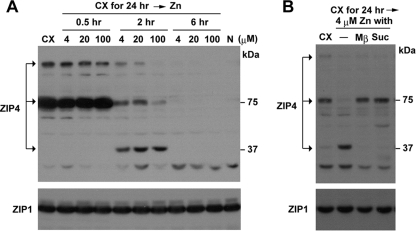
The processing and degradation of ZIP4 are regulated by zinc and require endocytosis. (A) Hepa cells cultured in medium containing 10% Chelex-treated FBS (CX) for 24 h were treated with the indicated concentrations of ZnSO4 (4, 20, or 100 μM) for the indicated times (0.5 to 6 h). Membrane proteins (20 μg) were analyzed by Western blotting using an anti-peptide ZIP4 antibody (top) or a ZIP1 antibody (bottom). Lane N, cells cultured in medium containing normal FBS. (B) Hepa cells were cultured in zinc-deficient medium as in panel A, treated with the indicated inhibitors for 30 min or not treated (−) and then incubated with 4 μM ZnSO4 for 2 h in the presence of inhibitor. Western blotting of membrane proteins (20 μg) was performed using an anti-peptide ZIP4 antibody (top) or a ZIP1 antibody (bottom). Endocytosis inhibitors used were as follows: Mβ, 10 mM methyl-β-cyclodextrin; Suc, 350 mM sucrose.

References

    1. Chen, E. I., S. J. Kridel, E. W. Howard, W. Li, A. Godzik, and J. W. Smith. 2002. A unique substrate recognition profile for matrix metalloproteinase-2. J. Biol. Chem. 2774485-4491. - PubMed
    1. Dufner-Beattie, J., Y. M. Kuo, J. Gitschier, and G. K. Andrews. 2004. The adaptive response to dietary zinc in mice involves the differential cellular localization and zinc-regulation of the zinc transporters ZIP4 and ZIP5. J. Biol. Chem. 27949082-49090. - PubMed
    1. Dufner-Beattie, J., S. J. Langmade, F. Wang, D. Eide, and G. K. Andrews. 2003. Structure, function, and regulation of a subfamily of mouse zinc transporter genes. J. Biol. Chem. 27850142-50150. - PubMed
    1. Dufner-Beattie, J., F. Wang, Y. M. Kuo, J. Gitschier, D. Eide, and G. K. Andrews. 2003. The acrodermatitis enteropathica gene ZIP4 encodes a tissue-specific, zinc-regulated zinc transporter in mice. J. Biol. Chem. 27833474-33481. - PubMed
    1. Dufner-Beattie, J., B. P. Weaver, J. Geiser, M. Bilgen, M. Larson, W. Xu, and G. K. Andrews. 2007. The mouse acrodermatitis gene Slc39a4 (ZIP4) is essential for development and heterozygosity causes hypersensitivity to zinc deficiency. Hum. Mol. Genet. 161391-1399. - PubMed

Publication types

MeSH terms