


Clinical outcome and predictors of survival in late relapse of germ cell tumor
- PMID: 18936477
- PMCID: PMC2651099
- DOI: 10.1200/JCO.2007.15.7453
Clinical outcome and predictors of survival in late relapse of germ cell tumor
Abstract
Purpose: Late relapse (LR) of germ cell tumor (GCT) is a well recognized entity associated with poor survival. We report on our experience with LR and determine predictors of survival.
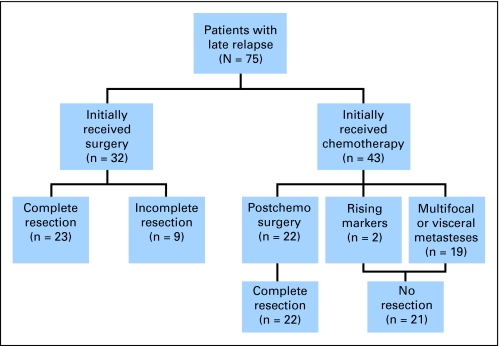
Patients and methods: From 1990 to 2004, 75 patients were managed for LR of GCT at our institution. Clinical and pathologic parameters were reviewed. Estimates of cancer-specific survival were generated using the Kaplan-Meier method, and a Cox proportional hazards model was used to assess potential predictors of outcome.
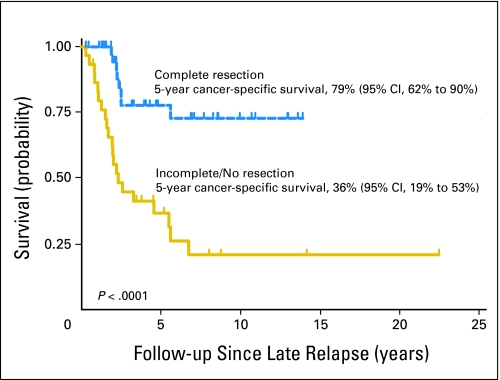
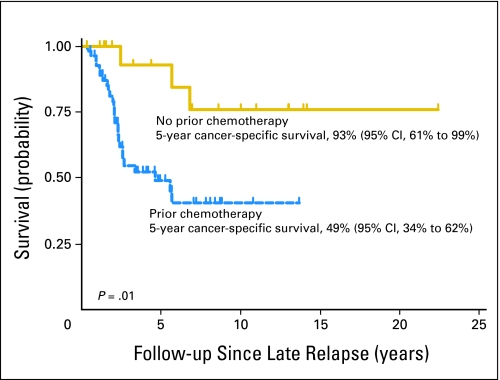
Results: The median time to LR was 6.9 years (range, 2.1 to 37.7 years). Overall, 56 patients (75%) had LR in the retroperitoneum, including 25 (93%) of 27 patients initially managed without retroperitoneal lymph node dissection. The 5-year cancer-specific survival (CSS) was 60% (95% CI, 46% to 71%). Patients who underwent complete surgical resection at time of LR (n = 45) had a 5-year CSS of 79% versus 36% for patients without complete resection (n = 30; P < .0001). The 5-year CSS for chemotherapy-naive patients was significantly greater than patients with a prior history of chemotherapy as part of their initial management (5-year CSS, 93% v 49%, respectively). In multivariable analysis of pretreatment parameters available at the time of LR, the presence of symptoms (hazard ratio [HR] = 4.9) and multifocal disease (HR = 3.0) were associated with an inferior CSS.
Conclusion: The data suggest that meticulous control of the retroperitoneum is critical to prevent LR in the retroperitoneum. In multivariable analysis, patients with a symptomatic presentation and those with multifocal disease have a significantly decreased survival. Survival is greatly improved if complete surgical excision of disease is attained.
Figures
Comment in
-
Clinical relevance of "late" in the management of late relapse after treatment for a germ cell tumor.J Clin Oncol. 2008 Dec 1;26(34):5502-3. doi: 10.1200/JCO.2008.18.7120. Epub 2008 Oct 20. J Clin Oncol. 2008. PMID: 18936469 No abstract available.
References
-
- Baniel J, Foster RS, Gonin R, et al: Late relapse of testicular cancer. J Clin Oncol 13:1170-1176, 1995 - PubMed
-
- Gerl A, Clemm C, Schmeller N, et al: Late relapse of germ cell tumors after cisplatin-based chemotherapy. Ann Oncol 8:41-47, 1997 - PubMed
-
- Shahidi M, Norman AR, Dearnaley DP, et al: Late recurrence in 1263 men with testicular germ cell tumors: Multivariate analysis of risk factors and implications for management. Cancer 95:520-530, 2002 - PubMed
-
- George DW, Foster RS, Hromas RA, et al: Update on late relapse of germ cell tumor: A clinical and molecular analysis. J Clin Oncol 21:113-122, 2003 - PubMed
-
- Dieckmann KP, Albers P, Classen J, et al: Late relapse of testicular germ cell neoplasms: A descriptive analysis of 122 cases. J Urol 173:824-829, 2005 - PubMed
Publication types
MeSH terms
Grants and funding
LinkOut - more resources
Full Text Sources
Medical
