


Age-specific incidence of cancer: Phases, transitions, and biological implications
- PMID: 18936480
- PMCID: PMC2570975
- DOI: 10.1073/pnas.0801151105
Age-specific incidence of cancer: Phases, transitions, and biological implications
Abstract
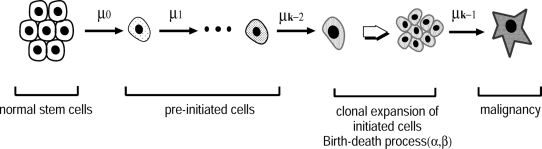
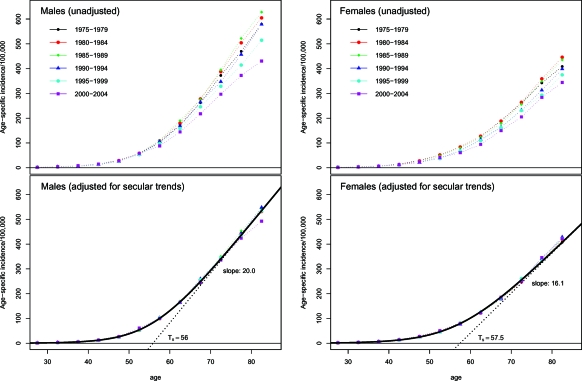
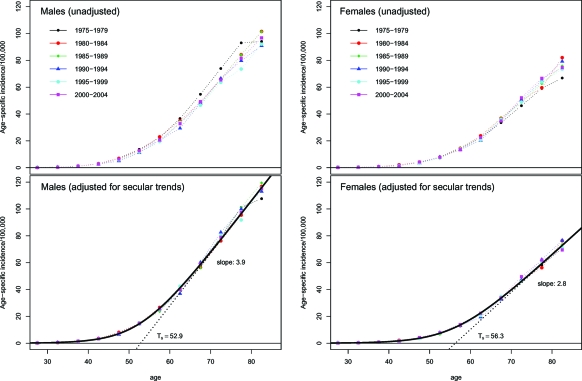
The observation that the age-specific incidence curve of many carcinomas is approximately linear on a double logarithmic plot has led to much speculation regarding the number and nature of the critical events involved in carcinogenesis. By a consideration of colorectal and pancreatic cancers in the Surveillance Epidemiology and End Results (SEER) registry we show that the log-log model provides a poor description of the data, and that a much better description is provided by a multistage model that predicts two basic phases in the age-specific incidence curves, a first exponential phase until the age of approximately 60 followed by a linear phase after that age. These two phases in the incidence curve reflect two phases in the process of carcinogenesis. Paradoxically, the early-exponential phase reflects events between the formation (initiation) of premalignant clones in a tissue and the clinical detection of a malignant tumor, whereas the linear phase reflects events leading to initiated cells that give rise to premalignant lesions because of abrogated growth/differentiation control. This model is consistent with Knudson's idea that renewal tissue, such as the colon, is converted into growing tissue before malignant transformation. The linear phase of the age-specific incidence curve represents this conversion, which is the result of recessive inactivation of a gatekeeper gene, such as the APC gene in the colon and the CDKN2A gene in the pancreas.
Conflict of interest statement
The authors declare no conflict of interest.
Figures
References
-
- Muller HJ. Radiation damage to the genetic material. Sci Prog. 1951;7:93–165. 481–493. - PubMed
-
- Moolgavkar SH. In: Stochastic Models of Carcinogenesis. Rao CR, Chakraborty R, editors. New York: Elsevier; 1991. pp. 372–393.
-
- Nowell PC. The clonal evolution of tumor cell populations. Science. 1976;194:23–28. - PubMed
Publication types
MeSH terms
Grants and funding
LinkOut - more resources
Full Text Sources
Miscellaneous
