


Review
doi: 10.1016/j.ceb.2008.09.010.
Epub 2008 Nov 2.
Reorganization of the nuclear envelope during open mitosis
Affiliations
- PMID: 18938243
- PMCID: PMC2713602
- DOI: 10.1016/j.ceb.2008.09.010
Item in Clipboard
Review
Reorganization of the nuclear envelope during open mitosis
Curr Opin Cell Biol.
2008 Dec.
Abstract
The nuclear envelope (NE) provides a selective barrier between the nuclear interior and the cytoplasm and constitutes a central component of intracellular architecture. During mitosis in metazoa, the NE breaks down leading to the complete mixing of the nuclear content with the cytosol. Interestingly, many NE components actively participate in mitotic progression. After chromosome segregation, the NE is reassembled around decondensing chromatin and the nuclear compartment is reestablished in the daughter cells. Here, we summarize recent progress in deciphering the molecular mechanisms underlying NE dynamics during cell division.
Figures
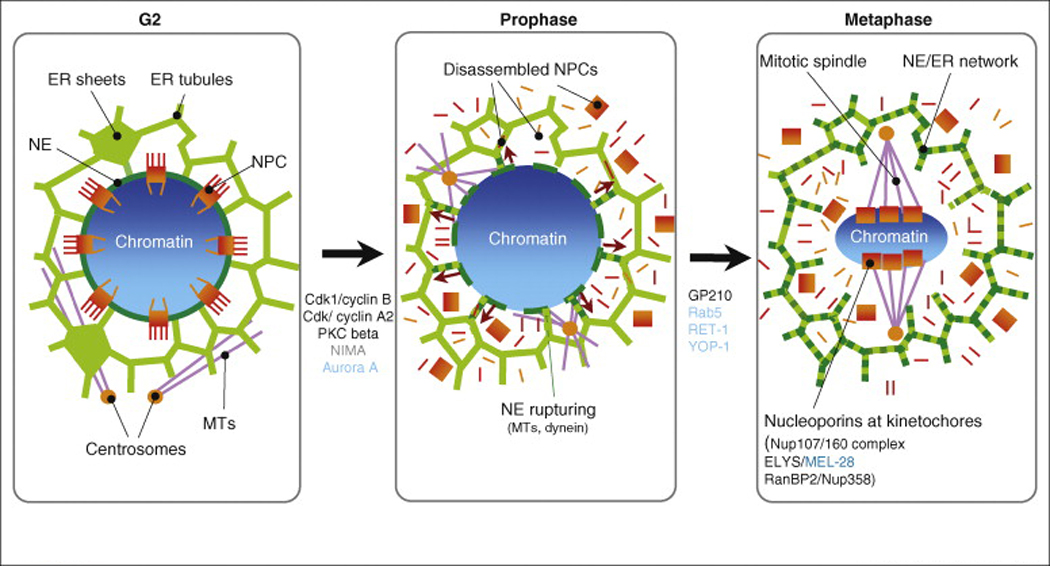
Schematic illustration of NEBD. In G2, the cell nucleus has completed DNA replication and NPC duplication. The NE (dark green), which is continuous with the ER network (green), encloses the chromosomes (blue). NPCs (red) mediate nuclear transport. At this stage, the ER is composed of tubules and sheets. When cells enter mitosis, NPCs disassemble and the NE gets reabsorbed into the ER, which at this stage is composed of tubules. NPC components are dispersed into the cytoplasm, except for three transmembrane nucleoporins, which together with other NE proteins are distributed into the ER (dashed lines). Centrosomes move to the NE (orange dots) and microtubules (purple) participate in the rupturing of the NE. In metaphase, a subset of NPC components has associated with kinetochores and the spindle is established. At this stage, chromosomes at the metaphase plate are devoid of membranes.
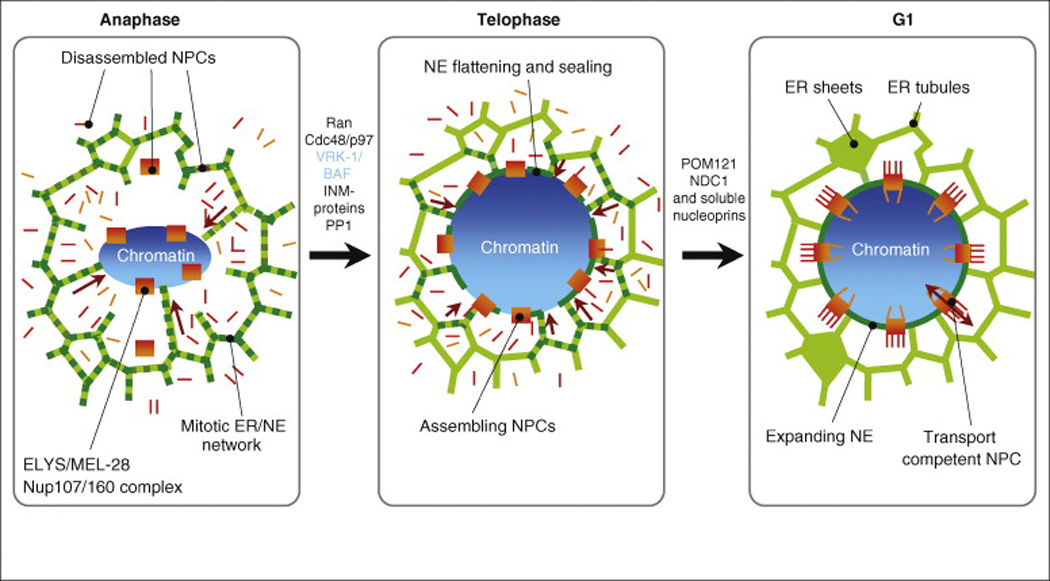
NE reformation around segregated chromosomes in one of the two daughter cells. In anaphase ER tubules associate with chromatin (purple arrows) and a subset of nucleoporins associates with chromatin. This step involves the small GTPase Ran and phosphatases such as PP1 [79,84,85]. Additional membrane tubules and NE proteins are recruited to the chromatin surface and mediate NE flattening. At this stage most NE proteins are cleared form the ER network. In late anaphase/early telophase a closed NE has formed with pores being assembled in a step-wise manner. Once pores become transport competent, the NE expands and cells move into G1.
References
-
- Busson S, Dujardin D, Moreau A, Dompierre J, De Mey JR. Dynein and dynactin are localized to astral microtubules and at cortical sites in mitotic epithelial cells. Curr Biol. 1998;8:541–544. - PubMed
-
- Beaudouin J, Gerlich D, Daigle N, Eils R, Ellenberg J. Nuclear envelope breakdown proceeds by microtubule-induced tearing of the lamina. Cell. 2002;108:83–96. - PubMed
-
- Salina D, Bodoor K, Eckley DM, Schroer TA, Rattner JB, Burke B. Cytoplasmic dynein as a facilitator of nuclear envelope breakdown. Cell. 2002;108:97–107. - PubMed
Publication types
MeSH terms
Substances
Grants and funding
LinkOut - more resources
Full Text Sources
