


Review
doi: 10.1016/j.conb.2008.09.020.
Epub 2008 Oct 23.
Better smelling through genetics: mammalian odor perception
Affiliations
- PMID: 18938244
- PMCID: PMC2590501
- DOI: 10.1016/j.conb.2008.09.020
Item in Clipboard
Review
Better smelling through genetics: mammalian odor perception
Curr Opin Neurobiol.
2008 Aug.
Abstract
The increasing availability of genomic and genetic tools to study olfaction-the sense of smell-has brought important new insights into how this chemosensory modality functions in different species. Newly sequenced mammalian genomes-from platypus to dog-have made it possible to infer how smell has evolved to suit the needs of a given species and how variation within a species may affect individual olfactory perception. This review will focus on recent advances in the genetics and genomics of mammalian smell, with a primary focus on rodents and humans.
Figures
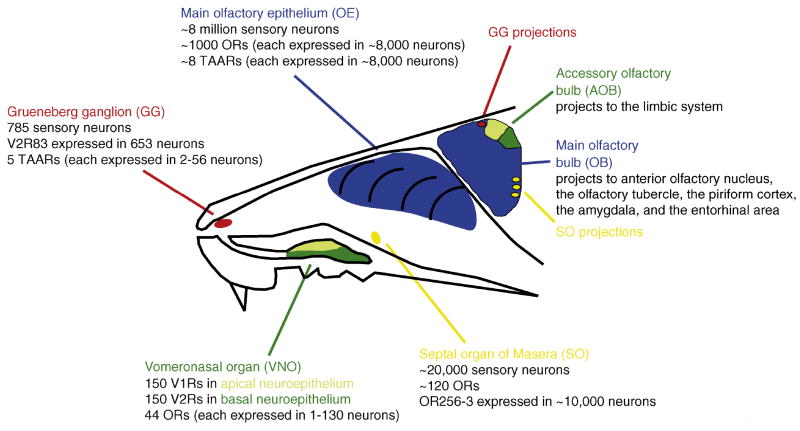
Schematic of the rodent olfactory system, indicating all four olfactory sensory organs, the classes of chemosensory receptor they express, and a summary of gene expression in each. Neurons in the VNO that express ORs project to the very rostral tip of the AOB (not indicated on the figure).
References
-
- Hu J, Zhong C, Ding C, Chi Q, W A, Mombaerts P, Matsunami H, Luo M. Detection of near-atmospheric concentrations of CO2 by an olfactory subsystem in the mouse. Science. 2007;317:953–957. - PubMed
-
- Buck L, Axel R. A novel multigene family may encode odorant receptors: a molecular basis for odor recognition. Cell. 1991;65:175–187. - PubMed
-
- Glusman G, Yanai I, Rubin I, Lancet D. The complete human olfactory subgenome. Genome Res. 2001;11:685–702. - PubMed
-
- Pace U, Hanski E, Salomon Y, Lancet D. Odorant-sensitive adenylate cyclase may mediate olfactory reception. Nature. 1985;316:255–258. - PubMed
Publication types
MeSH terms
Substances
Grants and funding
LinkOut - more resources
Full Text Sources
