. 2008 Dec;36(21):6645-55.
doi: 10.1093/nar/gkn743. Epub 2008 Oct 21.

Evidence for core exosome independent function of the nuclear exoribonuclease Rrp6p

Affiliations

Evidence for core exosome independent function of the nuclear exoribonuclease Rrp6p

Kevin P Callahan et al. Nucleic Acids Res. 2008 Dec.

Abstract

The RNA exosome processes and degrades RNAs in archaeal and eukaryotic cells. Exosomes from yeast and humans contain two active exoribonuclease components, Rrp6p and Dis3p/Rrp44p. Rrp6p is concentrated in the nucleus and the dependence of its function on the nine-subunit core exosome and Dis3p remains unclear. We found that cells lacking Rrp6p accumulate poly(A)+ rRNA degradation intermediates distinct from those found in cells depleted of Dis3p, or the core exosome component Rrp43p. Depletion of Dis3p in the absence of Rrp6p causes a synergistic increase in the levels of degradation substrates common to the core exosome and Rrp6p, but has no effect on Rrp6p-specific substrates. Rrp6p lacking a portion of its C-terminal domain no longer co-purifies with the core exosome, but continues to carry out RNA 3'-end processing of 5.8S rRNA and snoRNAs, as well as the degradation of certain truncated Rrp6-specific rRNA intermediates. However, disruption of Rrp6p-core exosome interaction results in the inability of the cell to efficiently degrade certain poly(A)+ rRNA processing products that require the combined activities of Dis3p and Rrp6p. These findings indicate that Rrp6p may carry out some of its critical functions without physical association with the core exosome.


Figures
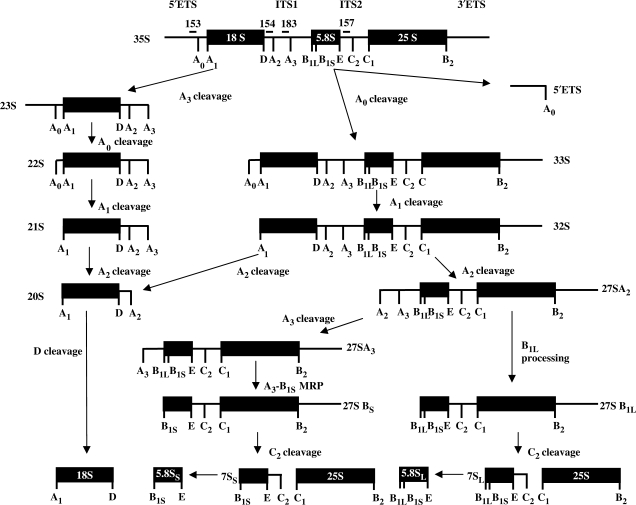
Figure 1.
Figure 1.
Ribosomal RNA processing in Saccharomyces cerevisiae. The 35S rRNA primary transcript undergoes several internal cleavages to produce the processing intermediates shown. Additional cleavages produce the mature 18S and 25S rRNAs and 5′- and 3′-end trimming reactions participate in the formation of 5.8S rRNA. 5S rRNA is produced from an independent transcription unit and is not shown. Numbered bars above the 35S pre-rRNA indicate the approximate positions of oligonucleotide probes used in the experiments described.
Figure 2.
Figure 2.
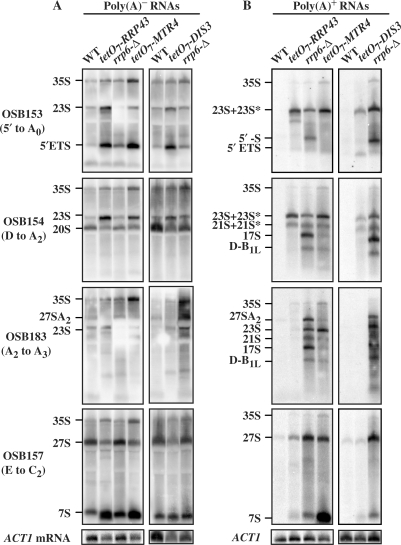
Cells deficient for core exosome, TRAMP and Rrp6p components accumulate specific polyadenylated pre-rRNAs. Total RNA was isolated from cells with the indicated genotypes grown in YPD at 30°C. The wild-type (WT) and tetO7 cells were treated for 5 h with 10 μg/ml doxycycline before harvest and RNA isolation. Total RNA was separated into (A) poly(A)- and (B) poly(A)+ fractions using two round of oligo(dT)-cellulose and analyzed by northern blotting with 5′-32P-labeled oligonucleotide probes as indicated to the left of each set of panels, except for ACT1 mRNA, which was detected with OSB400. The identity of the rRNA processing intermediates is indicated to the left of each panel.
Figure 3.
Figure 3.
Synergistic effects on poly(A)+ rRNA levels caused by depleting Dis3p in the absence of Rrp6p. Poly(A)+ RNA was isolated, using two round of oligo(dT)-cellulose fractionation, from cells with the indicated genotypes grown in YPD at 30°C. The wild-type (WT) and tetO7 cells were treated for 5 h with 10 μg/ml doxycycline before harvest and RNA isolation. Only the poly(A)+ fractions are shown. RNA was analyzed by northern blotting with 5′-32P-labeled oligonucleotide probes; (A) OSB153, (B) OSB254 and (C) OSB183. ACT1 mRNA was detected with OSB184. The identity of the rRNA processing intermediates is indicated to the left of each panel. The graphs display the ratio of each poly(A)+ RNA to ACT1 mRNA and are the average of two independent experiments.
Figure 4.
Figure 4.
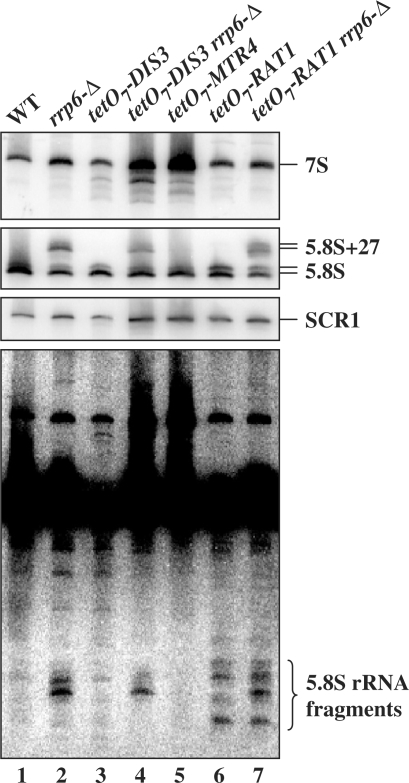
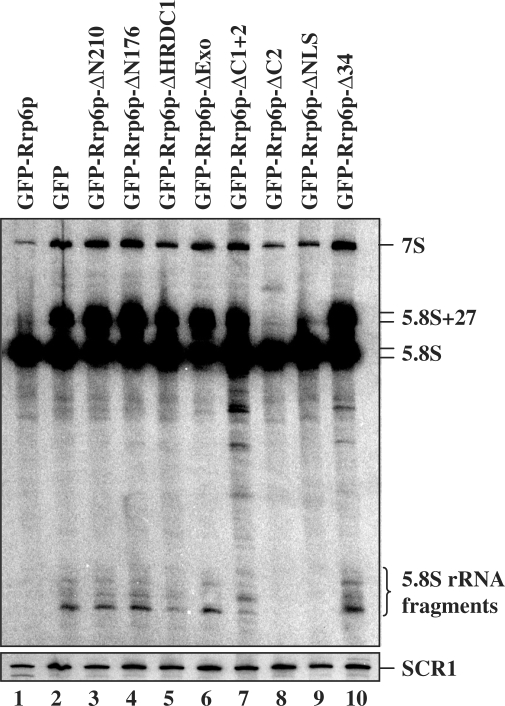
Rrp6p ΔC2 degrades 5.8S rRNA fragments. Total RNA was isolated from cells with the indicated genotypes grown in YPD at 30°C. The wild-type (WT) and tetO7 cells were treated for 5 h with 10 μg/ml doxycycline before harvest and RNA isolation. The RNA was separated by electrophoresis on an 8% polyacrylamide 8 M urea gel, transferred to a membrane and northern blot analysis carried out using 5′-32P-labeled oligonucleotide probes OSB157 (top panel) and OSB156 (middle and bottom panels). SCR1 is an RNA polymerase III transcript used as a loading control. The bottom panel is a longer exposure of the middle panel.
Figure 5.
Figure 5.
Analysis of the ability of Rrp6p deletion derivatives to co-purify with the core exosome. (A) Polypeptide structure of Rrp6p and the deletion derivatives tested. The relevant regions of Rrp6p are listed at the top of the diagram. (B and C) Western blot analysis of bound proteins after IgG-Sepharose bead purification of core exosomes from cell lysates containing the indicated GFP-Rrp6p derivatives and TAP-tagged Rrp46p as described in Materials and methods section. The antibody used to probe the blots in (B and C) is indicated to the right of each panel. In each case, the ‘bound’ fraction represents a 150-fold enrichment of the ‘Input’ and ‘Free’ fractions.
Figure 6.
Figure 6.
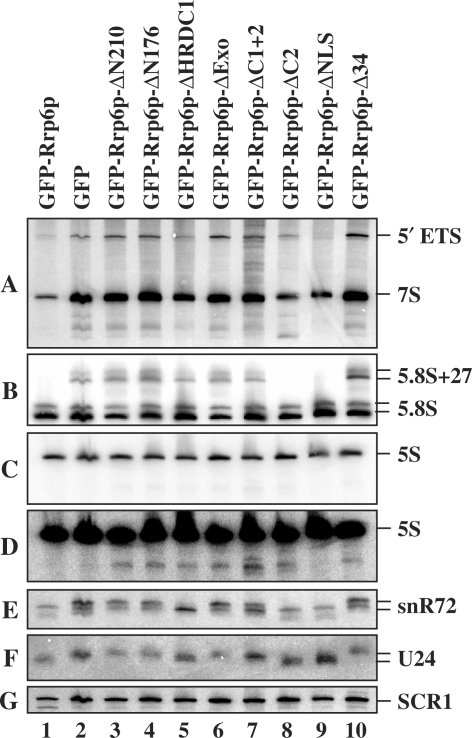
Analysis of RNA processing and degradation phenotypes in strains expressing Rrp6p deletion derivatives. Total RNA was prepared from an rrp6-Δ strain expressing the indicated Rrp6p mutant, the RNA was separated by electrophoresis on an 8% polyacrylamide 8 M urea gel, transferred to a membrane and northern blot analysis carried out using various 5′-32P-labeled oligonucleotide probes. Each panel shows the result of probing the same blot with different labeled oligonucleotides; (A) OSB153 and OSB157, (B) OSB156, (C) OSB23, (D) longer exposure of (C), (E) OSB267, (F) OSB138 and (G) OSB151. The identity of the RNAs is listed to the right of each panel. SCR1 is an RNA polymerase III transcript used as a loading control.
Figure 7.
Figure 7.
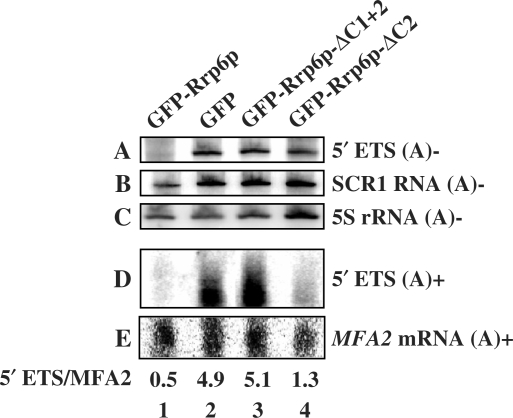
Rrp6p ΔC2 removes the poly(A) tail from 5′ETS RNA. Northern blot analysis of RNA from an rrp6-Δ strain (YSB232) expressing the indicated Rrp6p deletion derivatives. The RNA was separated into poly(A)- (top three panels) and poly(A)+ (bottom two panels) fractions prior to northern blot analysis with 5′-32P OSB153 (A), OSB151 (B), OSB23 (C), OSB153 (D) and a random-primed hexamer 32P-labeled probe to MFA2 mRNA (E).
Figure 8.
Figure 8.
Total RNA was isolated from an rrp6-Δ strain (YSB232), grown at 30°C in SCD–URA–MET media, which carried plasmids that express each of the indicated Rrp6p mutants. The RNA was separated by electrophoresis on an 8% polyacrylamide 8 M urea gel, transferred to a membrane and northern blot analysis carried out using 5′-32P-labeled oligonucleotide probes OSB157 (top panel) and OSB151 (bottom panel). SCR1 is an RNA polymerase III transcript used as a loading control.
Figure 9.
Figure 9.
Rrp6p ΔC2 degrades poly(A)+ rRNAs. Northern blot analysis of oligo-(dT)-selected RNAs from an rrp6-Δ strain expressing the indicated Rrp6p deletion derivatives. The RNA was separated in to poly(A)+ and poly(A)- fractions and the poly(A)+ analyzed by northern blotting with the indicated 5′-32P-labeled oligonucleotide probes.

References

    1. Moore MJ. Nuclear RNA turnover. Cell. 2002;108:431–434. - PubMed
    1. Amberg DC, Goldstein AL, Cole CN. Isolation and characterization of RAT1: an essential gene of Saccharomyces cerevisiae required for the efficient nucleocytoplasmic trafficking of mRNA. Genes Dev. 1992;6:1173–1189. - PubMed
    1. Geerlings TH, Vos JC, Raue HA. The final step in the formation of 25S rRNA in Saccharomyces cerevisiae is performed by 5′–>3′ exonucleases. RNA. 2000;6:1698–1703. - PMC - PubMed
    1. Henry Y, Wood H, Morrissey JP, Petfalski E, Kearsey S, Tollervey D. The 5′ end of yeast 5.8S rRNA is generated by exonucleases from an upstream cleavage site. EMBO J. 1994;13:2452–2463. - PMC - PubMed
    1. Kim M, Krogan NJ, Vasiljeva L, Rando OJ, Nedea E, Greenblatt JF, Buratowski S. The yeast Rat1 exonuclease promotes transcription termination by RNA polymerase II. Nature. 2004;432:517–522. - PubMed

Publication types

MeSH terms