


Left ventricular mechanical dispersion by tissue Doppler imaging: a novel approach for identifying high-risk individuals with long QT syndrome
- PMID: 18940888
- PMCID: PMC2639143
- DOI: 10.1093/eurheartj/ehn466
Left ventricular mechanical dispersion by tissue Doppler imaging: a novel approach for identifying high-risk individuals with long QT syndrome
Abstract
Aims: The aim of this study was to investigate whether prolonged and dispersed myocardial contraction duration assessed by tissue Doppler imaging (TDI) may serve as risk markers for cardiac events (documented arrhythmia, syncope, and cardiac arrest) in patients with long QT syndrome (LQTS).
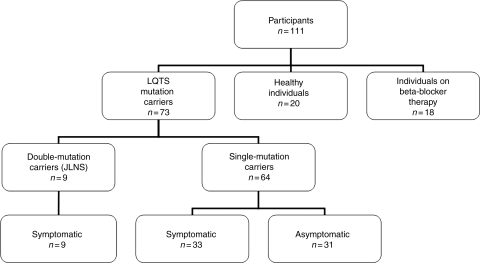
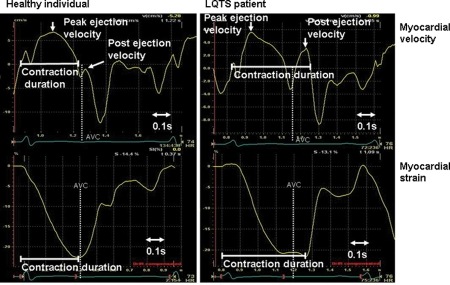
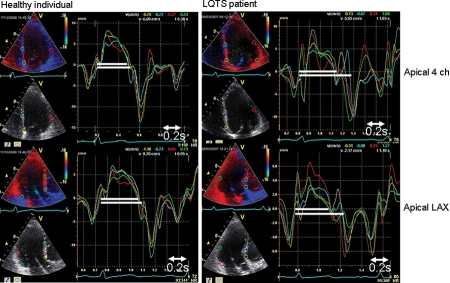
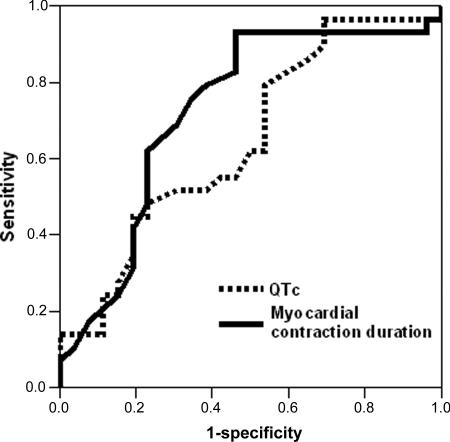
Methods and results: Seventy-three patients with genetically confirmed LQTS (nine double- and 33 single-mutation carriers with previous cardiac events and 31 single-mutation carriers without events) were studied. Myocardial contraction duration was prolonged in each group of LQTS patients compared with 20 healthy controls (P < 0.001). Contraction duration was longer in single-mutation carriers with previous cardiac events compared with those without (0.46 +/- 0.06 vs. 0.40 +/- 0.06 s, P = 0.001). Prolonged contraction duration could better identify cardiac events compared with corrected QT (QTc) interval in single-mutation carriers [area under curve by receiver-operating characteristic analysis 0.77 [95% confidence interval (95% CI) 0.65-0.89] vs. 0.66 (95% CI 0.52-0.79)]. Dispersion of contraction was more pronounced in single-mutation carriers with cardiac events compared with those without (0.048 +/- 0.018 vs. 0.031 +/- 0.019 s, P = 0.001).
Conclusion: Dispersion of myocardial contraction assessed by TDI was increased in LQTS patients. Prolonged contraction duration was superior to QTc for risk assessment. These new methods can easily be implemented in clinical routine and may improve clinical management of LQTS patients.
Figures
Comment in
-
Long QT syndrome, a purely electrical disease? Not anymore.Eur Heart J. 2009 Feb;30(3):253-5. doi: 10.1093/eurheartj/ehn587. Epub 2009 Jan 16. Eur Heart J. 2009. PMID: 19151080 No abstract available.
-
Abnormal left ventricular relaxation in patients with long QT syndrome.Eur Heart J. 2009 Nov;30(22):2813-4; author reply 2814-5. doi: 10.1093/eurheartj/ehp444. Epub 2009 Oct 20. Eur Heart J. 2009. PMID: 19843555 No abstract available.
References
-
- Priori SG, Schwartz PJ, Napolitano C, Bloise R, Ronchetti E, Grillo M, Vicentini A, Spazzolini C, Nastoli J, Bottelli G, Folli R, Cappelletti D. Risk stratification in the long-QT syndrome. N Engl J Med. 2003;348:1866–1874. - PubMed
-
- Jervell A, Lange-Nielsen F. Congenital deaf-mutism, functional heart disease with prolongation of the Q-T interval and sudden death. Am Heart J. 1957;54:59–68. - PubMed
-
- Romano C, Gemme G, Pongiglione R. Rare cardiac arrhythmias of the pediatric age. II. Syncopal attacks due to paroxysmal ventricular fibrillation. Presentation of 1st case in Italian pediatric literature. Clin Pediatr (Bologna) 1963;45:656–683. - PubMed
-
- Ward OC. A new familial cardiac syndrome in children. J Ir Med Assoc. 1964;54:103–106. - PubMed
-
- Hofman N, Wilde AA, Kaab S, van Langen I, Tanck MW, Mannens MM, Hinterseer M, Beckmann BM, Tan HL. Diagnostic criteria for congenital long QT syndrome in the era of molecular genetics: do we need a scoring system? Eur Heart J. 2007;28:575–580. - PubMed
Publication types
MeSH terms
Substances
LinkOut - more resources
Full Text Sources
Other Literature Sources
Medical
