


Physiology and pathophysiology of canonical transient receptor potential channels
- PMID: 18940894
- PMCID: PMC2630793
- DOI: 10.1096/fj.08-119495
Physiology and pathophysiology of canonical transient receptor potential channels
Abstract
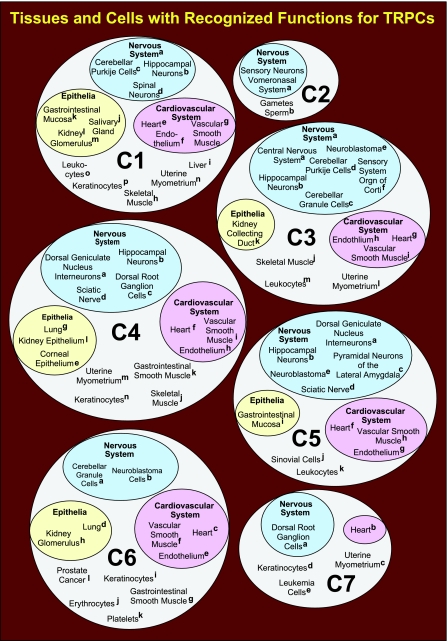
The existence of a mammalian family of TRPC ion channels, direct homologues of TRP, the visual transduction channel of flies, was discovered during 1995-1996 as a consequence of research into the mechanism by which the stimulation of the receptor-Gq-phospholipase Cbeta signaling pathway leads to sustained increases in intracellular calcium. Mammalian TRPs, TRPCs, turned out to be nonselective, calcium-permeable cation channels, which cause both a collapse of the cell's membrane potential and entry of calcium. The family comprises 7 members and is widely expressed. Many cells and tissues express between 3 and 4 of the 7 TRPCs. Despite their recent discovery, a wealth of information has accumulated, showing that TRPCs have widespread roles in almost all cells studied, including cells from excitable and nonexcitable tissues, such as the nervous and cardiovascular systems, the kidney and the liver, and cells from endothelia, epithelia, and the bone marrow compartment. Disruption of TRPC function is at the root of some familial diseases. More often, TRPCs are contributing risk factors in complex diseases. The present article reviews what has been uncovered about physiological roles of mammalian TRPC channels since the time of their discovery. This analysis reveals TRPCs as major and unsuspected gates of Ca(2+) entry that contribute, depending on context, to activation of transcription factors, apoptosis, vascular contractility, platelet activation, and cardiac hypertrophy, as well as to normal and abnormal cell proliferation. TRPCs emerge as targets for a thus far nonexistent field of pharmacological intervention that may ameliorate complex diseases.
Figures
References
-
- Zhu X, Jiang M, Peyton M, Boulay G, Hurst R, Stefani E, Birnbaumer L. Trp, a novel mammalian gene family essential for agonist-activated capacitative Ca2+ entry. Cell. 1996;85:661–671. - PubMed
-
- Thebault S, Flourakis M, Vanoverberghe K, Vandermoere F, Roudbaraki M, Lehen'kyi V, Slomianny C, Beck B, Mariot P, Bonnal J L, Mauroy B, Shuba Y, Capiod T, Skryma R, Prevarskaya N. Differential role of transient receptor potential channels in Ca2+ entry and proliferation of prostate cancer epithelial cells. Cancer Res. 2006;66:2038–2047. - PubMed
Publication types
MeSH terms
Substances
Grants and funding
LinkOut - more resources
Full Text Sources
Molecular Biology Databases
Miscellaneous
