


Differences in partitioning of meal fatty acids into blood lipid fractions: a comparison of linoleate, oleate, and palmitate
- PMID: 18940935
- PMCID: PMC2636984
- DOI: 10.1152/ajpendo.90730.2008
Differences in partitioning of meal fatty acids into blood lipid fractions: a comparison of linoleate, oleate, and palmitate
Abstract
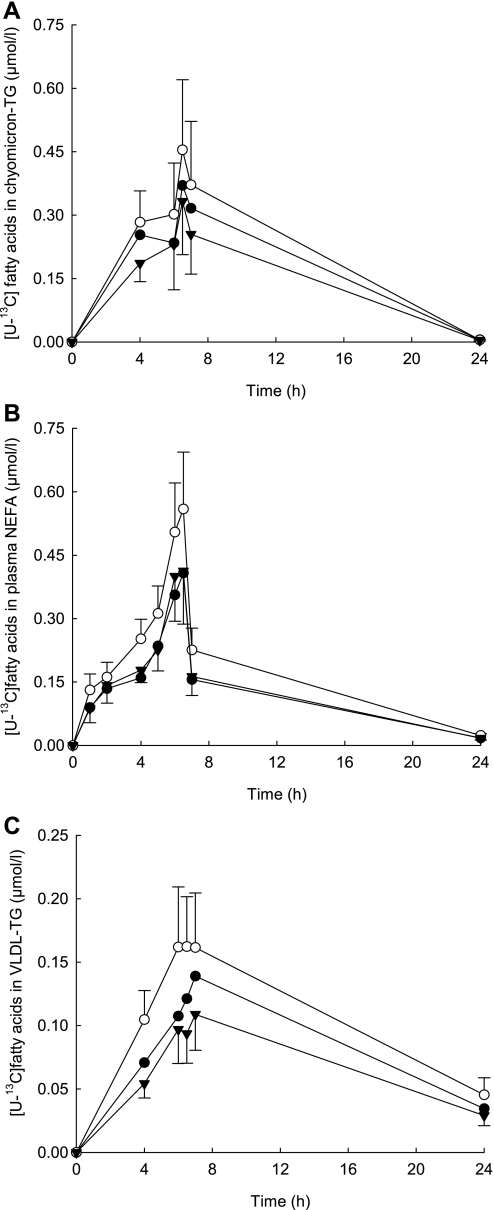
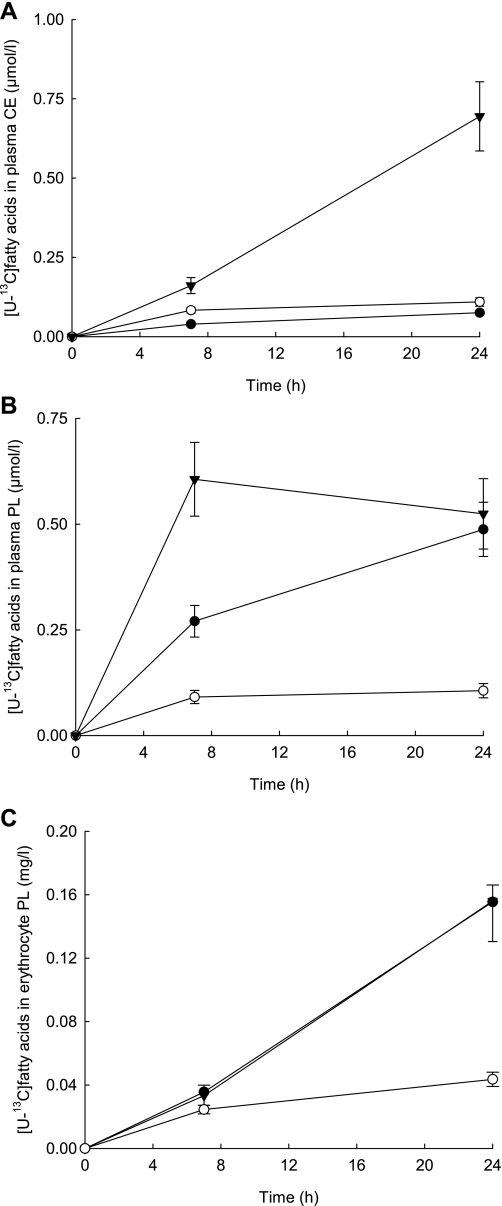
There has been much interest in the health effects of dietary fat, but few studies have comprehensively compared the acute metabolic fate of specific fatty acids in vivo. We hypothesized that different classes of fatty acids would be variably partitioned in metabolic pathways and that this would become evident over 24 h. We traced the fate of fatty acids using equal amounts of [U-(13)C]linoleate, [U-(13)C]oleate, and [U-(13)C]palmitate given in a test breakfast meal in 12 healthy subjects. There was a tendency for differences in the concentrations of the tracers in plasma chylomicron-triacylglycerol (TG) (oleate > palmitate > linoleate). This pattern remained in plasma nonesterified fatty acid (NEFA) and very low-density lipoprotein (VLDL)-TG (P <or= 0.01 and P <or= 0.02 for [U-(13)C]oleate vs. both [U-(13)C]palmitate and [U-(13)C]linoleate for NEFA and VLDL-TG, respectively). There was significantly more [U-(13)C]linoleate than the other two tracers in plasma cholesteryl ester and phospholipid (PL). Using the values for isotopic enrichment in the different lipid fractions compared with the test meal, we calculated the contribution of meal fatty acids to the respective fractions. At 24 h, 10% of plasma PL-linoleate originated from the breakfast test meal. This was significantly greater than for oleate and palmitate (both 3 +/- 0.3%; P < 0.05). This pattern was also true for erythrocyte PL fatty acids. The marked rapid incorporation of linoleate from a single meal into blood PL fractions may have functional consequences such as maintenance of membrane fluidity and may explain why linoleate is a useful biomarker of dietary intake.
Figures
References
-
- Aarsland A, Wolfe RR. Hepatic secretion of VLDL fatty acids during stimulated lipogenesis in men. J Lipid Res 39: 1280–1286, 1998. - PubMed
-
- Bergouignan A, Schoeller DA, Normand S, Gauquelin-Koch G, Laville M, Shriver T, Desage M, Le Maho Y, Ohshima H, Gharib C, Blanc S. Effect of physical inactivity on the oxidation of saturated and monounsaturated dietary Fatty acids: results of a randomized trial. PLoS Clin Trials 1: e27, 2006. - PMC - PubMed
-
- Bickerton AS, Roberts R, Fielding BA, Hodson L, Blaak EE, Wagenmakers AJ, Gilbert M, Karpe F, Frayn KN. Preferential uptake of dietary fatty acids in adipose tissue and muscle in the postprandial period. Diabetes 56: 168–176, 2007. - PubMed
-
- Brossard N, Croset M, Normand S, Pousin J, Lecerf J, Laville M, Tayot JL, Lagarde M. Human plasma albumin transports [13C]docosahexaenoic acid in two lipid forms to blood cells. J Lipid Res 38: 1571–1582, 1997. - PubMed
Publication types
MeSH terms
Substances
Grants and funding
LinkOut - more resources
Full Text Sources
Medical
Miscellaneous
