


Insulin is required for amino acid stimulation of dual pathways for translational control in skeletal muscle in the late-gestation ovine fetus
- PMID: 18940943
- PMCID: PMC2636989
- DOI: 10.1152/ajpendo.90310.2008
Insulin is required for amino acid stimulation of dual pathways for translational control in skeletal muscle in the late-gestation ovine fetus
Abstract
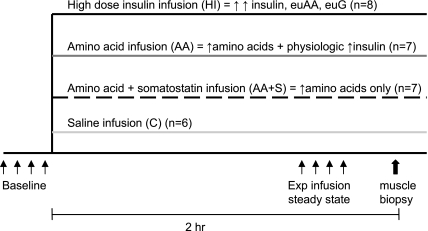
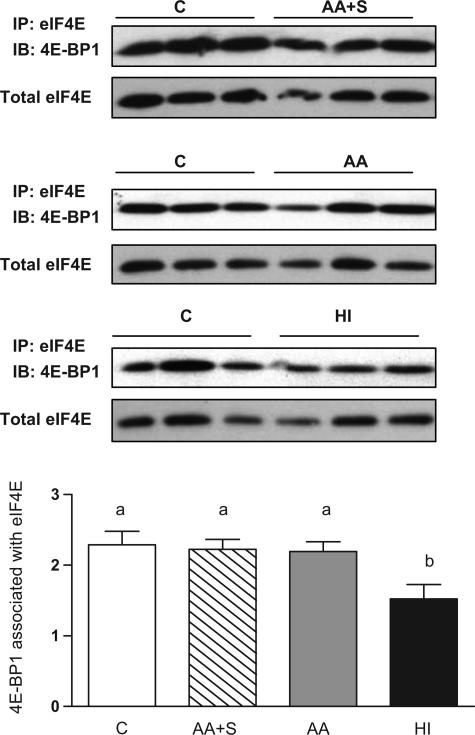
During late gestation, amino acids and insulin promote skeletal muscle protein synthesis. However, the independent effects of amino acids and insulin on the regulation of mRNA translation initiation in the fetus are relatively unknown. The purpose of this study was to determine whether acute amino acid infusion in the late-gestation ovine fetus, with and without a simultaneous increase in fetal insulin concentration, activates translation initiation pathway(s) in skeletal muscle. Fetuses received saline (C), mixed amino acid infusion plus somatostatin infusion to suppress amino acid-stimulated fetal insulin secretion (AA+S), mixed amino acid infusion with concomitant physiological increase in fetal insulin (AA), or high-dose insulin infusion with euglycemia and euaminoacidemia (HI). After a 2-h infusion period, fetal skeletal muscle was harvested under in vivo steady-state conditions and frozen for quantification of proteins both upstream and downstream of mammalian target of rapamycin (mTOR). In the AA group, we found a threefold increase in ribosomal protein S6 kinase (p70(S6k)) and Erk1/2 phosphorylation; however, blocking the physiological rise in insulin with somatostatin in the AA+S group prevented this increase. In the HI group, Akt, Erk1/2, p70(S6k), and ribosomal protein S6 were highly phosphorylated and 4E-binding protein 1 (4E-BP1) associated with eukaryotic initiation factor (eIF)4E decreased by 30%. These data show that insulin is a significant regulator of intermediates involved in translation initiation in ovine fetal skeletal muscle. Furthermore, the effect of amino acids is dependent on a concomitant increase in fetal insulin concentrations, because amino acid infusion upregulates p70(S6k) and Erk only when amino acid-stimulated increase in insulin occurs.
Figures


References
-
- Aldoretta PW, Carver TD, Hay WW Jr. Maturation of glucose-stimulated insulin secretion in fetal sheep. Biol Neonate 73: 375–386, 1998. - PubMed
-
- Anderson MS, Thamotharan M, Kao D, Devaskar SU, Qiao L, Friedman JE, Hay WW Jr. Effects of acute hyperinsulinemia on insulin signal transduction and glucose transporters in ovine fetal skeletal muscle. Am J Physiol Regul Integr Comp Physiol 288: R473–R481, 2005. - PubMed
-
- Anthony JC, Anthony TG, Kimball SR, Vary TC, Jefferson LS. Orally administered leucine stimulates protein synthesis in skeletal muscle of postabsorptive rats in association with increased eIF4F formation. J Nutr 130: 139–145, 2000. - PubMed
-
- Anthony JC, Yoshizawa F, Anthony TG, Vary TC, Jefferson LS, Kimball SR. Leucine stimulates translation initiation in skeletal muscle of postabsorptive rats via a rapamycin-sensitive pathway. J Nutr 130: 2413–2419, 2000. - PubMed
-
- Avruch J Insulin signal transduction through protein kinase cascades. Mol Cell Biochem 182: 31–48, 1998. - PubMed
Publication types
MeSH terms
Substances
Grants and funding
LinkOut - more resources
Full Text Sources
Medical
Research Materials
Miscellaneous
