. 2008;3(10):e3500.
doi: 10.1371/journal.pone.0003500. Epub 2008 Oct 22.

Complete genome viral phylogenies suggests the concerted evolution of regulatory cores and accessory satellites

Affiliations

Complete genome viral phylogenies suggests the concerted evolution of regulatory cores and accessory satellites

Paolo Marinho de Andrade Zanotto et al. PLoS One. 2008.

Abstract

We consider the concerted evolution of viral genomes in four families of DNA viruses. Given the high rate of horizontal gene transfer among viruses and their hosts, it is an open question as to how representative particular genes are of the evolutionary history of the complete genome. To address the concerted evolution of viral genes, we compared genomic evolution across four distinct, extant viral families. For all four viral families we constructed DNA-dependent DNA polymerase-based (DdDp) phylogenies and in addition, whole genome sequence, as quantitative descriptions of inter-genome relationships. We found that the history of the polymerase gene was highly predictive of the history of the genome as a whole, which we explain in terms of repeated, co-divergence events of the core DdDp gene accompanied by a number of satellite, accessory genetic loci. We also found that the rate of gene gain in baculovirus and poxviruses proceeds significantly more quickly than the rate of gene loss and that there is convergent acquisition of satellite functions promoting contextual adaptation when distinct viral families infect related hosts. The congruence of the genome and polymerase trees suggests that a large set of viral genes, including polymerase, derive from a phylogenetically conserved core of genes of host origin, secondarily reinforced by gene acquisition from common hosts or co-infecting viruses within the host. A single viral genome can be thought of as a mutualistic network, with the core genes acting as an effective host and the satellite genes as effective symbionts. Larger virus genomes show a greater departure from linkage equilibrium between core and satellites functions.


Conflict of interest statement

Competing Interests: The authors have declared that no competing interests exist.

Figures

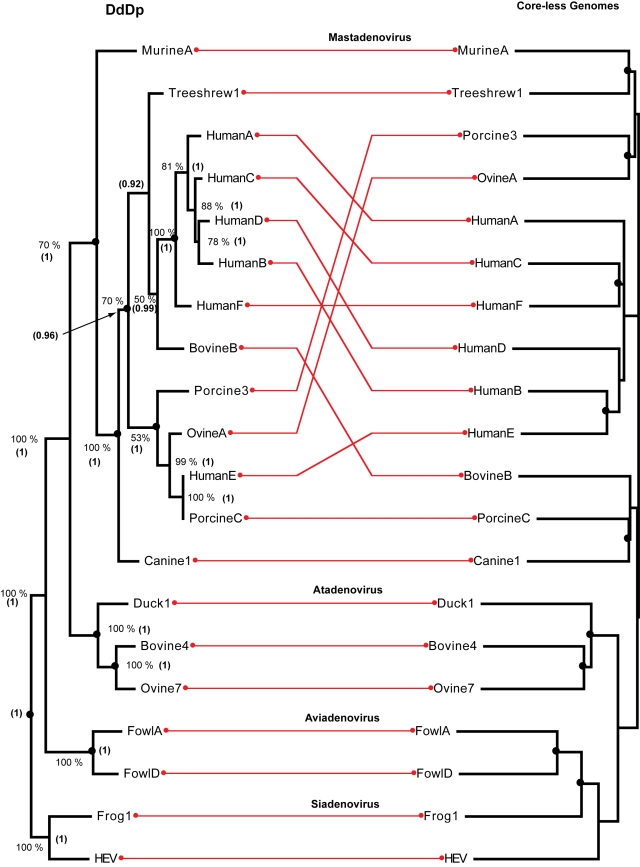
Figure 1
Figure 1. Assemblage of an adenovirus DNA-dependent-DNA polymerases (DdDp or cores) maximum likelihood tree (inferred with phyml) rooted at the Siadenovirus (left) and a phenogram clustered with the neighbor-joining method implemented in the Weighbor program for adenovirus “core-less” genomes, i.e., without the DdDp (including satellite functions) rooted at the node connecting the Atadenovirus to the Siadenovirus (right).
Nodes encircled by black dots indicate codivergence events. Values near the nodes of the DdDp indicate the number of times that each tree component was observed during 500 non-parametric bootstrap maximum likelihood iterations with phyml, value between parenthesis are the posterior Bayesian probability of the node estimated with MrBayes. Nodes encircled by black dots indicate codivergence events estimated with the TreeMap program.
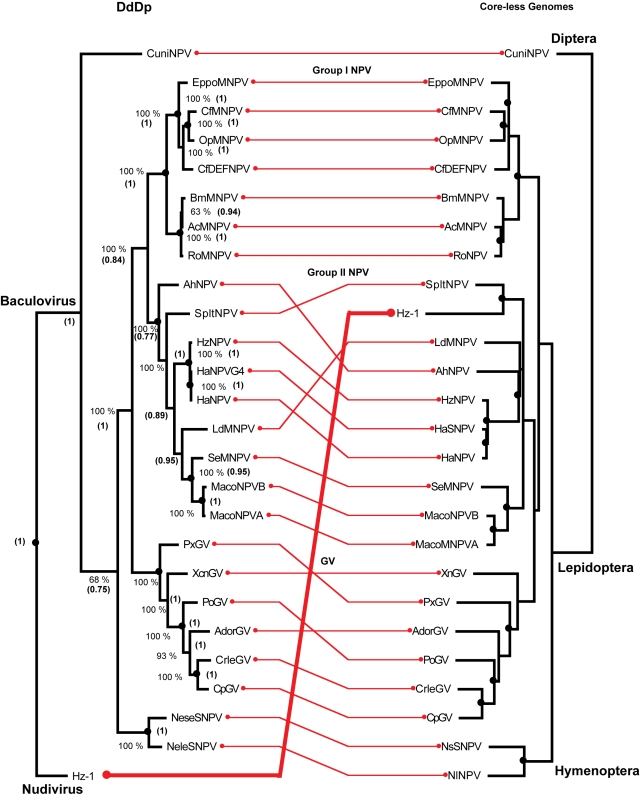
Figure 2
Figure 2. Assemblage of a baculovirus DNA-dependent-DNA polymerase (DdDp or cores) maximum likelihood tree rooted at the Heliothis zea nudivirus Hz-1 (left) and a phenogram clustered with the neighbor-joining method implemented in the Weighbor program for baculovirus “core-less” genomes, i.e., without the DdDp (including satellite functions) rooted at the most distantly-related baculovirus the CuniNPV (right).
Nodes encircled by black dots indicate co-divergence events. Values near the nodes of the DdDp indicate the number of times that each tree component was observed during 500 non-parametric bootstrap maximum likelihood iterations with phyml, value between parenthesis are the posterior Bayesian probability of the node estimated with MrBayes. Nodes encircled by black dots indicate codivergence events estimated with the TreeMap program.
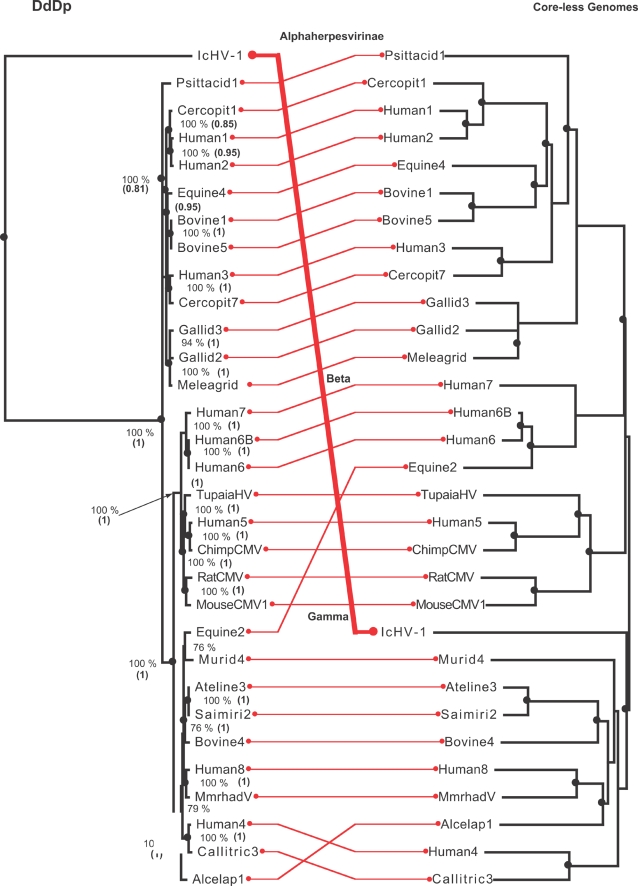
Figure 3
Figure 3. Assemblage of a herpesvirus DNA-dependent-DNA polymerase (DdDp or cores) maximum likelihood tree rooted with the Ictalurid virus (IcHV-1) infecting the Channel catfish (right) and a phenogram clustered with the neighbor-joining method implemented in the Weighbor program for herpesvirus “core-less” genomes, i.e., without the DdDp (including satellite functions) rooted at the Alpha-herpesvirus (Alphaherpesvirinae) that infect birds and mammals (right).
In spite of the IcHV-1 being distantly related to the herpesvirus and of questionable membership in the Herpesviridae family, it shares several satellite functions with the Beta and Gammaherpesvirinae infecting tetrapods. Nodes encircled by black dots indicate co-divergence events. Values near the nodes of the DdDp indicate the number of times that each tree component was observed during 500 non-parametric bootstrap maximum likelihood iterations with phyml, value between parenthesis are the posterior Bayesian probability of the node estimated with MrBayes. Nodes encircled by black dots indicate codivergence events estimated with the TreeMap program.
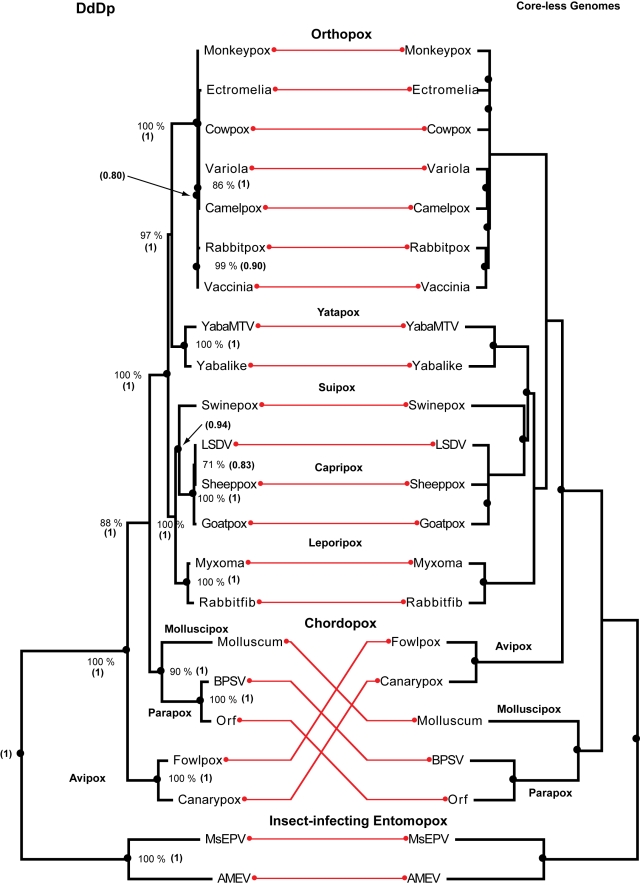
Figure 4
Figure 4. Assemblage of poxvirus trees rooted with the insect-infecting entomopoxvirus and a phenogram clustered with the neighbor-joining method implemented in the Weighbor program for poxvirus “core-less” genomes, i.e., without the DdDp (including satellite functions).
All major groups of posxvirus were recovered. Nodes encircled by black dots indicate co-divergence events. Values near the nodes of the DdDp indicate the number of times that each tree component was observed during 500 non-parametric bootstrap maximum likelihood iterations with phyml, value between parenthesis are the posterior Bayesian probability of the node estimated with MrBayes. Nodes encircled by black dots indicate codivergence events estimated with the TreeMap program.
Figure 5
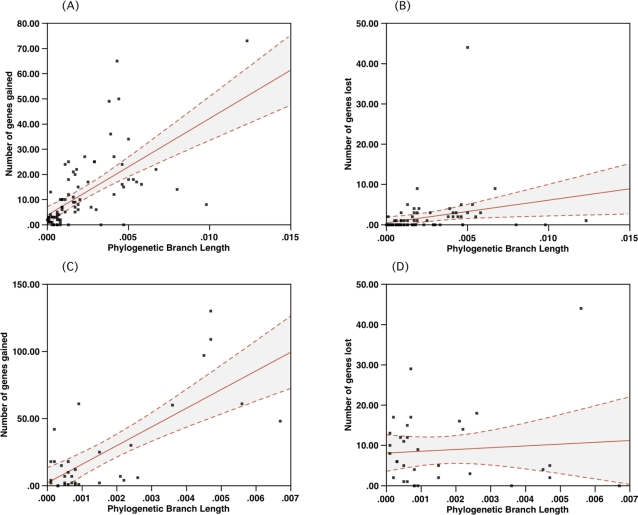
Figure 5. Gene accretion and loss in the baculovirus (5A and 5B) and poxvirus (5C and 5D).
Solid lines are least squares linear regression to the data. Dashed lines bound 95% confidence intervals on the mean regression lines. Rates of gene gain are far higher than rates of gene loss. The number of gain and loss events for baculovirus was estimated with MacClade and for poxvirus was obtained from McLysaght et al., . The regression indicate a positive dependence on the number of gene gains on branch length in the tree for the complete genomes, whereas loss events were less frequent and had no significant dependence on branch length (as indicated by the low correlation coefficients on the shallow gradients). The data suggested that the process of gene gain in these 2 viral families is temporally organized, since genetic distance (branch lengths) is proportional to time. For both loss and gain the distribution of gain and loss departs from a simple exponential model predicted by the branch lengths. A similar accretion process of auxiliary gene functions in large DNA viruses has been observed for herpesvirus .
Figure 6
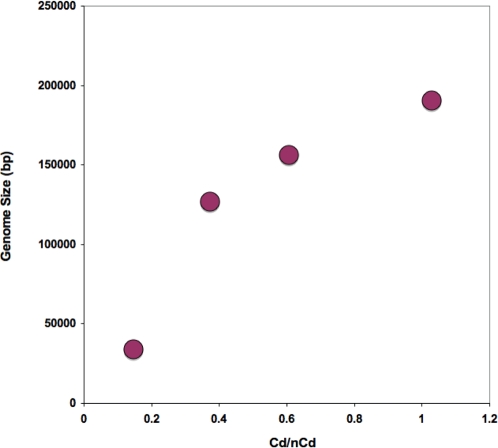
Figure 6. Plot showing a positive correlation (r2 = 0.84) between the average genome in each viral family versus the ratio (Cd/nCd) of codivergence (Cd) over non-codivergence (nCd) events.
The ratio is a measure of the linkage disequilibrium between the core polymerase gene and the remainder of the genome. Larger genomes tend to diverge in a more concerted fashion, whereas smaller genomes show greater independence in genetic segregation among constituents of their genomes. Hence smaller viral genomes behave somewhat like a mutualistic network, with the core acting as a host and the accessory satellites as symbionts.
Figure 7
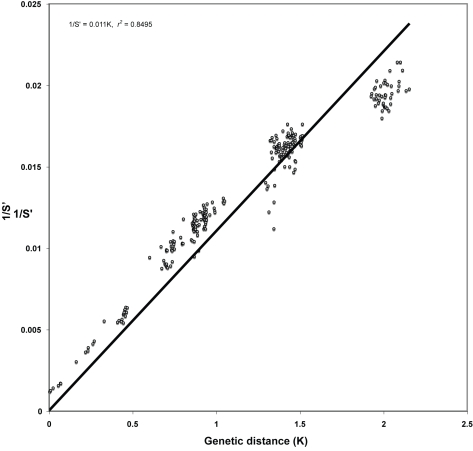
Figure 7. Plot of phenetic distance (1/S′) versus genetic distance (K) for baculoviruses.
K was estimated from a protein concatamer of the 29 genes conserved in 24 complete baculovirus genomes (excluding the CuniNPV). K was obtained using phylogenetic ML reconstruction. 1/S′ was estimated using BlastPhen. 85% of the data was explained by the regression supporting the use of 1/S′ as a practical measure of genetic diversity. The measure is however unable to correct for superposition as K increases above 1.5. Given k≅φ/S′, φ was estimated to average 82.91 for these data.

References

    1. Montague MG, Hutchison CA., III Gene content phylogeny of herpesviruses. Proc Natl Acad Sci USA. 2000;97:5334–5339. - PMC - PubMed
    1. McLysaght A, Baldi PF, Gaut BS. Extensive gene gain associated with adaptive evolution of poxviruses. Proc Natl Acad Sci USA. 2003;100:15655–15660. - PMC - PubMed
    1. Herniou EA, Olszewski JA, Cory JS, O'Reilly DR. The genome sequence and evolution of baculovirus. Annu Rev Entomol. 2003;48:211–234. - PubMed
    1. Herniou EA, Olszewski JA, O'Reilly DR, Cory JS. Ancient coevolution of baculovirus and their hot isnsects. Journal of Virology. 2004;78:3244–3251. - PMC - PubMed
    1. Morse SS. Towards an evolutionary Biology of Viruses. In: Morse SS, editor. The Evolutionary Biology of Viruses. New York: Raven Press; 1994. pp. 1–27.

Publication types