


The effect of heat waves on mental health in a temperate Australian city
- PMID: 18941580
- PMCID: PMC2569097
- DOI: 10.1289/ehp.11339
The effect of heat waves on mental health in a temperate Australian city
Abstract
Objective: The goal of this study was to identify mental, behavioral, and cognitive disorders that may be triggered or exacerbated during heat waves, predisposing individuals to heat-related morbidity and mortality.
Design: Using health outcome data from Adelaide, South Australia, for 1993-2006, we estimated the effect of heat waves on hospital admissions and mortalities attributed to mental, behavioral, and cognitive disorders. We analyzed data using Poisson regression accounting for overdispersion and controlling for season and long-term trend, and we performed threshold analysis using hockey stick regression.
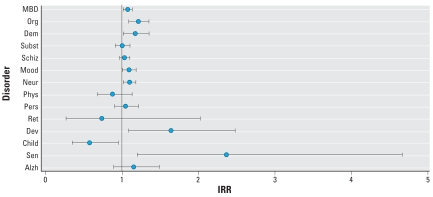
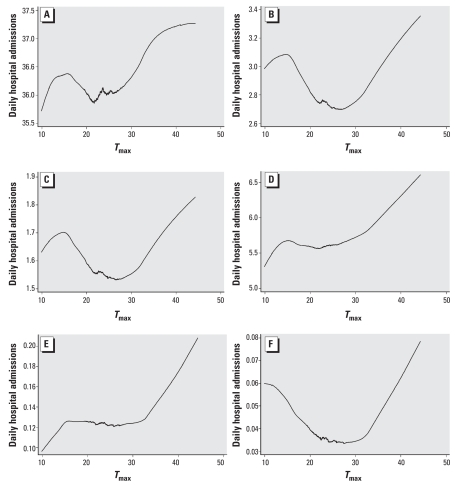
Results: Above a threshold of 26.7 degrees C, we observed a positive association between ambient temperature and hospital admissions for mental and behavioral disorders. Compared with non-heat-wave periods, hospital admissions increased by 7.3% during heat waves. Specific illnesses for which admissions increased included organic illnesses, including symptomatic mental disorders; dementia; mood (affective) disorders; neurotic, stress related, and somatoform disorders; disorders of psychological development; and senility. Mortalities attributed to mental and behavioral disorders increased during heat waves in the 65- to 74-year age group and in persons with schizophrenia, schizotypal, and delusional disorders. Dementia deaths increased in those up to 65 years of age.
Conclusion: Our results suggest that episodes of extreme heat pose a salient risk to the health and well-being of the mentally ill.
Relevance to clinical or professional practice: Improvements in the management and care of the mentally ill need to be addressed to avoid an increase in psychiatric morbidity and mortality as heat waves become more frequent.
Keywords: dementia; heat waves; mental health; psychiatric; schizophrenia; temperature; weather.
Figures
References
-
- AIHW. Australia’s Health 2004. AIHW catalog no. AUS 44, AIHW. Canberra, Australia: Australian Institute of Health and Welfare; 2004. [[accessed 2 September 2008]]. Health Resources; pp. 228–275. Available: http://www.aihw.gov.au/publications/aus/ah04/ah04-c09-040804.pdf.
-
- AIHW. Australia’s Health 2006: The Tenth Biennial Health Report of the Australian Institute of Health and Welfare. AIHW catalog no. AUS 73. Canberra, Australia: Australian Institute of Health and Welfare; 2006. [[accessed 26 August 2007]]. Mental health problems and illnesses; pp. 97–104. Available: http://www.aihw.gov.au/publications/index.cfm/title/10321.
-
- Australian Bureau of Statistics. Mental Health in Australia: A Snapshot, 2004–2005. 2006. [[accessed 26 August 2007]]. Available: http://www.abs.gov.au/ausstats/abs@.nsf/mf/4824.0.55.001.
-
- Australian Bureau of Statistics. Regional Population Growth, Australia, 2006–2007. 2008. [[accessed 29 August 2008]]. Catalog no. 3218.0. Available: http://www.abs.gov.au/AUSSTATS/abs@.nsf/39433889d406eeb9ca2570610019e9a5....
-
- Bark N. Deaths of psychiatric patients during heat waves. Psychiatr Serv. 1998;49(8):1088–1090. - PubMed
Publication types
MeSH terms
LinkOut - more resources
Full Text Sources
Medical