


In vivo evaluation of intravesical paclitaxel and combined bcl-xL antisense oligodeoxynucleotide treatment for orthotopic urothelial carcinoma
- PMID: 18941779
- PMCID: PMC12160161
- DOI: 10.1007/s00432-008-0500-5
In vivo evaluation of intravesical paclitaxel and combined bcl-xL antisense oligodeoxynucleotide treatment for orthotopic urothelial carcinoma
Abstract
Purpose: To evaluate intravesical paclitaxel monotherapy and combined treatment with antiapoptotic bcl-xL antisense oligodeoxynucleotides (AS-ODNs) on urothelial carcinoma (UC).
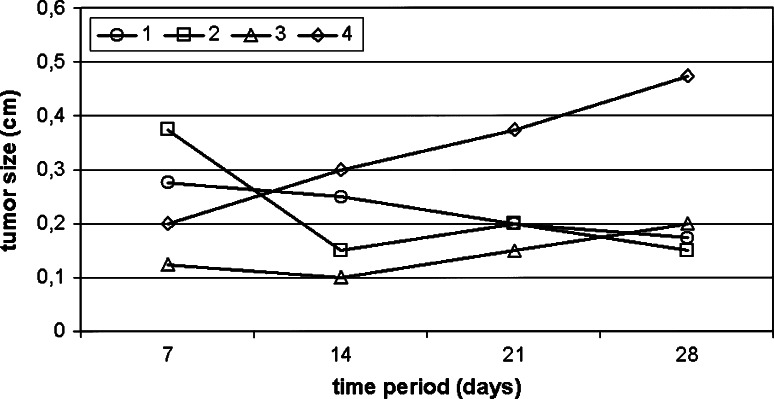
Methods: Forty-eight FoxN(rnu) athymic nude rats with orthotopic human bladder UC were randomized to four treatment groups [1, paclitaxel; 2, paclitaxel/bcl-xL AS-ODNs; 3, bcl-xL AS-ODNs (control); 4, medium (control)]. Three consecutive instillations were applied and weekly endoscopic tumor size measurements were performed.
Results: Significant tumor size reduction was achieved in groups 1 and 2 (each P < 0.0001), whereas continuous UC growth was observed in control animals (groups 3 and 4; P < 0.0001 and P < 0.0020). Complete tumor eradication was achieved in four treated animals (groups 1 and 2). No significant difference in chemoresection effects was found between groups 1 and 2 (P = 0.2251).
Conclusions: We present an in vivo evaluation of intravesical treatment with paclitaxel and combined bcl-xL AS-ODNs. Despite efficient tumor size reduction, no gain was observed when adding bcl-xL AS-ODNs in this experimental setting.
Figures



References
-
- Au JL, Kalns J, Gan Y, Wientjes MG (1997) Pharmacologic effects of paclitaxel in human bladder tumors. Cancer Chemother Pharmacol 41:69–74. doi:10.1007/s002800050709 - PubMed
-
- Bolenz C, Becker A, Trojan L, Schaaf A, Cao Y, Weiss C et al (2007a) Optimizing chemotherapy for transitional cell carcinoma by application of bcl-2 and bcl-xL antisense oligodeoxynucleotides. Urol Oncol 25:476–482. doi:10.1016/j.urolonc.2007.01.017 - PubMed
-
- Bolenz C, Wenzel M, Cao Y, Trojan L, Hacker A, Arancibia MF et al (2007b) Newly developed mini-endoscope for diagnosis and follow-up of orthotopic bladder transitional-cell carcinoma in vivo. J Endourol 21:789–794. doi:10.1089/end.2006.0355 - PubMed
-
- Botteman MF, Pashos CL, Redaelli A, Laskin B, Hauser R (2003) The health economics of bladder cancer: a comprehensive review of the published literature. Pharmacoeconomics 21:1315–1330. doi:10.2165/00019053-200321180-00003 - PubMed
-
- Duggan BJ, Gray S, Johnston SR, Williamson K, Miyaki H, Gleave M (2002) The role of antisense oligonucleotides in the treatment of bladder cancer. Urol Res 30:137–147. doi:10.1007/s00240-002-0248-3 - PubMed
Publication types
MeSH terms
Substances
LinkOut - more resources
Full Text Sources
Medical
Research Materials
