


Step-wedge cluster-randomised community-based trials: an application to the study of the impact of community health insurance
- PMID: 18945332
- PMCID: PMC2583992
- DOI: 10.1186/1478-4505-6-10
Step-wedge cluster-randomised community-based trials: an application to the study of the impact of community health insurance
Abstract
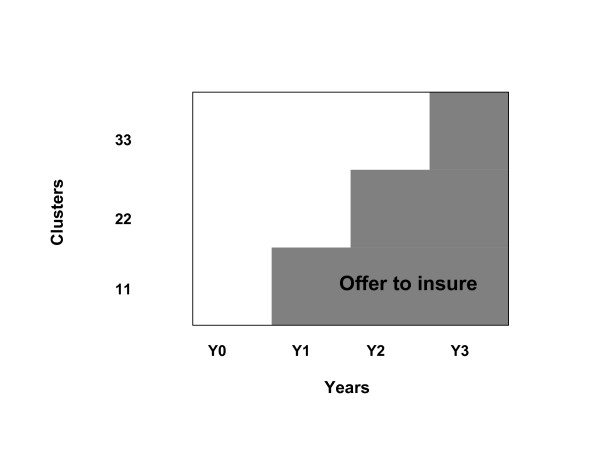
Background: We describe a step-wedge cluster-randomised community-based trial which has been conducted since 2003 to accompany the implementation of a community health insurance (CHI) scheme in West Africa. The trial aims at overcoming the paucity of evidence-based information on the impact of CHI. Impact is defined in terms of changes in health service utilisation and household protection against the cost of illness. Our exclusive focus on the description and discussion of the methods is justified by the fact that the study relies on a methodology previously applied in the field of disease control, but never in the field of health financing.
Methods: First, we clarify how clusters were defined both in respect of statistical considerations and of local geographical and socio-cultural concerns. Second, we illustrate how households within clusters were sampled. Third, we expound the data collection process and the survey instruments. Finally, we outline the statistical tools to be applied to estimate the impact of CHI.
Conclusion: We discuss all design choices both in relation to methodological considerations and to specific ethical and organisational concerns faced in the field. On the basis of the appraisal of our experience, we postulate that conducting relatively sophisticated trials (such as our step-wedge cluster-randomised community-based trial) aimed at generating sound public health evidence, is both feasible and valuable also in low income settings. Our work shows that if accurately designed in conjunction with local health authorities, such trials have the potential to generate sound scientific evidence and do not hinder, but at times even facilitate, the implementation of complex health interventions such as CHI.
Figures
References
-
- Atim C. The Contribution of Mutual Health Organizations to Financing, Delivery, and Access to Health Care: Synthesis of Research in Nine West and Central African Countries. Bethesda, MD: Partnerships for Health Reform Project, Abt Associates Inc; 1998.
-
- Dror DM, Jacquier C. Micro-Insurance: Extending Health insurance to the Excluded. International Social Security Review. 1999;52:71–97. doi: 10.1111/1468-246X.00034. - DOI
-
- Preker AS, Carrin G, Dror D, Jakab M, Hsiao W, Arhin-Tenkorang D. Rich-Poor Differences in Health Care Financing. In: Preker AS, Carrin G, editor. Health Financing for Poor People – Resource Mobilization and Risk Sharing. Washington: The World Bank; 2004. pp. 3–52.
-
- Criel B. District-based Health insurance in sub-Saharan Africa Part I: From Theory to Practice. Antwerp: ITG Press; 1998.
LinkOut - more resources
Full Text Sources
