


The role of progenitor cells in the development of intimal hyperplasia
- PMID: 18945574
- PMCID: PMC2924205
- DOI: 10.1016/j.jvs.2008.07.060
The role of progenitor cells in the development of intimal hyperplasia
Abstract
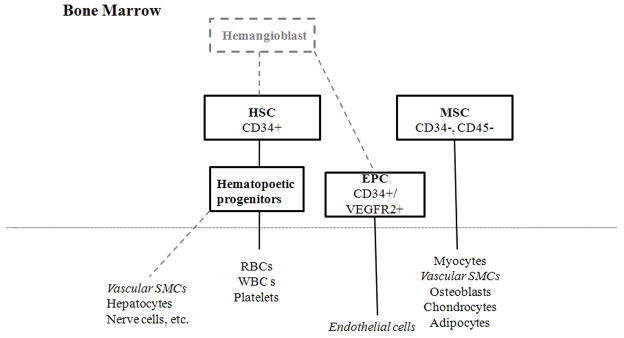
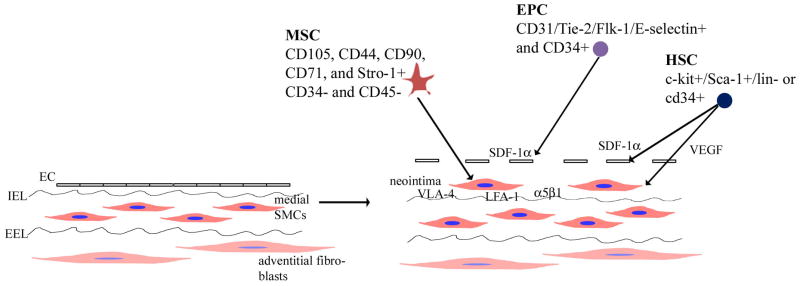
Recent evidence has suggested that bone marrow derived progenitor cells may contribute to the development of intimal hyperplasia after arterial injury, a process that classically has been believed to involve extracellular matrix deposition and the migration and proliferation of cells within the arterial wall. The first studies demonstrating the existence of bone marrow derived cells in the neointima employed mouse models of arterial injury in conjunction with whole bone marrow transplant. Later studies have shown specifically that bone marrow derived hematopoietic or mesenchymal stem cells can be recruited to the neointima and differentiate into smooth muscle cells or endothelial cells. Although the data vary widely depending on different animal models of arterial injury and methods of labeling bone marrow derived cells, it appears that progenitor cells do indeed contribute to intimal hyperplasia, at least in mouse models of arterial injury. To date, signaling molecules such as c-kit and c-kit ligand, and stromal derived factor-1alpha, in addition to matrix metalloproteinase-9, have emerged as critical factors that recruit progenitor cells to sites of arterial injury. While much progress has been made, several tasks remain, including the need for a more in-depth understanding of the mechanisms underlying progenitor cell recruitment, characterization of the involved progenitor cells, and finally validation that the observations made in these mouse models of disease are also applicable to human arterial restenosis.
Conflict of interest statement
No competing interests declared.
Figures
References
-
- Newby AC, Zaltsman AB. Molecular mechanisms in intimal hyperplasia. The Journal of pathology. 2000 Feb;190(3):300–309. - PubMed
-
- Zalewski A, Shi Y. Vascular myofibroblasts. Lessons from coronary repair and remodeling. Arteriosclerosis, thrombosis, and vascular biology. 1997 Mar;17(3):417–422. - PubMed
-
- Sata M, Saiura A, Kunisato A, Tojo A, Okada S, Tokuhisa T, Hirai H, Makuuchi M, Hirata Y, Nagai R. Hematopoietic stem cells differentiate into vascular cells that participate in the pathogenesis of atherosclerosis. Nature medicine. 2002 Apr;8(4):403–409. - PubMed
-
- Tanaka K, Sata M, Hirata Y, Nagai R. Diverse contribution of bone marrow cells to neointimal hyperplasia after mechanical vascular injuries. Circulation research. 2003 Oct 17;93(8):783–790. - PubMed
-
- Wang CH, Anderson N, Li SH, Szmitko PE, Cherng WJ, Fedak PW, Fazel S, Li RK, Yau TM, Weisel RD, Stanford WL, Verma S. Stem cell factor deficiency is vasculoprotective: unraveling a new therapeutic potential of imatinib mesylate. Circulation research. 2006 Sep 15;99(6):617–625. - PubMed
Publication types
MeSH terms
Grants and funding
LinkOut - more resources
Full Text Sources
Medical
