Case Reports
doi: 10.3174/ajnr.A1282.
Epub 2008 Oct 22.
Demonstration of cerebellar atrophy in neuroacanthocytosis of 2 siblings
Affiliations
- PMID: 18945802
- PMCID: PMC7051402
- DOI: 10.3174/ajnr.A1282
Item in Clipboard
Case Reports
Demonstration of cerebellar atrophy in neuroacanthocytosis of 2 siblings
AJNR Am J Neuroradiol.
2009 Feb.
Abstract
Neuroacanthocytosis is a rare hereditary disorder characterized by involuntary choreiform movements and erythrocytic acanthocytosis in the peripheral blood. Clinical manifestations of this disorder resemble those of Huntington disease (HD). Neuroimaging features of neuroacanthocytosis are atrophy and signal intensity change of the striata on MR imaging, as in HD. We report herein the cases of 2 siblings with neuroacanthocytosis showing cerebellar atrophy as well as atrophy and signal intensity changes of striata.
Figures
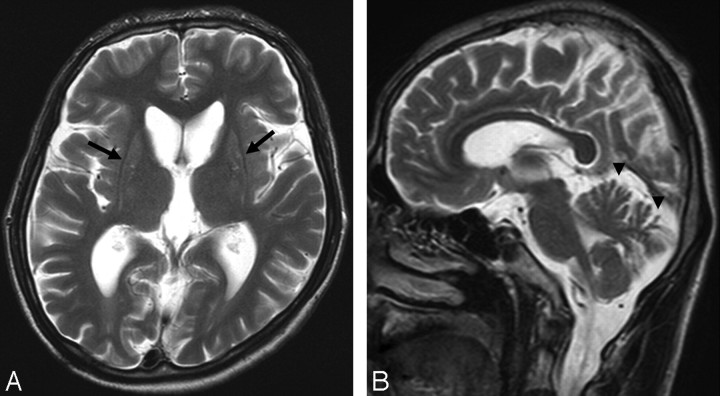
Case 1. T2-weighted MR imaging examination of the brain. A, Axial image showing atrophy of bilateral striata and mildly increased signal intensity from the putamen (arrow). B, Sagittal image showing atrophy in the superior cerebellum (arrowhead).
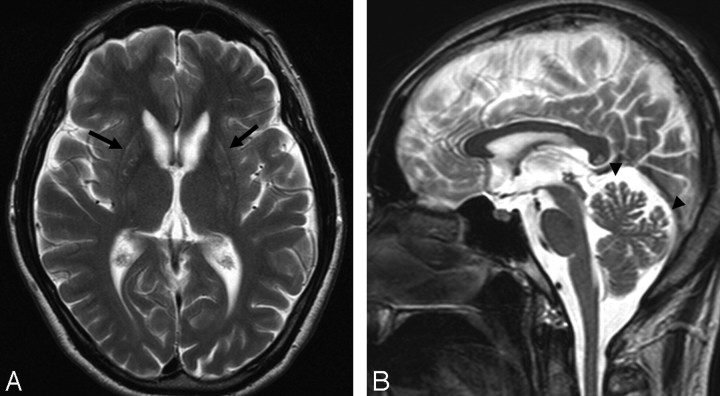
Case 2. T2-weighted MR imaging examination of the brain. Atrophy of bilateral striata, mildly increased signal intensity of the putamen (arrow, A) and cerebellar atrophy (arrowhead, B) are apparent, as in case 1.
References
-
- Citchley EM, Clark DB, Wikler A. Acanthocytosis and neurological disorder without abetalipoproteinemia. Arch Neurol 1968;18:134–40 - PubMed
-
- Levine IM, Estes JW, Looney JM. Hereditary neurological disease with acanthocytosis: a new syndrome. Arch Neurol 1968;19:403–09 - PubMed
-
- Sundaram SM, Kumar MJ, Sridhar R, et al. Neuroacanthocytosis misdiagnosed as Huntington's disease: a case report. J Neurol Sci 2004;219:163–66 - PubMed
-
- Kutcher JS, Kahn MJ, Andersson HC, et al. Neuroacanthocytosis masquerading as Huntington's disease: CT/MRI findings. J Neuroimaging 1999;9:187–89 - PubMed
-
- Okamoto K, Ito J, Furusawa T, et al. CT and MR findings of neuroacanthocytosis J Comput Assist Tomogr 1997;21:221–22 - PubMed
Publication types
MeSH terms
LinkOut - more resources
Full Text Sources
Medical