OPPORTUNITY: a randomized clinical trial of growth hormone on outcome in hemodialysis patients
- PMID: 18945992
- PMCID: PMC2572295
- DOI: 10.2215/CJN.02760608
OPPORTUNITY: a randomized clinical trial of growth hormone on outcome in hemodialysis patients
Abstract
Background: The mortality rate of maintenance hemodialysis (MHD) patients remains high. Measures of protein-energy wasting, including hypoalbuminemia, are strongly associated with their high mortality. Growth hormone (GH) may improve lean body mass (LBM) and serum albumin levels, and health-related quality of life (HRQoL), which are significantly and positively associated with survival in MHD patients. The OPPORTUNITY Trial will examine whether GH reduces mortality and morbidity and improves overall health in hypoalbuminemic MHD patients.
Hypothesis: The primary hypothesis is that daily recombinant human GH injections, compared with placebo, improve survival in hypoalbuminemic MHD patients. Secondary hypotheses are that GH improves morbidity and health, including number of hospitalized days, time to cardiovascular events, LBM, serum protein and inflammatory marker levels, exercise capacity, and HRQoL, and has a favorable safety profile.
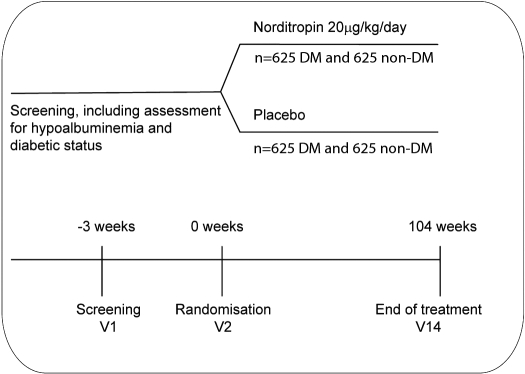
Design/measurements: This is a prospective, double-blind, multicenter, randomized clinical trial involving 2500 MHD patients, up to 50% with diabetes mellitus, from 22 countries. Patients are randomized in a 1:1 ratio to receive daily injections of GH (20 microg/kg per day) or placebo for 104 weeks. Key inclusion criteria include clinically stable and well-dialyzed (Kt/V > or =1.2) adult MHD patients with serum albumin <4.0 g/dl. Exclusion criteria include active malignancy, active proliferative or severe nonproliferative diabetic retinopathy, uncontrolled hypertension, chronic use of high-dose glucocorticoids, or immunosuppressive agents and pregnancy.
Conclusions: The OPPORTUNITY Trial is the first large-scale randomized clinical trial in adult MHD patients evaluating the response to GH of such clinical endpoints as mortality, morbidity, markers of body protein mass, inflammation, exercise capacity, and HRQoL.
Figures
References
-
- Lopes AA, Bragg-Gresham JL, Goodkin DA, Fukuhara S, Mapes DL, Young EW, Gillespie BW, Akizawa T, Greenwood RN, Andreucci VE, Akiba T, Held PJ, Port FK: Factors associated with health-related quality of life among hemodialysis patients in the DOPPS. Qual Life Res 16: 545–557, 2007 - PubMed
-
- U.S. Renal Data System: Annual Data Report: Atlas of chronic kidney disease and end-stage renal disease in the United States. Bethesda, MD, National Institutes of Health, National Institute of Diabetes and Digestive and Kidney Diseases, Vol. II, 2007, Reference tables page H207
-
- Kalantar-Zadeh K, Block G, McAllister CJ, Humphreys MH, Kopple JD: Appetite and inflammation, nutrition, anemia, and clinical outcome in hemodialysis patients. Am J Clin Nutr 80: 299–307, 2004 - PubMed
-
- Kalantar-Zadeh K, Kopple JD, Humphreys MH, Block G: Comparing outcome predictability of markers of malnutrition-inflammation complex syndrome in haemodialysis patients. Nephrol Dial Transplant 19: 1507–1519, 2004 - PubMed
-
- Mehrotra R, Kopple JD: Causes of protein-energy malnutrition in chronic renal failure. In: Nutritional Management of Renal Disease, edited by Kopple JD, Massry SG, Baltimore, MD, Lippincott Williams & Wilkins, 2004, pp 167–182
Publication types
MeSH terms
Substances
LinkOut - more resources
Full Text Sources
Medical