


An electrophysiological investigation of cross-language effects of orthographic neighborhood
- PMID: 18948089
- PMCID: PMC2656968
- DOI: 10.1016/j.brainres.2008.09.078
An electrophysiological investigation of cross-language effects of orthographic neighborhood
Abstract
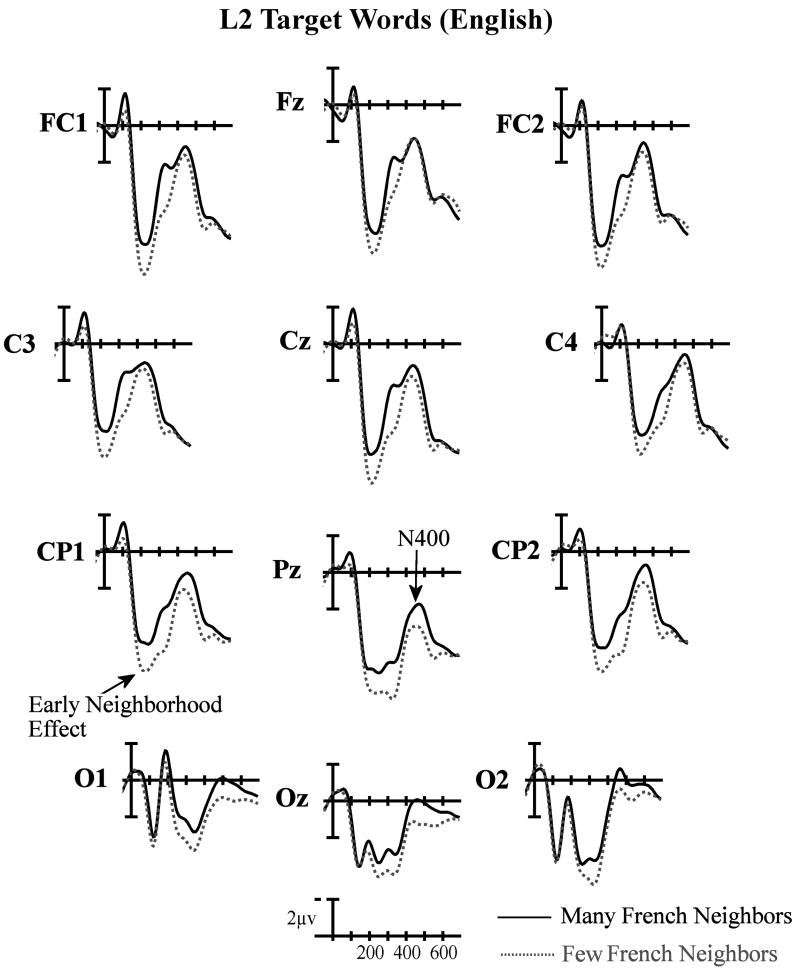
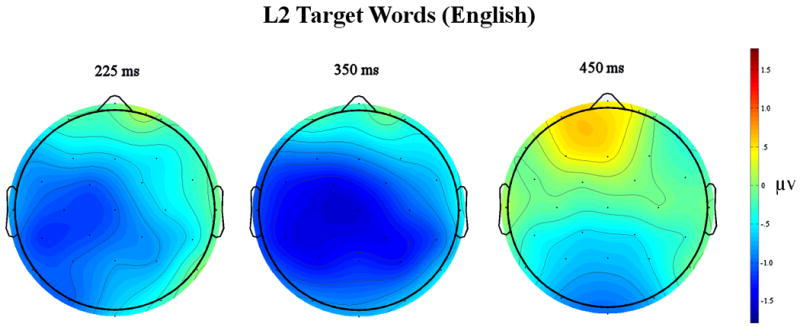
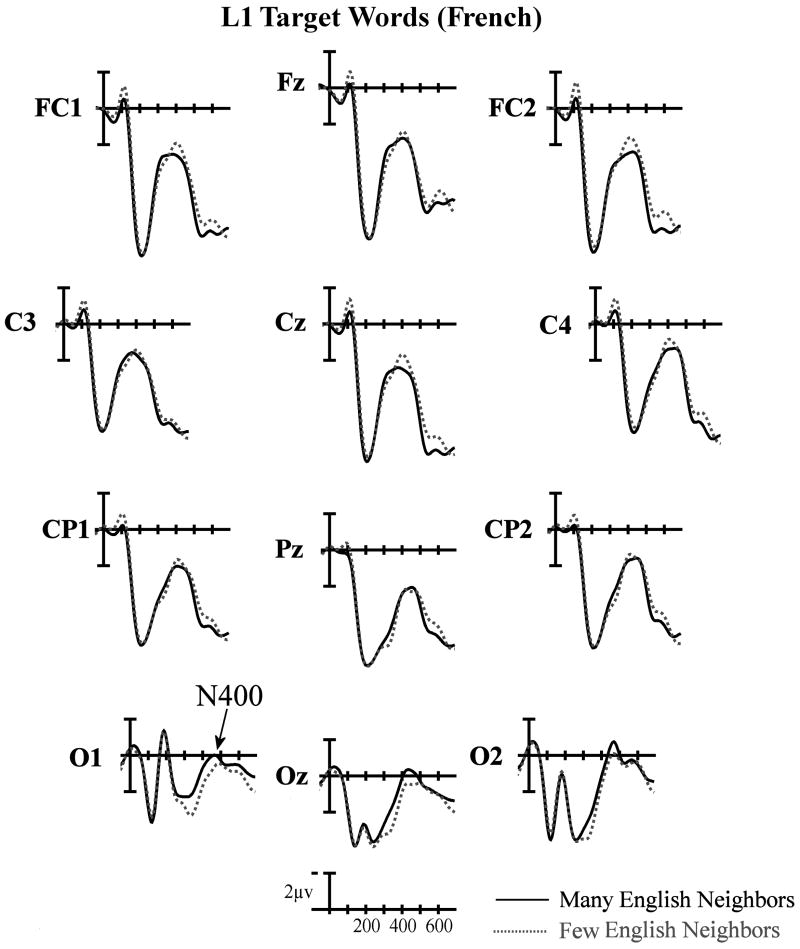
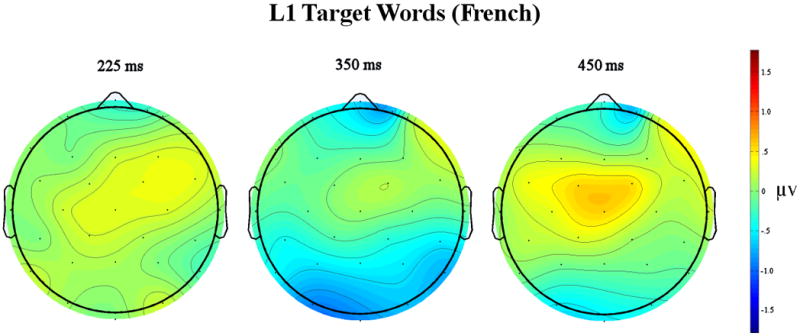
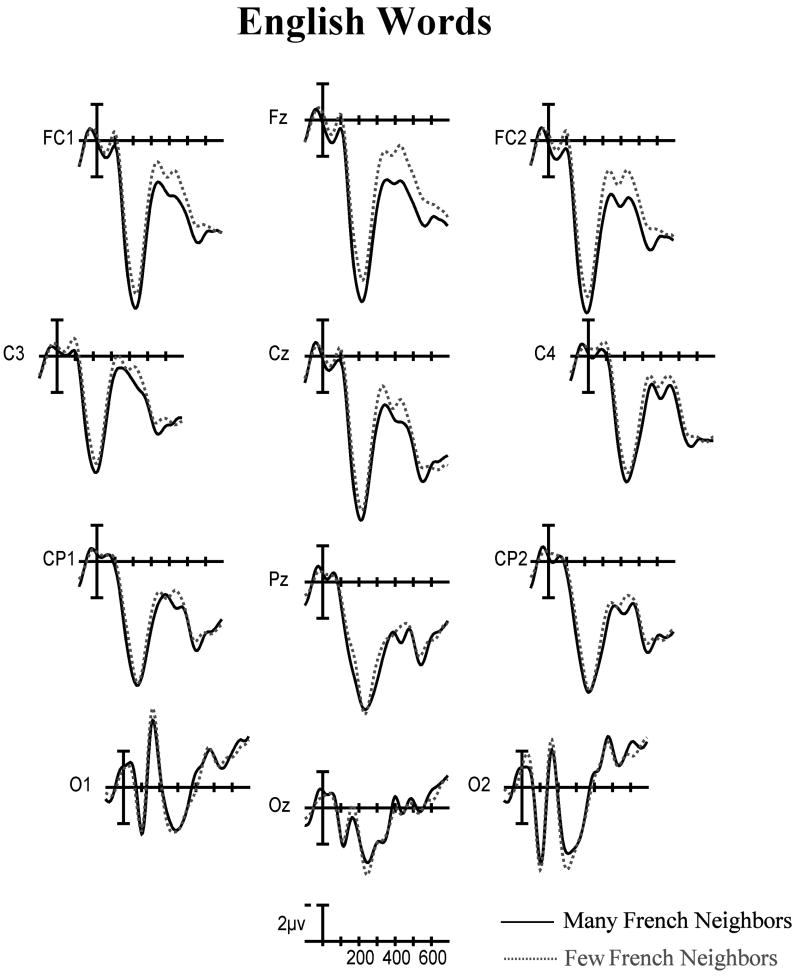
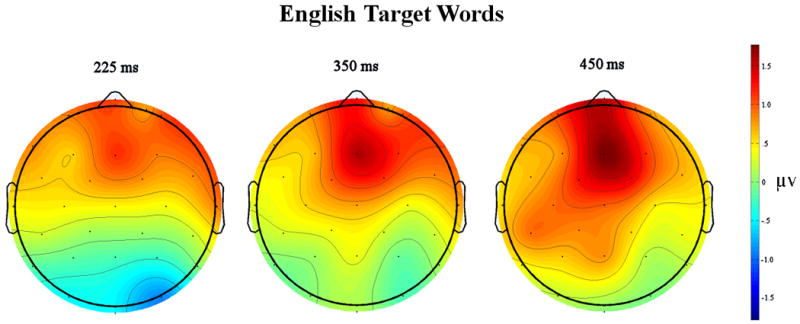
In Experiment 1 ERPs were recorded while French-English bilinguals read pure language lists of French and English words that differed in terms of the number of orthographic neighbors (many or few) they had in the other language. That is the number of French neighbors for English target words was varied and the number of English neighbors for French target words was varied. These participants showed effects of cross-language neighborhood size in the N400 ERP component that arose earlier and were more widely distributed for English (L2) target words than French (L1) targets. In a control experiment that served to demonstrate that these effects were not due to any other uncontrolled for item effects, monolingual L1 English participants read only the list of English targets that varied in the number of French (an unknown L) neighbors. These participants showed a very different pattern of effects of cross-language neighbors. These results provide further crucial evidence showing cross-language permeability in bilingual word recognition, a phenomena that was predicted and correctly simulated by the bilingual interactive-activation model (BIA+).
Figures
References
-
- Alvarez RP, Holcomb PJ, Grainger J. Accessing word meaning in two languages: An event-related brain potential study of beginning bilinguals. Brain Language. 2003;87(2):290–304. - PubMed
-
- Andrews S. Frequency and neighborhood effects on lexical access: Activation or search? Journal of Experimental Psychology: Learning, Memory, and Cognition. 1989;15(5):802–814.
-
- Andrews S. The effect of orthographic similarity on lexical retrieval: Resolving neighborhood conflicts. Psychonomic Bulletin Review. 1997;4(4):439–461.
-
- Baayen RH, Piepenbrock R, Gulikers L. The celex lexical database. Philadelphia, PA: Linguistic Data Consortium; 1995.
-
- Beauvillain C, Grainger J. Accessing interlexical homographs: Some limitations of a language-selective access. Journal of Memory and Language. 1987;26(6):658–672.
Publication types
MeSH terms
Grants and funding
LinkOut - more resources
Full Text Sources
