. 2008 Oct 28;105(43):16484-9.
doi: 10.1073/pnas.0806574105. Epub 2008 Oct 23.

Kinase requirements in human cells: III. Altered kinase requirements in VHL-/- cancer cells detected in a pilot synthetic lethal screen

Affiliations

Kinase requirements in human cells: III. Altered kinase requirements in VHL-/- cancer cells detected in a pilot synthetic lethal screen

Archana Bommi-Reddy et al. Proc Natl Acad Sci U S A. .

Abstract

Clear cell renal carcinomas are the most common form of kidney cancer and frequently are linked to biallelic inactivation of the von Hippel-Lindau (VHL) tumor suppressor gene. The VHL gene product, pVHL, has multiple functions including directing the polyubiquitylation of the HIF transcription factor. We screened 100 shRNA vectors, directed against 88 kinases, for their ability to inhibit the viability of VHL-/- renal carcinoma cells preferentially compared with isogenic cells in which pVHL function was restored. shRNAs for "hits" identified in the primary screen were interrogated in secondary screens that included shRNA titration studies. Multiple shRNAs against CDK6, MET, and MAP2K1 (also known as MEK1) preferentially inhibited the viability of 786-O and RCC4 VHL-/- cells compared with their wild-type pVHL-reconstituted counterparts. The sensitivity of pVHL-proficient cells to these shRNAs was not restored upon HIF activation, suggesting that loss of an hypoxia-inducible factor (HIF)-independent pVHL function formed the basis for selectivity. A small-molecule Cdk4/6 inhibitor displayed enhanced activity against VHL-/- renal carcinoma cells, suggesting that in some cases hits from shRNA screens such as described here might translate into therapeutic targets.


Conflict of interest statement

The authors declare no conflict of interest.

Figures

Fig. 1.
Fig. 1.
VHL status affects sensitivity to shRNA-mediated kinase inhibition. (A) Raw alamarBlue fluorescence values for 786-O cells infected with lentiviruses encoding kinase shRNAs. Red and black bars depict values for 786-O cells infected with a retrovirus encoding HA-pVHL or with the empty vector, respectively. The x-axis indicates rank order of shRNAs based on corresponding alamarBlue values after infection of the empty vector cells. See Table S2 for gene names. (B and C). Difference in percentage loss of viability (Δ %LOV), after normalization (see text) for 786-O cells (B) and RCC4 cells (C) infected with lentiviruses encoding kinase shRNAs. shRNAs that preferentially inhibit VHL−/− cells appear on the right, and the pVHL-restored cells to the left. See Tables S4 and S5 for gene names. Lentiviruses that scored positively in 786-O cells (Δ %LOV > 30% in B) are indicated with yellow bars in C.
Fig. 2.
Fig. 2.
Kinase shRNAs that preferentially inhibit VHL−/− renal carcinoma cells. (A) Heat map depicting the effects of the 100 shRNA vectors on the two cell-line pairs after normalization to the GFP cDNA and scrambled shRNA controls (see text). Hierarchical clustering analysis using the Manhattan clustering method was done using the TM4 program (35). Experiments or shRNAs with relatively similar patterns are clustered together. shRNAs causing > 50% loss of viability are indicated in red, and those with < 50% loss of viability are in green. (B) List of shRNA vectors (kinase name followed by TRC collection shRNA number) that scored positively (see text for criteria) when tested in 786-O and RCC4 isogenic cell-line pairs that did (VHL) or did not (vector) produce wild-type pVHL. (C) Photomicrographs (100 × magnification) of crystal violet-stained 786-O cells 5 days after infection with lentiviruses encoding the indicated shRNAs. scr = scrambled shRNA vector.
Fig. 3.
Fig. 3.
Kinase shRNAs that preferentially inhibit 786-O VHL−/− cells over a range of viral titers. (A) Viability of 786-O cells infected with indicated amounts of lentiviruses encoding shRNAs directed against CDK6, MET, or MAP2K1. Cell number was assayed in triplicate using alamarBlue 5 days after infection and normalized to scrambled hairpin control. Circles and squares depict values for 786-O cells infected with a retrovirus encoding HA-pVHL or with the empty vector, respectively. Error bars = 1 SEM. (B) Immunoblot analysis of cells treated with 2.5 μl, 5 μl, and 10 μl of virus as in A. scr = scrambled shRNA vector.
Fig. 4.
Fig. 4.
Deregulation of HIF2α does not fully explain the increased requirement of 786-O VHL−/− cells for CDK6, MAP2K1, and MET. (A) Immunoblot analysis of 786-O cells infected to produced HA-pVHL alone (VHL) or HA-pVHL and a stabilized version of HIF2α (VHL + dP →A). Parental cells infected with an empty virus (vector) served as controls. (B) Percentage loss of viability (% LOV) of cells (normalized to scrambled shRNA) infected as in A after subsequent infection with 5 μl (gray bars) or 10 μl (black bars) of lentiviruses encoding shRNAs targeting CDK6, MET, or MAP2K1. Cells were grown in 96-well plates and were assayed for survival in triplicate using alamarBlue 5 days post-infection. Error bars = 1 SEM.
Fig. 5.
Fig. 5.
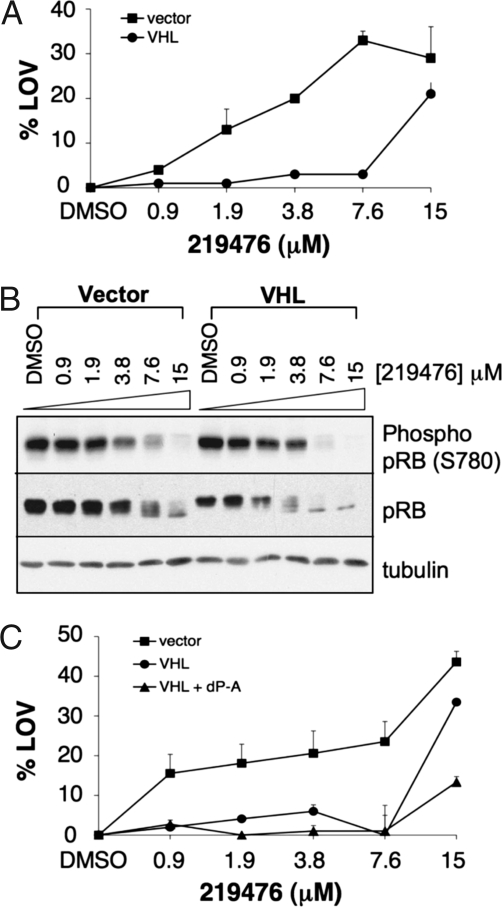
A CDK4/6 inhibitor preferentially inhibits VHL−/− cells. (A) Percentage loss of viability (%LOV) of 786-O cells infected with a retrovirus encoding HA-pVHL (circles) or empty vector (squares) and then treated with Cdk4/6 inhibitor (Calbiochem catalog no. 219476) at indicated concentrations for 48 h in 96-well plates. Viable cell number was determined in triplicate by XTT assay and normalized to DMSO-treated controls. Error bar = 1 SEM. (B). Immunoblot analysis of cells treated as in A. (C) Percentage loss of viability (%LOV) of 786-O cells infected to produced HA-pVHL alone (VHL; circles) or HA-pVHL and a stabilized version of HIF2α (VHL + dP →A; triangles) and then treated with Cdk4/6 inhibitor (Calbiochem catalog no. 219476). Parental cells infected with an empty virus (vector; squares) served as controls, and viability was determined as in A.

References

    1. Hartwell L, Szankasi P, Roberts C, Murray A, Friend S. Integrating genetic approaches into the discovery of anticancer drugs. Science. 1997;278:1064–1068. - PubMed
    1. Kaelin WG., Jr The concept of synthetic lethality in the context of anticancer therapy. Nat Rev Cancer. 2005;5:689–698. - PubMed
    1. Kaelin WG., Jr Cell biology: Divining cancer cell weaknesses. Nature. 2006;441:32–34. - PubMed
    1. Sharom JR, Bellows DS, Tyers M. From large networks to small molecules. Curr Opin Chem Biol. 2004;8:81–90. - PubMed
    1. Tong AH, et al. Global mapping of the yeast genetic interaction network. Science. 2004;303:808–813. - PubMed

Publication types

MeSH terms

LinkOut - more resources