


Inverse association between BMI and prefrontal metabolic activity in healthy adults
- PMID: 18948965
- PMCID: PMC2681079
- DOI: 10.1038/oby.2008.469
Inverse association between BMI and prefrontal metabolic activity in healthy adults
Abstract
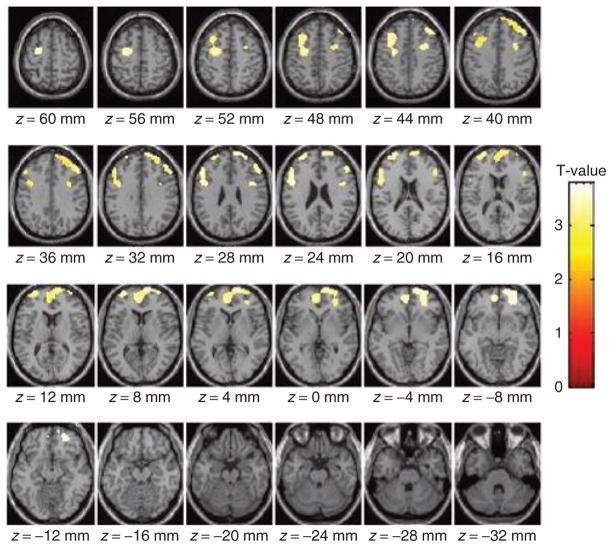
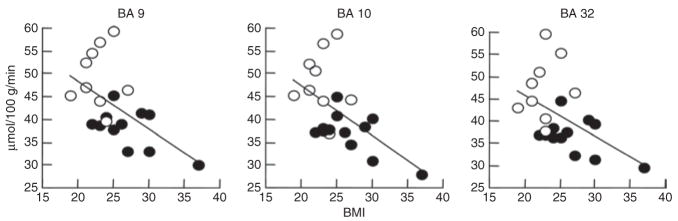
Obesity has been associated with a higher risk for impaired cognitive function, which most likely reflects associated medical complications (i.e., cerebrovascular pathology). However, there is also evidence that in healthy individuals excess weight may adversely affect cognition (executive function, attention, and memory). Here, we measured regional brain glucose metabolism (using positron emission tomography (PET) and 2-deoxy-2[(18)F]fluoro-D-glucose (FDG)) to assess the relationship between BMI and brain metabolism (marker of brain function) in 21 healthy controls (BMI range 19-37 kg/m(2)) studied during baseline (no stimulation) and during cognitive stimulation (numerical calculations). Statistical parametric mapping (SPM) revealed a significant negative correlation between BMI and metabolic activity in prefrontal cortex (Brodmann areas 8, 9, 10, 11, 44) and cingulate gyrus (Brodmann area 32) but not in other regions. Moreover, baseline metabolism in these prefrontal regions was positively associated with performance on tests of memory (California Verbal Learning Test) and executive function (Stroop Interference and Symbol Digit Modality tests). In contrast, the regional brain changes during cognitive stimulation were not associated with BMI nor with neuropsychological performance. The observed association between higher BMI and lower baseline prefrontal metabolism may underlie the impaired performance reported in healthy obese individuals on some cognitive tests of executive function. On the other hand, the lack of an association between BMI and brain metabolic activation during cognitive stimulation indicates that BMI does not influence brain glucose utilization during cognitive performance. These results further highlight the urgency to institute public health interventions to prevent obesity.
Conflict of interest statement
DISCLOSURE
The authors declared no conflict of interest.
Figures
References
-
- Pi-Sunyer FX. NHLBI Obesity education initiative expert panel of the identification, evaluation, and treatment of overweight and obesity in adults—the evidence report. Obes Res. 1998;6:51S–209S. - PubMed
-
- Elias M, Elias P, Sullivan L, Wolf P, D’Agostino R. Lower cognitive function in the presence of obesity and hypertension: the Framingham heart study. Int J Obes. 2003;27:260–268. - PubMed
-
- Chelune G, Ortega D, Linton J, Boustany M. Personality and cognitive findings among patients electing gastroplasty for morbid obesity. Int J Eat Disord. 1986;5:701–712.
-
- Gunstad J, Paul RH, Cohen RA, et al. Elevated body mass index is associated with executive dysfunction in otherwise healthy adults. Compr Psychiatry. 2007;48:57–61. - PubMed
Publication types
MeSH terms
Grants and funding
LinkOut - more resources
Full Text Sources
Other Literature Sources
Medical
