Horizontal versus familial transmission of Helicobacter pylori
- PMID: 18949030
- PMCID: PMC2563686
- DOI: 10.1371/journal.ppat.1000180
Horizontal versus familial transmission of Helicobacter pylori
Abstract
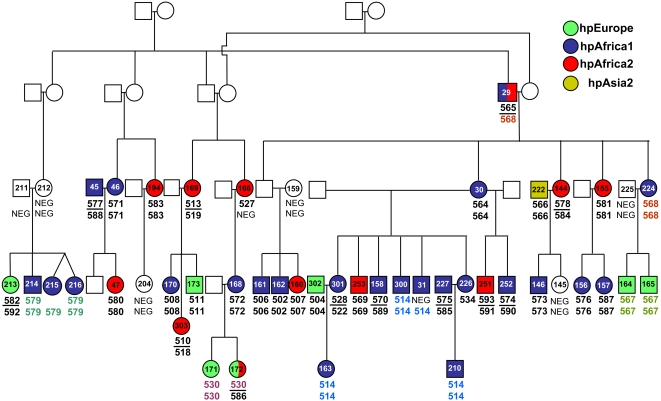
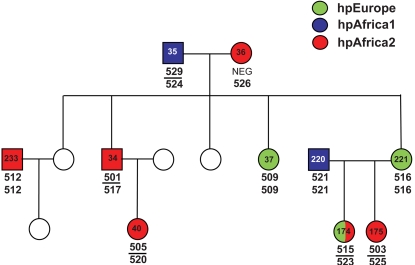
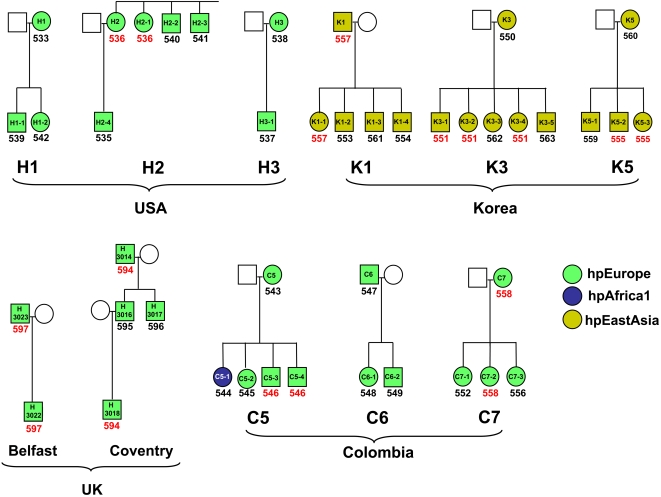
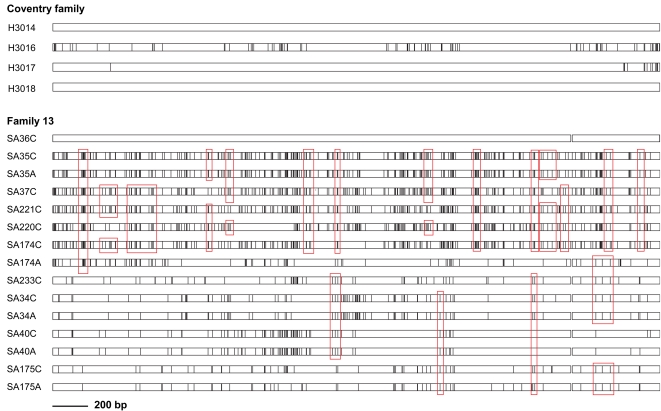
Transmission of Helicobacter pylori is thought to occur mainly during childhood, and predominantly within families. However, due to the difficulty of obtaining H. pylori isolates from large population samples and to the extensive genetic diversity between isolates, the transmission and spread of H. pylori remain poorly understood. We studied the genetic relationships of H. pylori isolated from 52 individuals of two large families living in a rural community in South Africa and from 43 individuals of 11 families living in urban settings in the United Kingdom, the United States, Korea, and Colombia. A 3,406 bp multilocus sequence haplotype was determined for a total of 142 H. pylori isolates. Isolates were assigned to biogeographic populations, and recent transmission was measured as the occurrence of non-unique isolates, i.e., isolates whose sequences were identical to those of other isolates. Members of urban families were almost always infected with isolates from the biogeographic population that is common in their location. Non-unique isolates were frequent in urban families, consistent with familial transmission between parents and children or between siblings. In contrast, the diversity of H. pylori in the South African families was much more extensive, and four distinct biogeographic populations circulated in this area. Non-unique isolates were less frequent in South African families, and there was no significant correlation between kinship and similarity of H. pylori sequences. However, individuals who lived in the same household did have an increased probability of carrying the same non-unique isolates of H. pylori, independent of kinship. We conclude that patterns of spread of H. pylori under conditions of high prevalence, such as the rural South African families, differ from those in developed countries. Horizontal transmission occurs frequently between persons who do not belong to a core family, blurring the pattern of familial transmission that is typical of developed countries. Predominantly familial transmission in urban societies is likely a result of modern living conditions with good sanitation and where physical contact between persons outside the core family is limited and regulated by societal rules. The patterns observed in rural South African families may be representative of large parts of the developing world.
Conflict of interest statement
The authors have declared that no competing interests exist.
Figures
References
-
- Suerbaum S, Michetti P. Helicobacter pylori infection. N Engl J Med. 2002;347:1175–1186. - PubMed
-
- Achtman M, Azuma T, Berg DE, Ito Y, Morelli G, et al. Recombination and clonal groupings within Helicobacter pylori from different geographic regions. Mol Microbiol. 1999;32:459–470. - PubMed
-
- Falush D, Wirth T, Linz B, Pritchard JK, Stephens M, et al. Traces of human migrations in Helicobacter pylori populations. Science. 2003;299:1582–1585. - PubMed
-
- Ng BL, Ng HC, Goh KT, Ho B. Helicobacter pylori in familial clusters based on antibody profile. FEMS Immunol Med Microbiol. 2001;30:139–142. - PubMed
Publication types
MeSH terms
LinkOut - more resources
Full Text Sources
Medical