doi: 10.1371/journal.pgen.1000232.
Epub 2008 Oct 24.
Genetical genomics: spotlight on QTL hotspots
Affiliations
- PMID: 18949031
- PMCID: PMC2563687
- DOI: 10.1371/journal.pgen.1000232
Item in Clipboard
Genetical genomics: spotlight on QTL hotspots
PLoS Genet.
2008 Oct.
No abstract available
Figures
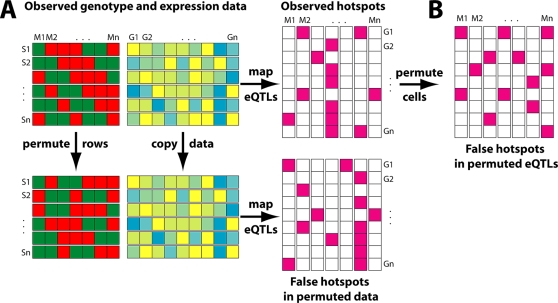
(A) The top panel shows the original data. The genotype matrix contains information about the genotype of each strain (S1…Sn) at each marker position along the genome (M1…Mn). For each strain, the expression of genes G1…Gn is measured. Linkage or association mapping combines these two sources of information to yield the eQTL matrix, where each purple entry indicates a significant linkage or association for a gene at a particular locus. The bottom panel illustrates the permutation strategy advocated here, where the strain labels are permuted, so that each strain is assigned the genotype vector of another random strain, while the expression matrix is unchanged. When the mapping is repeated on these permuted data, the correlation structure of gene expression is maintained, leading to an accurate estimate of the clustered distribution of false eQTLs along the genome. (B) shows the permutation strategy used in , where the original eQTL matrix is permuted by assigning the same number of eQTLs to genes randomly. The correlation of gene expression is lost, leading to an underestimate of the clustered pattern of spurious eQTLs.
Comment on
- PLoS Genet. 4:e070.
References
-
- Schadt EE, Monks SA, Drake TA, Lusis AJ, Che N, et al. Genetics of gene expression surveyed in maize, mouse and man. Nature. 2003;422:297–302. - PubMed
-
- de Koning DJ, Haley CS. Genetical genomics in humans and model organisms. Trends Genet. 2005;21:377–381. - PubMed
-
- Emilsson V, Thorleifsson G, Zhang B, Leonardson AS, Zink F, et al. Genetics of gene expression and its effect on disease. Nature. 2008;452:423–428. - PubMed
MeSH terms
LinkOut - more resources
Full Text Sources