Review
. 2009 Feb;23(1):41-8.
doi: 10.1007/s10557-008-6140-9. Epub 2008 Oct 24.

Leukotriene signaling in atherosclerosis and ischemia

Affiliations
Review

Leukotriene signaling in atherosclerosis and ischemia

Magnus Bäck. Cardiovasc Drugs Ther. 2009 Feb.

Abstract

Introduction: The inflammatory process of atherosclerosis is associated with several pathophysiological reactions within the vascular wall. The arachidonic acid released by phospholipase A(2) serves as substrate for the production of a group of lipid mediators known as the leukotrienes, which induce pro-inflammatory signaling through activation of specific BLT and CysLT receptors.

Discussion: Leukotriene signaling has been implicated in early lipid retention and foam cell accumulation, as well as in the development of intimal hyperplasia and advanced atherosclerotic lesions. Furthermore, the association of leukotrienes with degradation of extracellular matrix has suggested a role in atherosclerotic plaque rupture. Finally, studies of either myocardial or cerebral ischemia and reperfusion indicate that leukotriene signaling in addition may be involved in the development of ischemic injury.

Conclusion: Both leukotriene synthesis inhibitors and leukotriene receptor antagonists have been suggested to induce beneficial effects at different stages of the atherosclerosis process.


Figures
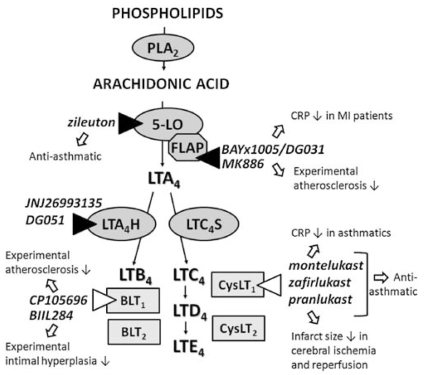
Fig. 1
Fig. 1
The formation of leukotrienes (LTs) through the 5-lipoxygenase pathway of arachidonic acid metabolism, and the effects of LT inhibitors in different contexts. Gray ovals indicate the enzymes involved in LT biosynthesis; Phospholipase A2 (PLA2), 5-lipoxygenase (5-LO) with its activating protein (FLAP), LTA4 hydrolase (LTA4H), and LTC4 synthase (LTC4S). Rectangles indicate the LT receptors. Examples of LT synthesis inhibitors are indicated by black triangles, whereas examples of LT receptor antagonists are indicated by open triangles
Fig. 2
Fig. 2
The potential involvement of leukotrienes in the different stages of the atherosclerosis process eventually leading to cerebral and myocardial ischemia. Abbreviations: SMC smooth muscle cells, MMP matrix metalloproteinase, I/R ischemia and reperfusion

References

    1. Brocklehurst WE. The release of histamine and formation of a slow-reacting substance (SRS-A) during anaphylactic shock. J Physiol. 1960;151:416–35. - PMC - PubMed
    1. Feldberg W, Kellaway CH. Liberation of histamine and formation of lysocithin-like substances by cobra venom. J Physiol. 1938;94:187–226. - PMC - PubMed
    1. Schaloske RH, Dennis EA. The phospholipase A2 superfamily and its group numbering system. Biochim Biophys Acta. 2006;1761:1246–59. - PubMed
    1. Peters-Golden M, Henderson WR., Jr Leukotrienes. N Engl J Med. 2007;357:1841–54. - PubMed
    1. Bäck M. Leukotriene receptors: crucial components in vascular inflammation. Scientific World Journal. 2007;7:1422–39. - PMC - PubMed

Publication types

MeSH terms
