


Prevalence of CKD in the United States: a sensitivity analysis using the National Health and Nutrition Examination Survey (NHANES) 1999-2004
- PMID: 18950914
- PMCID: PMC2664624
- DOI: 10.1053/j.ajkd.2008.07.034
Prevalence of CKD in the United States: a sensitivity analysis using the National Health and Nutrition Examination Survey (NHANES) 1999-2004
Abstract
Background: Estimates of chronic kidney disease (CKD) in the United States using the continuous National Health and Nutrition Examination Survey (NHANES) data set 1999-2004 indicate that 13.1% of the population (26.3 million people based on the 2000 census) has CKD stages 1 to 4.
Study design: We performed sensitivity analyses to highlight assumptions underlying these estimates and illustrate their robustness to varying assumptions.
Setting & participants: NHANES 1999-2004 was a nationally representative cross-sectional continuous survey of the civilian noninstitutionalized US population. Our sample included participants 20 years and older.
Reference test: Estimated glomerular filtration rate (GFR) less than 60 mL/min/1.73 m(2) defined from the 4-variable Modification of Diet in Renal Disease (MDRD) Study equation; albuminuria defined as persistence of urinary albumin-creatinine ratio greater than 30 mg/g.
Index tests: We compared prevalence estimates using the MDRD Study equation with 2 other GFR estimating equations (equation 5 by Rule et al from the Mayo Clinic Donors study; Cockcroft-Gault equation adjusted for body surface area and corrected for the bias in the MDRD Study sample), and sex-specific cutoff values to define albuminuria.
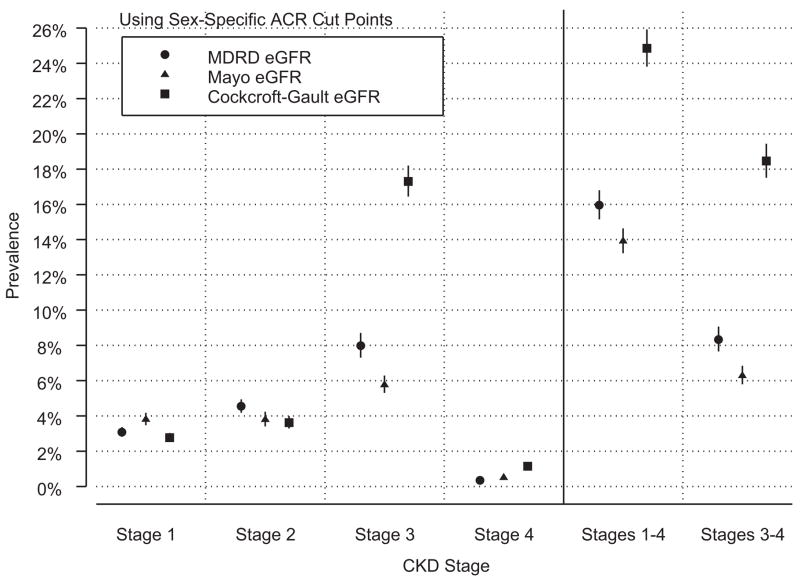
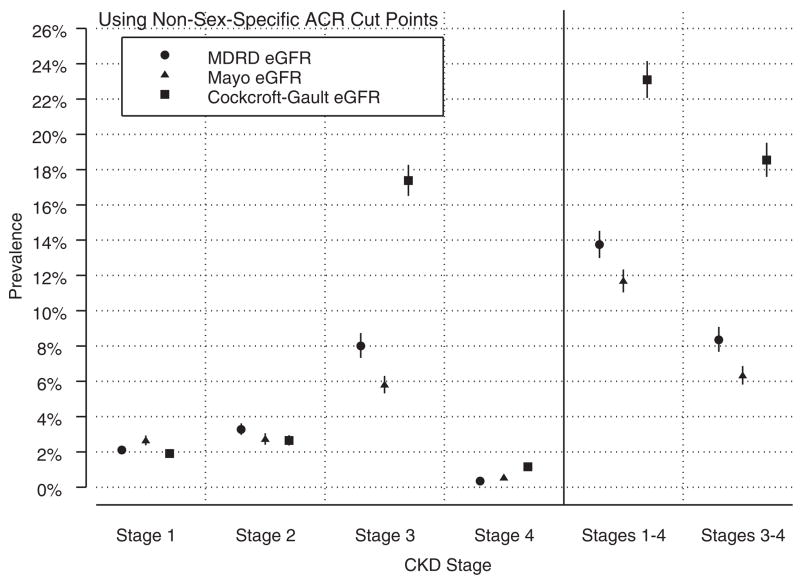
Results: We found CKD stages 1 to 4 prevalence estimates ranging from 11.7% to 24.9%, a more than 2-fold difference resulting in population estimates of 25.8 million to 54.0 million people using 2006 population estimates. Considering only stages 3 and 4, which are not affected by the choice of cutoff values to define albuminuria, prevalence estimates ranged from 6.3% to 18.6%, resulting in population estimates of 13.7 million to 40.3 million people, a nearly 3-fold difference.
Limitations: NHANES 1999-2004 is a cross-sectional survey and allows for GFR and albumin-creatinine ratio estimates at 1 point in time. NHANES does not account for seniors in long-term care facilities.
Conclusions: Although CKD prevalence is high regardless of varying modeling assumptions, different assumptions yield large differences in prevalence estimates.
Figures
Comment in
-
Prevalence of CKD in the United States: GFR-estimating equations matter.Am J Kidney Dis. 2009 Jul;54(1):184-5; author reply 185. doi: 10.1053/j.ajkd.2009.02.020. Am J Kidney Dis. 2009. PMID: 19559341 Free PMC article. No abstract available.
References
-
- Coresh J, Selvin E, Stevens LA, et al. Prevalence of chronic kidney disease in the United States. JAMA. 2007;298:2038–2047. - PubMed
-
- National Kidney Foundation. K/DOQI clinical practice guidelines for chronic kidney disease: evaluation, classification, and stratification. Kidney Disease Outcome Quality Initiative. Am J Kidney Dis. 2002;39:S1–246. - PubMed
-
- Levey AS, Greene T, Kusek JW, Beck GL. A Simplified Equation to Predict Glomerular Filtration Rate from Serum Creatinine. J Am Soc Nephrol. 2000;11:155A.
-
- Levey AS, Coresh J, Greene T, et al. Expressing the Modification of Diet in Renal Disease Study equation for estimating glomerular filtration rate with standardized serum creatinine values. Clin Chem. 2007;53:766–772. - PubMed
-
- Eknoyan G, Hostetter T, Bakris GL, et al. Proteinuria and other markers of chronic kidney disease: a position statement of the national kidney foundation (NKF) and the national institute of diabetes and digestive and kidney diseases (NIDDK) Am J Kidney Dis. 2003;42:617–622. - PubMed
Publication types
MeSH terms
Substances
Grants and funding
LinkOut - more resources
Full Text Sources
Other Literature Sources
Medical
