


Mid- and late-life diabetes in relation to the risk of dementia: a population-based twin study
- PMID: 18952836
- PMCID: PMC2606895
- DOI: 10.2337/db08-0586
Mid- and late-life diabetes in relation to the risk of dementia: a population-based twin study
Abstract
Objective: We aimed to verify the association between diabetes and the risk of dementia, Alzheimer's disease, and vascular dementia in twins and to explore whether genetic and early-life environmental factors could contribute to this association.
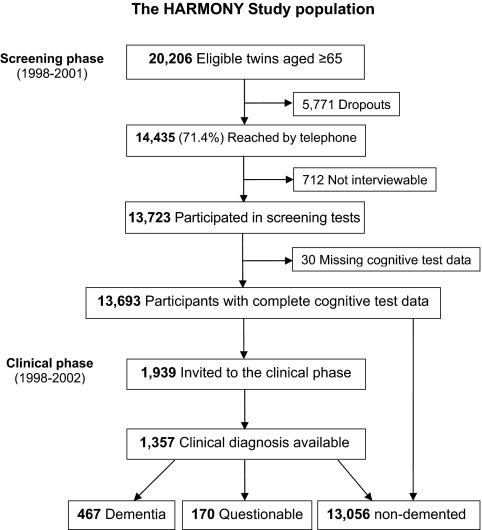
Research design and methods: This study included 13,693 twin individuals aged > or =65 years. Dementia was diagnosed according to DSM-IV (Diagnostic Manual of Mental Disorders, 4th ed.) criteria. Information on diabetes was collected from the inpatient registry and self- or informant-reported history of diabetes. Data were analyzed following two strategies: 1) unmatched case-control analysis for all participants using generalized estimating equation (GEE) models and 2) cotwin matched case-control analysis for dementia-discordant twin pairs using conditional logistic regression.
Results: Of all participants, 467 were diagnosed with dementia, including 292 with Alzheimer's disease and 105 with vascular dementia, and an additional 170 were diagnosed with questionable dementia. Diabetes was present in 1,396 subjects. In GEE models, diabetes was associated with adjusted odds ratios (ORs) (95% CI) of 1.89 (1.51-2.38) for dementia, 1.69 (1.16-2.36) for Alzheimer's disease, and 2.17 (1.36-3.47) for vascular dementia. Compared with late-life diabetes (onset age > or =65 years), the risk effect of mid-life diabetes (onset age <65 years) on dementia was stronger. Conditional logistic analysis of 210 dementia-discordant twin pairs led to ORs of 2.41 (1.05-5.51) and 0.68 (0.30-1.53) for dementia related to mid- and late-life diabetes, respectively.
Conclusions: Diabetes increases the risk of Alzheimer disease and vascular dementia. The risk is stronger when diabetes occurs at mid-life than in late life. Genetic and early-life environmental factors might contribute to the late-life diabetes-dementia association but could not account for the mid-life diabetes-dementia association.
Figures

References
-
- Leibson CL, Rocca WA, Hanson VA, Cha R, Kokmen E, O'Brien PC, Palumbo PJ: Risk of dementia among persons with diabetes mellitus: a population-based cohort study. Am J Epidemiol 145: 301–308, 1997 - PubMed
-
- Ott A, Stolk RP, van Harskamp F, Pols HA, Hofman A, Breteler MM: Diabetes mellitus and the risk of dementia: the Rotterdam Study. Neurology 53: 1937–1942, 1999 - PubMed
-
- Luchsinger JA, Tang MX, Stern Y, Shea S, Mayeux R: Diabetes mellitus and risk of Alzheimer's disease and dementia with stroke in a multiethnic cohort. Am J Epidemiol 154: 635–641, 2001 - PubMed
-
- Hassing LB, Johansson B, Nilsson SE, Berg S, Pedersen NL, Gatz M, McClearn G: Diabetes mellitus is a risk factor for vascular dementia, but not for Alzheimer's disease: a population-based study of the oldest old. Int Psychogeriatr 14: 239–248, 2002 - PubMed
-
- Peila R, Rodriguez BL, Launer LJ: Type 2 diabetes, APOE gene, and the risk for dementia and related pathologies: the Honolulu-Asia Aging Study. Diabetes 51: 1256–1262, 2002 - PubMed
Publication types
MeSH terms
Grants and funding
LinkOut - more resources
Full Text Sources
Other Literature Sources
Medical
