


Mouse and human phenotypes indicate a critical conserved role for ERK2 signaling in neural crest development
- PMID: 18952847
- PMCID: PMC2579387
- DOI: 10.1073/pnas.0805239105
Mouse and human phenotypes indicate a critical conserved role for ERK2 signaling in neural crest development
Abstract
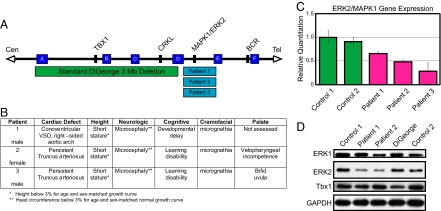
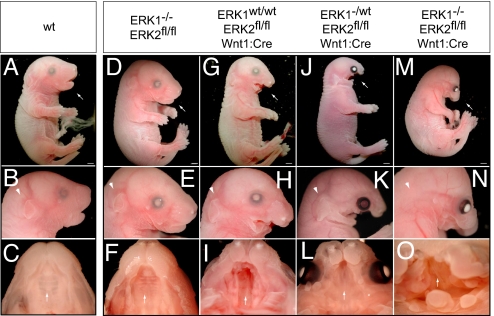
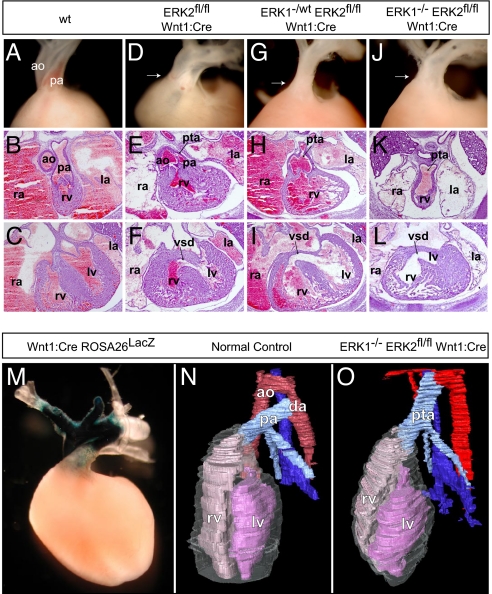
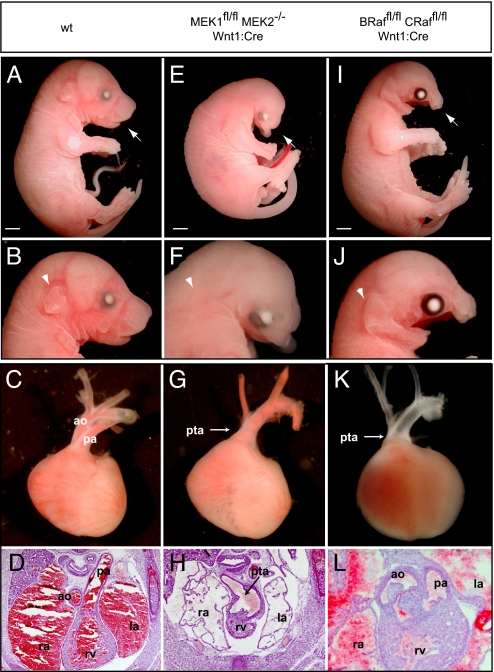
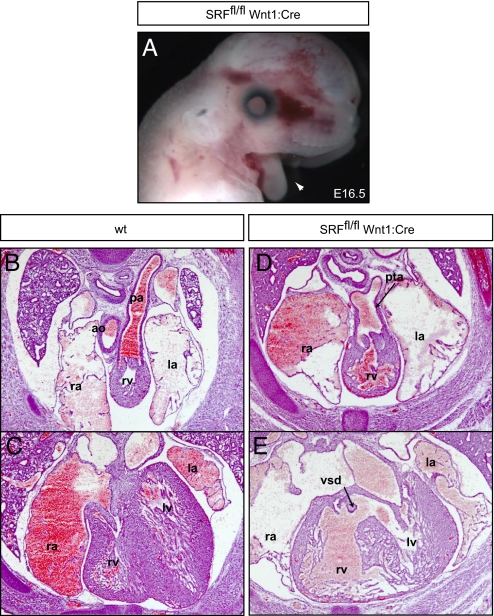
Disrupted ERK1/2 (MAPK3/MAPK1) MAPK signaling has been associated with several developmental syndromes in humans; however, mutations in ERK1 or ERK2 have not been described. We demonstrate haplo-insufficient ERK2 expression in patients with a novel approximately 1 Mb micro-deletion in distal 22q11.2, a region that includes ERK2. These patients exhibit conotruncal and craniofacial anomalies that arise from perturbation of neural crest development and exhibit defects comparable to the DiGeorge syndrome spectrum. Remarkably, these defects are replicated in mice by conditional inactivation of ERK2 in the developing neural crest. Inactivation of upstream elements of the ERK cascade (B-Raf and C-Raf, MEK1 and MEK2) or a downstream effector, the transcription factor serum response factor resulted in analogous developmental defects. Our findings demonstrate that mammalian neural crest development is critically dependent on a RAF/MEK/ERK/serum response factor signaling pathway and suggest that the craniofacial and cardiac outflow tract defects observed in patients with a distal 22q11.2 micro-deletion are explained by deficiencies in neural crest autonomous ERK2 signaling.
Conflict of interest statement
The authors declare no conflict of interest.
Figures
References
-
- Pearson G, et al. Mitogen-activated protein (MAP) kinase pathways: Regulation and physiological functions. Endocr Rev. 2001;22:153–183. - PubMed
-
- Posern G, Treisman R. Actin' together: Serum response factor, its cofactors and the link to signal transduction. Trends Cell Biol. 2006;16:588–596. - PubMed
-
- Shaw PE, Saxton J. Ternary complex factors: Prime nuclear targets for mitogen-activated protein kinases. Int J Biochem Cell Biol. 2003;35:1210–1226. - PubMed
-
- Schubbert S, Bollag G, Shannon K. Deregulated Ras signaling in developmental disorders: New tricks for an old dog. Curr Opin Genet Dev. 2007;17:15–22. - PubMed
-
- Bentires-Alj M, Kontaridis MI, Neel BG. Stops along the RAS pathway in human genetic disease. Nat Med. 2006;12:283–285. - PubMed
Publication types
MeSH terms
Substances
Grants and funding
- HL080637/HL/NHLBI NIH HHS/United States
- R01 NS031768/NS/NINDS NIH HHS/United States
- R01 NS034814/NS/NINDS NIH HHS/United States
- F31 MH074241/MH/NIMH NIH HHS/United States
- R21 HL080637/HL/NHLBI NIH HHS/United States
- F32 NS061591/NS/NINDS NIH HHS/United States
- F31-MH074241/MH/NIMH NIH HHS/United States
- R37 NS034814/NS/NINDS NIH HHS/United States
- Howard Hughes Medical Institute/United States
- HL074731/HL/NHLBI NIH HHS/United States
- P50 HL074731/HL/NHLBI NIH HHS/United States
- NS34814/NS/NINDS NIH HHS/United States
- NS031768/NS/NINDS NIH HHS/United States
LinkOut - more resources
Full Text Sources
Molecular Biology Databases
Research Materials
Miscellaneous
