. 2009 Jan;37(Database issue):D987-91.
doi: 10.1093/nar/gkn807. Epub 2008 Oct 25.

ATTED-II provides coexpressed gene networks for Arabidopsis

Affiliations

ATTED-II provides coexpressed gene networks for Arabidopsis

Takeshi Obayashi et al. Nucleic Acids Res. 2009 Jan.

Abstract

ATTED-II (http://atted.jp) is a database of gene coexpression in Arabidopsis that can be used to design a wide variety of experiments, including the prioritization of genes for functional identification or for studies of regulatory relationships. Here, we report updates of ATTED-II that focus especially on functionalities for constructing gene networks with regard to the following points: (i) introducing a new measure of gene coexpression to retrieve functionally related genes more accurately, (ii) implementing clickable maps for all gene networks for step-by-step navigation, (iii) applying Google Maps API to create a single map for a large network, (iv) including information about protein-protein interactions, (v) identifying conserved patterns of coexpression and (vi) showing and connecting KEGG pathway information to identify functional modules. With these enhanced functions for gene network representation, ATTED-II can help researchers to clarify the functional and regulatory networks of genes in Arabidopsis.


Figures
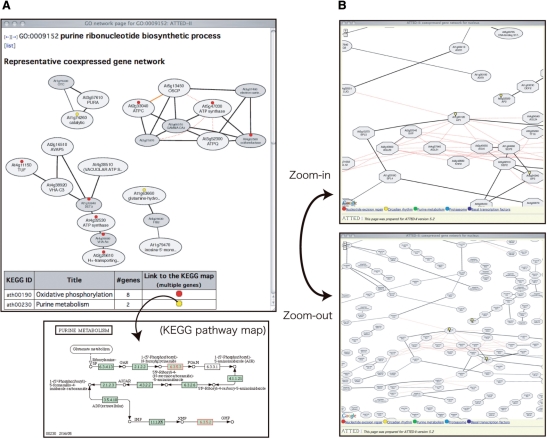
Figure 1.
Figure 1.
(A) An example of coexpressed gene networks for ‘purine ribonucleotide biosynthetic process’ (GO:0009152). Solid edges (lines) indicate gene coexpression, and red dotted edges indicate PPIs. Orange edges indicate conserved coexpression between Arabidopsis and at least one of three mammalian species (human, mouse and rat). Octagon-shaped nodes indicate TF genes, and circular nodes indicate other types of genes. Large nodes are genes with the GO annotation, which are the input genes used to construct these networks. The small gray-shaded nodes are genes automatically selected based on the strength of gene coexpression. Common KEGG pathways in the network are denoted by color-coded (red or yellow) dots in the nodes. (Note that this KEGG pathway is just part of the whole pathway.) This page can be obtained at [http://atted.jp/data/gonetwork/GO:0009152.html]. (B) An example of coexpressed gene networks for an organelle (nucleus). We used Google Maps API to display the huge coexpression map interactively. Yellow balloons mark the user-specified genes (AP1, AP2, AP3 in this case). Black solid edges indicate gene coexpression, and red dotted edges indicate PPIs. Octagon-shaped nodes indicate TF genes, and circular nodes indicate other types of genes. This page can be generated at [http://atted.jp/gmap/nucleus/?gene=At1g69120,At5g52020,At3g54340]. The window focuses on the first gene (At1g69120).

References

    1. Eisen MB, Spellman PT, Brown PO, Botstein D. Cluster analysis and display of genome-wide expression patterns. Proc. Natl. Acad. Sci. USA. 1998;95:14863–14868. - PMC - PubMed
    1. Aoki K, Ogata Y, Shibata D. Approaches for extracting practical information from gene co-expression networks in plant biology. Plant Cell Physiol. 2007;48:381–390. - PubMed
    1. Shoemaker BA, Panchenko AR. Deciphering protein-protein interactions. Part I. Experimental techniques and databases. PLoS Comput. Biol. 2007;3:e42. - PMC - PubMed
    1. Barrett T, Troup DB, Wilhite SE, Ledoux P, Rudnev D, Evangelista C, Kim IF, Soboleva A, Tomashevsky M, Edgar R. NCBI GEO: mining tens of millions of expression profiles–database and tools update. Nucleic Acids Res. 2007;35:D760–D765. - PMC - PubMed
    1. Craigon DJ, James N, Okyere J, Higgins J, Jotham J, May S. NASCArrays: a repository for microarray data generated by NASC's transcriptomics service. Nucleic Acids Res. 2004;32:D575–D577. - PMC - PubMed

Publication types
