. 2009 Jan;30(3):409-22.
doi: 10.1016/j.biomaterials.2008.09.040. Epub 2008 Oct 26.

Elastin-mimetic protein polymers capable of physical and chemical crosslinking

Affiliations

Elastin-mimetic protein polymers capable of physical and chemical crosslinking

Rory E Sallach et al. Biomaterials. 2009 Jan.

Abstract

We report the synthesis of a new class of recombinant elastin-mimetic triblock copolymer capable of both physical and chemical crosslinking. These investigations were motivated by a desire to capture features unique to both physical and chemical crosslinking schemes so as to exert optimal control over a wide range of potential properties afforded by protein-based multiblock materials. We postulated that by chemically locking a multiblock protein assembly in place, functional responses that are linked to specific domain structures and morphologies may be preserved over a broader range of loading conditions that would otherwise disrupt microphase structure solely stabilized by physical crosslinking. Specifically, elastic modulus was enhanced and creep strain reduced through the addition of chemical crosslinking sites. Additionally, we have demonstrated excellent in vivo biocompatibility of glutaraldehyde treated multiblock systems.


Figures
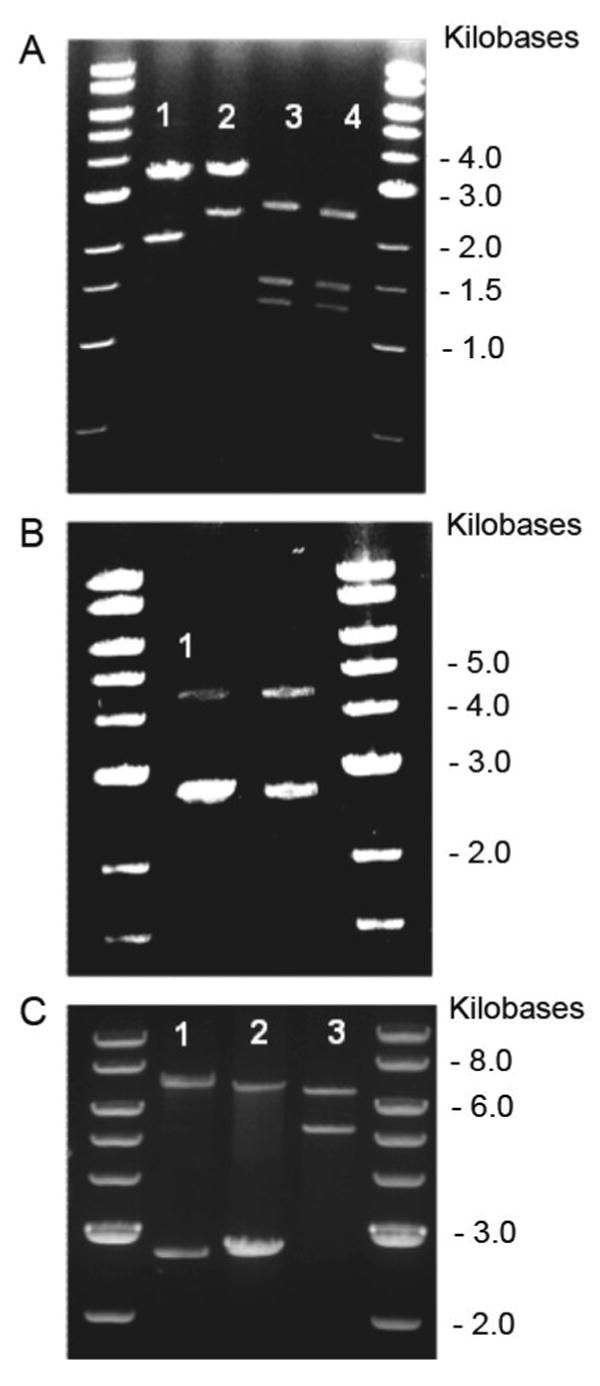
Figure 1
Figure 1
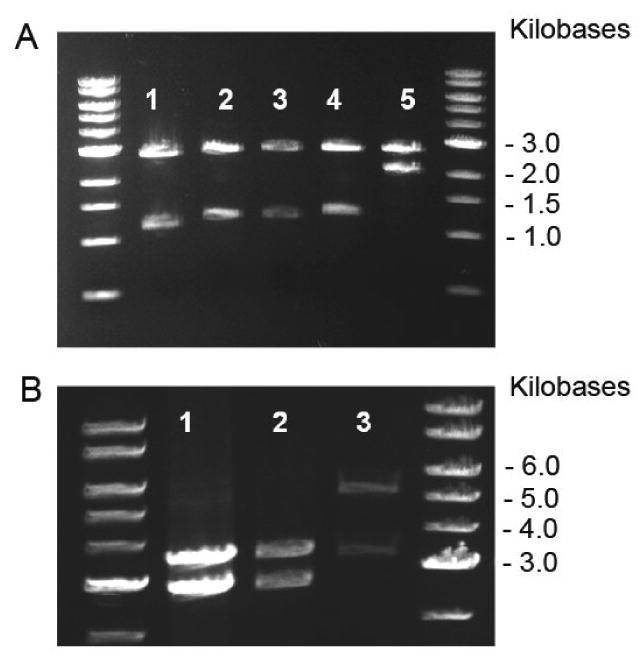
Analytical restriction digests, 1% TAE (Tris-acetate-EDTA) agarose gel, depicting gene and vector sizes at each stage of the LysB10 assembly process with corresponding digestion schemes. DNA standard used was a 1Kb DNA ladder (NEB). A. Lane 1: BamHI / HinDIII digest pE1 (2.1 Kb), pZerO-2 (3.3 Kb). Lane 2: BamHI / HinDIII digest pP1 (2.5 Kb), pZerO-2 (3.3Kb). Lane 3: Nsi I / Xma I digest pP1I (2.56 Kb), pZerO-1 (1.3, 1.5 Kb). Lane 4: Nsi I / Xma I digest pIP1 (2.56 Kb), pZerO-1 (1.3, 1.5 Kb). B. Lane 1: Nsi I digest pP1IE1 (4.66 Kb), pZErO-1 (2.8 Kb). C. Lane 1: Nsi I digest pP1IE1IP1 (7.22 Kb), pZErO-1 (2.8 Kb). Lane 2: Nsi I digest LysB10 (7.28 Kb), pZErO-1 (2.8 Kb). Lane 3: BamHI / HinDIII digest LysB10 (7.28 Kb), pET 24a (5.3 Kb).
Figure 2
Figure 2
Analytical restriction digests, 1% TAE (Tris-acetate-EDTA) agarose gel, depicting gene and vector sizes at each stage of the R4 assembly process with corresponding digestion schemes. DNA standard used was a 1Kb DNA ladder (NEB). A. Lane 1: Nsi I digest pE2 (1.1 Kb), pZerO-1 (2.8 Kb). Lane 2: Nsi I digest pP2 (1.2 Kb), pZerO-1 (2.8Kb). Lane 3: Nsi I digest pE2I (1.16 Kb), pZerO-1 (2.8 Kb). Lane 4: Nsi I digest pP2I (1.26 Kb), pZerO-1 (2.8 Kb). Lane 5: Nsi I digest pP2IE2I (2.42 Kb), pZerO-1 (2.8 Kb). B. Lane 1: Nsi I digest pP2IE2IP2 (3.62 Kb), pZerO-1 (2.8 Kb). Lane 2: Nsi I digest pR4 (3.7 Kb), pZerO-1 (2.8Kb). Lane 3: BamH I / HinD III digest pR4 (3.7 Kb), pET24-a (5.3 Kb).
Figure 3
Figure 3
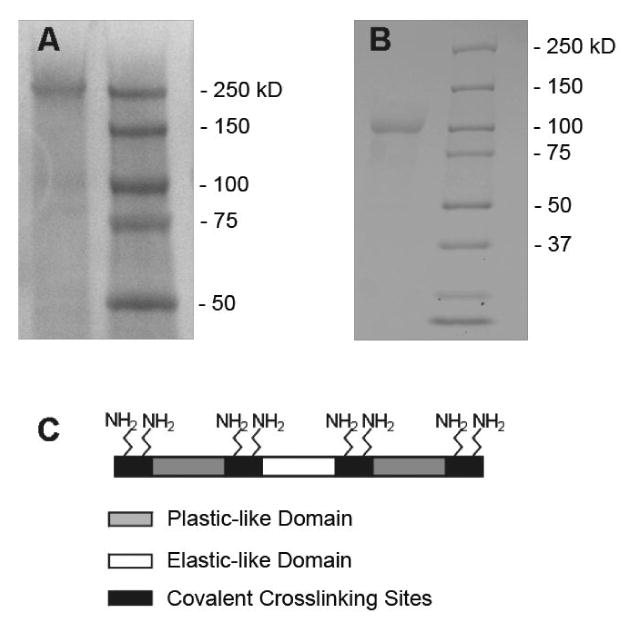
Sodium dodecyl sulfate-polyacrylamide gel electrophoresis (SDS-PAGE) analysis of crosslinkable elastin-mimetic triblock copolymers. A. LysB10, run on 7.5% SDS-PAGE stained with Copper Stain (BioRad). Expected molecular weight: 209 KDa. B. R4 run on 7.5% SDS-PAGE stained with Copper Stain. Expected molecular weight: 108 KDa. Marker lane: Precision Plus Protein Kaleidoscope (Bio-Rad). C. Assembly scheme for crosslinkable elastin-mimetic proteins, LysB10 and R4. Both proteins are triblock copolymers with lysine-containing crosslinking domains flanking each plastic-like and elastic-like domain. Together, there are eight possible sites for chemical crosslinking afforded by the free amine of the lysine residues and the N-terminal amine of the peptide chain. Plastic-like domain (grey), elastic-like domain (white), crosslinking domain (black).
Figure 4
Figure 4
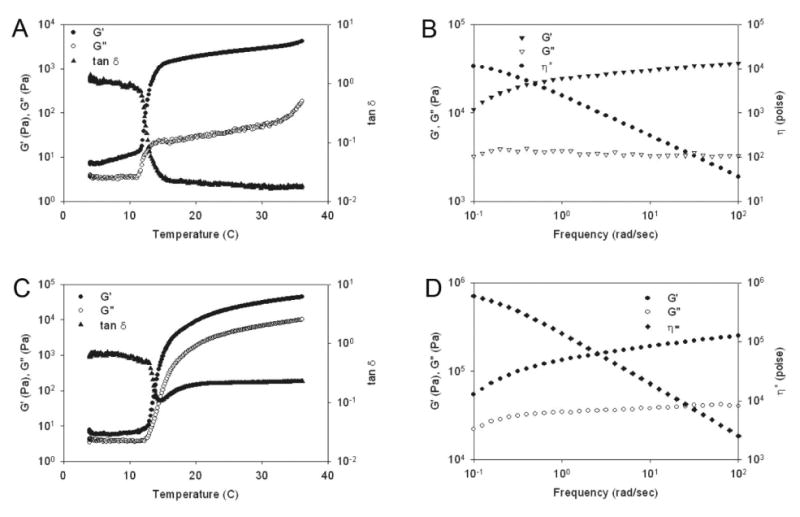
Rheological behavior of triblock protein polymers in water. (A) LysB10 dynamic shear storage (G′) and loss modulus (G″) are plotted as a function of temperature (γ 2%, ω 1Hz). (B) LysB10 dynamic shear storage (G′), loss modulus (G″), and complex viscosity (η*) are plotted as a function of frequency (γ 2%, 37°C). (C) R4 dynamic shear storage (G′) and loss modulus (G″) are plotted as a function of temperature (γ 2%, ω 1Hz). (D) R4 dynamic shear storage (G′), loss modulus (G″), and complex viscosity (η*) are plotted as a function of frequency (γ 2%, 37°C).
Figure 5
Figure 5
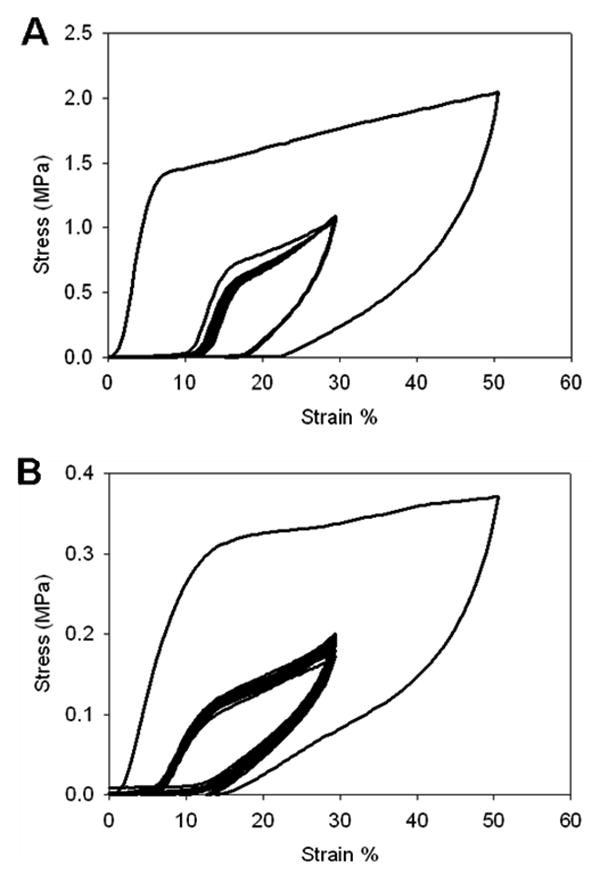
Mechanical preconditioing of glutaraldehyde crosslinked (A) and non-crosslinked (B) LysB10 films. Sample were cyclically stretched to 50% strain and then to 30% strain for 20 cycles.
Figure 6
Figure 6
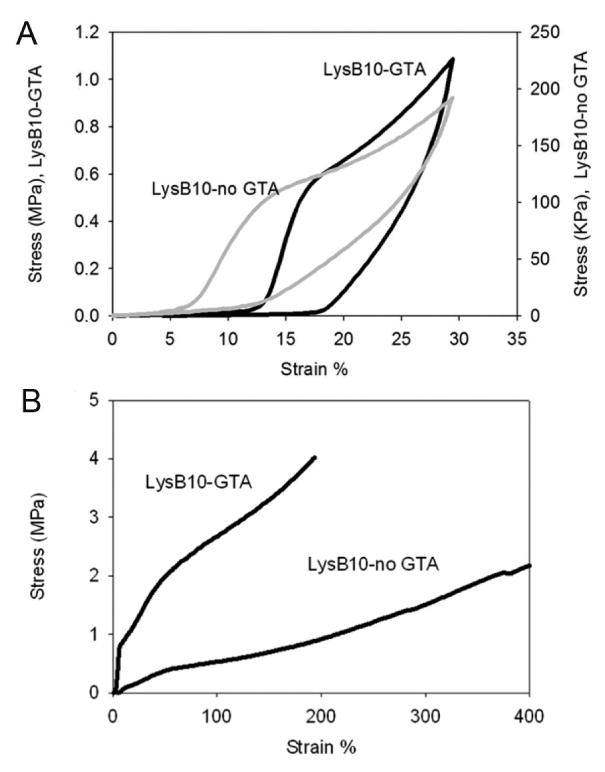
(A) Resilience of glutaraldehyde crosslinked and non-crosslinked LysB10 films after mechanical preconditioning. The response is representative of multiple data sets and illustrates cycle 20 of 30% stretch. (B) Uniaxial stress-strain response for preconditioned glutaraldehyde crosslinked and non-crosslinked LysB10 films. Films were strained to failure.
Figure 7
Figure 7
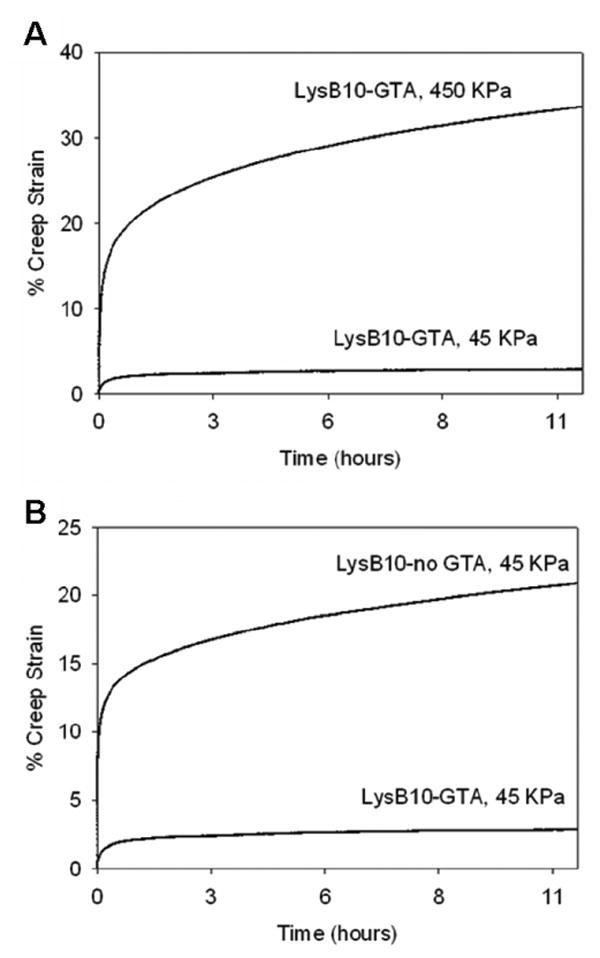
(A) Representative creep response of glutaraldehyde crosslinked LysB10 films subjected to tensile stress at 45kPa and 450kPa. (B) Creep behavior of glutaraldehyde crosslinked and non-crosslinked LysB10 films at a stress of 45 kPa.
Figure 8
Figure 8
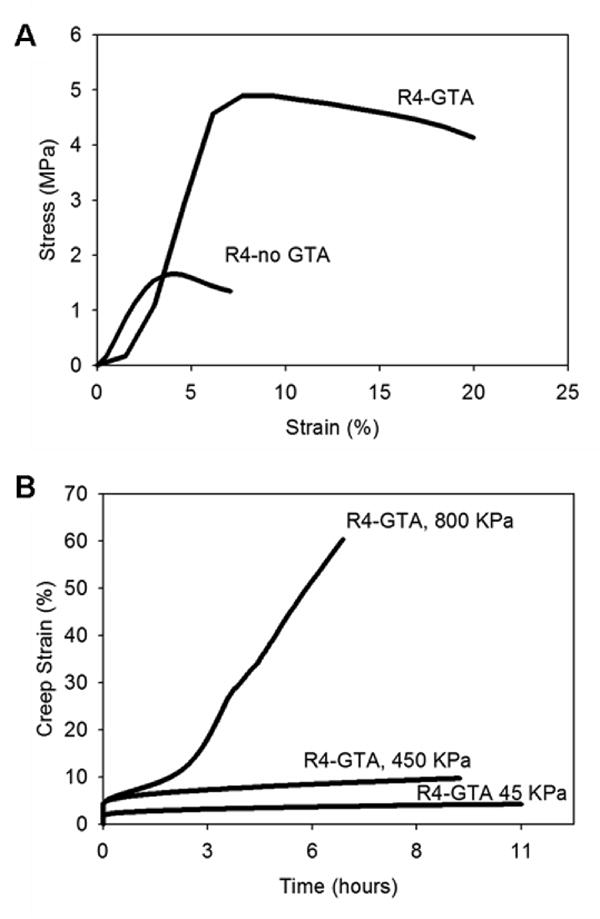
(A) Uniaxial stress-strain behavior for glutaraldehyde crosslinked and non-crosslinked hydrated R4 films. (B) Representative creep response of glutaraldehyde crosslinked R4 films subjected tensile stress at 45kPa, 450kPa, or 800kPa.
Figure 9
Figure 9
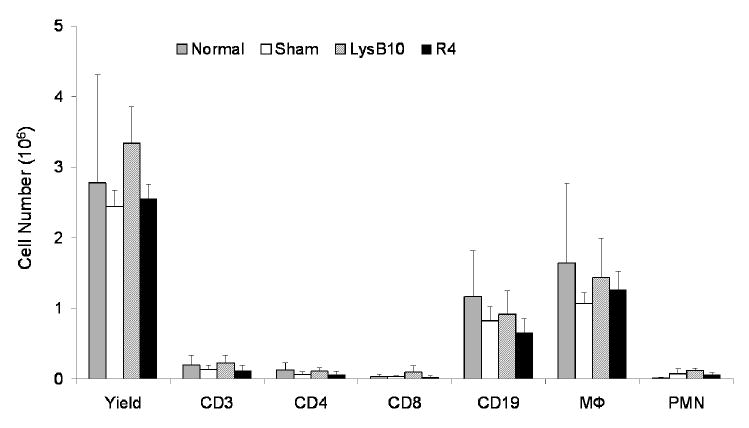
FACS analysis of peritoneal cells one week after implantation of LysB10 and R4 cylindrical hydrogels (n=5 for each group). Experimental groups displayed an identical cell profile to non-operated and sham surgery groups.
Figure 10
Figure 10
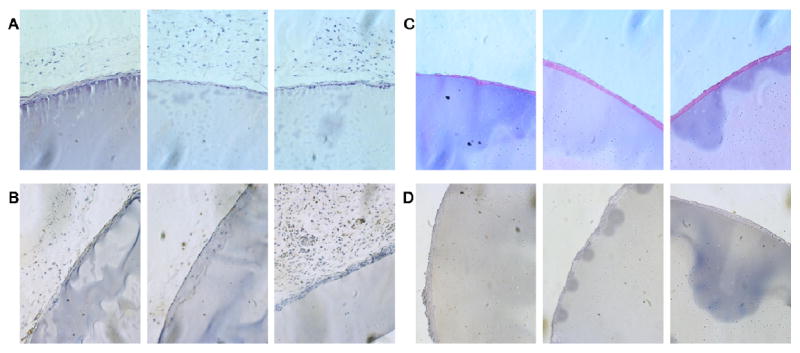
(A) Hematoxylin and eosin staining of subcutaneous LysB10 implants demonstrates the presence of a mild foreign body reaction along the periphery. (B) F4/80 staining of subcutaneous LysB10 implants demonstrate the presence of macrophages along the periphery of the fibrous capsule. (C) H&E staining of peritoneal LysB10 implants demonstrates the presence of a mild foreign body reaction along the periphery. (D) F4/80 staining of peritoneal LysB10 implants demonstrates the presence of macrophages along the periphery. Images are oriented so that the LysB10 gel is located in the bottom right corner, 20x magnification.
Figure 11
Figure 11
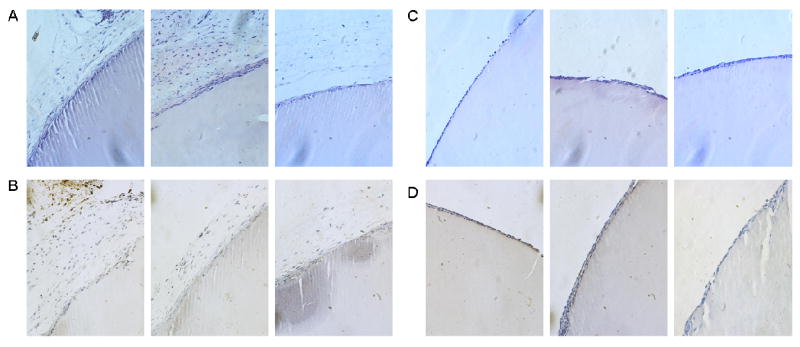
(A) H&E staining of subcutaneous R4 implants demonstrates the presence of a mild foreign body reaction along the periphery of the sample. (B) F4/80 staining of subcutaneous R4 implants demonstrates the presence of macrophages along the periphery of the fibrous capsule. (C) H&E staining of peritoneal R4 implants demonstrates the presence of a mild foreign body reaction along the periphery of the implant. (D) F4/80 staining of peritoneal R4 implants demonstrates the presence of macrophages along the periphery of the fibrous capsule. Images are oriented so that the R4 gel is located in the bottom right corner, 20x magnification.

References

    1. Petka WA, Harden JL, McGrath KP, Wirtz D, Tirrell DA. Reversible hydrogels from self-assembling artificial proteins. Science. 1998;281:389–392. - PubMed
    1. Rodríguez-Cabello JC, Reguera J, Girotti A, Arias FJ, Alonso M. Genetic engineering of protein-based polymers: The example of elastinlike polymers. Adv Polym Sci. 2006;200:119–167.
    1. Wright ER, Conticello VP. Self-assembly of block copolymers derived from elastin-mimetic polypeptide sequences. Adv Drug Deliv Rev. 2002;54:1057–1073. - PubMed
    1. Nagapudi K, Brinkman WT, Thomas BS, Park JO, Srinivasarao M, Wright E, et al. Viscoelastic and mechanical behavior of recombinant protein elastomers. Biomaterials. 2005;26(23):4695–4706. - PubMed
    1. Wright ER, McMillan RA, Cooper A, Apkarian RP, Conticello VP. Thermoplastic elastomer hydrogels via self-assembly of an elastin-mimetic triblock polypeptide. Advanced Functional Materials. 2002;12(2):1–6.

Publication types

MeSH terms