


One year follow-up after cryoballoon isolation of the pulmonary veins in patients with paroxysmal atrial fibrillation
- PMID: 18955409
- PMCID: PMC2573029
- DOI: 10.1093/europace/eun218
One year follow-up after cryoballoon isolation of the pulmonary veins in patients with paroxysmal atrial fibrillation
Abstract
Aims: Pulmonary vein isolation (PVI) with cryoenergy delivered through a balloon is a new approach in the treatment of atrial fibrillation (AF), but long-term follow-up is lacking. The aim of this study was to provide insight in the success rate and the incidence of recurrences.
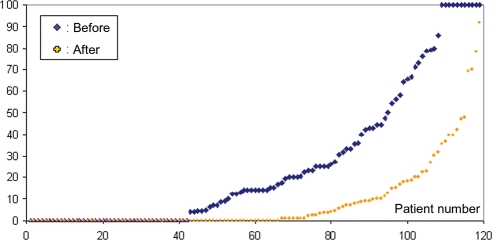
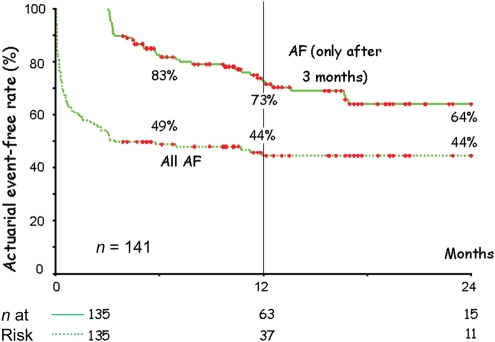
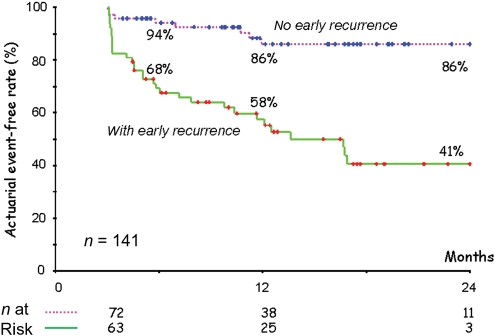
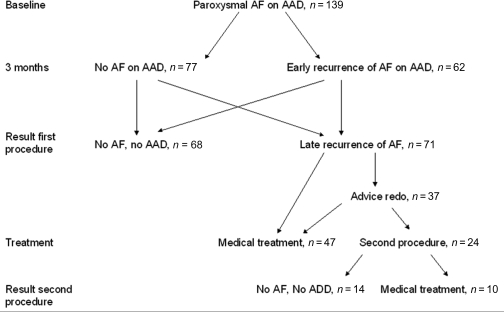
Methods and results: Patients with symptomatic AF despite anti-arrhythmic drugs (AADs) were treated with cryoballoon PVI. Daily transtelephonic ECG monitoring, 24 h Holter-ECG, and an arrhythmia-focused questionnaire were used to document AF. One hundred and forty-one patients completed a follow-up of 457 +/- 252 days. Before ablation, Holter-ECG showed AF in 45%, including 16% continuous AF throughout the recording. Event recording revealed a median AF burden of 26%. The questionnaire showed a median of weekly AF complaints lasting for hours. All but one patient had successful PVI with a single procedure. After ablation, AF (defined as lasting for more than 30 s) was seen in 11% of Holter-ECGs, with 1% continuous AF. The event recording showed an AF burden of 9%. The median patient reported no more AF-related symptoms. Recurrence during the first 3 months was predictive for later recurrence. A second procedure was performed in 24 patients. The freedom of AF was 59% without AADs after 1,2 procedures. Four right phrenic nerve paralyses occurred, all resolving within 6 months. No PV stenoses were observed.
Conclusion: Pulmonary vein isolation with a cryothermal balloon is an effective treatment for paroxysmal AF, resulting in a clinical success rate comparable to studies involving radiofrequency ablation. Temporary right phrenic nerve paralysis is the most important complication.
Keywords: Ablation; Atrial fibrillation; Cryoablation; Cryoballoon; Follow-up.
Figures
Comment in
-
Balloon cryoablation for paroxysmal atrial fibrillation.Europace. 2008 Nov;10(11):1251-2. doi: 10.1093/europace/eun284. Europace. 2008. PMID: 18955408 No abstract available.
References
-
- Calkins H, Brugada J, Packer DL, Cappato R, Chen SA, Crijns HJ, et al. HRS/EHRA/ECAS expert Consensus Statement on catheter and surgical ablation of atrial fibrillation: recommendations for personnel, policy, procedures and follow-up. A report of the Heart Rhythm Society (HRS) Task Force on catheter and surgical ablation of atrial fibrillation. Heart Rhythm. 2007;4:816–61. - PubMed
-
- Avitall B, Lafontaine D, Rozmus G, Adoni N, Dehnee A, Urbonas A, et al. Ablation of atrial-ventricular junction tissues via the coronary sinus using cryo balloon technology. J Interv Card Electrophysiol. 2005;12:203–11. - PubMed
-
- Avitall B, Lafontaine D, Rozmus G, Adoni N, Le KM, Dehnee A, et al. The safety and efficacy of multiple consecutive cryo lesions in canine pulmonary veins-left atrial junction. Heart Rhythm. 2004;1:203–9. - PubMed
-
- Garan A, Al-Ahmad A, Mihalik T, Cartier C, Capuano L, Holtan D, et al. Cryoablation of the pulmonary veins using a novel balloon catheter. J Interv Card Electrophysiol. 2006;15:79–81. - PubMed
-
- Sarabanda AV, Bunch TJ, Johnson SB, Mahapatra S, Milton MA, Leite LR, et al. Efficacy and safety of circumferential pulmonary vein isolation using a novel cryothermal balloon ablation system. J Am Coll Cardiol. 2005;46:1902–12. - PubMed
